
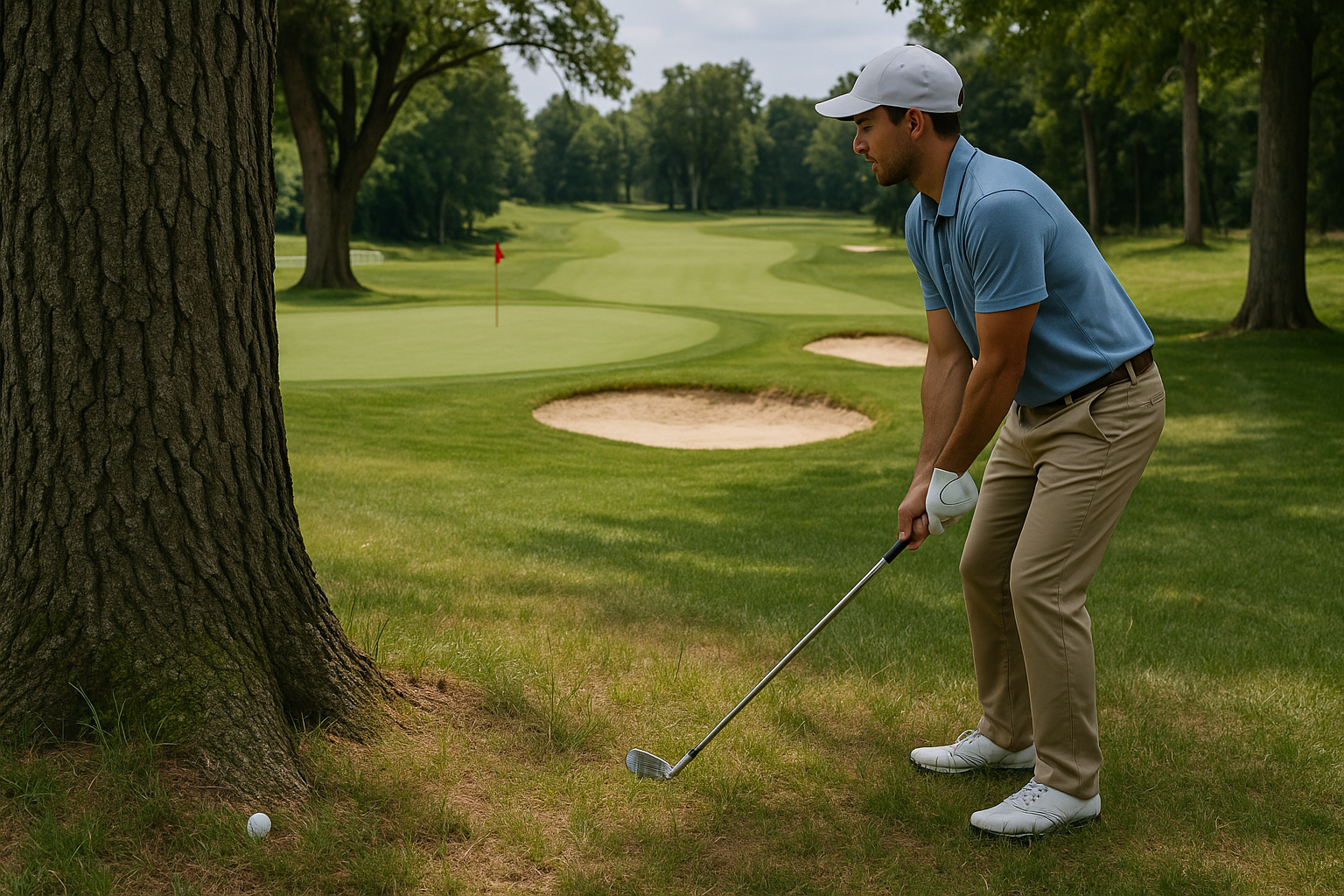
Behind a Tree? Ask These Three Questions Before Choosing Your Recovery Shot
Your ball has found the worst possible place: just behind a tree, with the green partly visible through a narrow gap. You can see a heroic shot. You can also see the out-of-bounds fence, a bunker, or a second tree waiting to punish you.
Before reaching for the club that might save par, pause. Recovery shots are not about proving you can hit a difficult shot. They are about giving yourself the best chance of finishing the hole with the fewest additional problems.
Question 1: What Is the Safest Next Shot?
Start by forgetting the green for a moment. Look for the shot that puts your ball somewhere playable.
That might mean:
- Hitting backward into the fairway
- Chipping sideways into an open area
- Punching under the branches and advancing the ball 30 or 40 yards
- Taking an intentional penalty if no reasonable shot exists
Golfers often define success as getting the ball close to the hole. From trouble, success may simply mean avoiding a second mistake.
If your safest option leaves you 150 yards from the green but in the fairway, that is usually better than trying to thread a gap and bringing a double bogey into play.
Question 2: What Happens If You Miss?
Every recovery shot has a target and a miss. The target might be a gap between two trees, but what happens if the ball starts slightly left or right?
Before hitting, identify the worst realistic miss. Do not judge the shot only by its perfect result.
- If you miss left, does the ball hit another tree?
- If you miss right, does it reach water or out of bounds?
- If you hit the branches, could the ball come back toward you?
- If the ball runs through the gap, is there a safe landing area?
A narrow gap is not automatically a good target. If both sides of the gap create serious trouble, the shot may be much harder than it looks.
A useful rule is this: choose the recovery shot with the most forgiving miss, not the most impressive perfect result.
Question 3: What Score Are You Actually Trying to Save?
Your decision should also depend on what happened before the recovery.
If your tee shot went behind a tree on a par 4, you may still be able to make bogey easily by returning to the fairway. If you are already playing your fourth shot on a par 5, a more aggressive attempt may make sense because simply laying up may not change the likely score very much.
Ask yourself:
- Can I still realistically make par?
- Would a safe shot almost guarantee bogey?
- Does the aggressive option create a real chance of a better score?
- What score becomes likely if I miss?
This is not permission to force difficult shots whenever you are behind. It is a way to match the risk to the situation. When a safe recovery keeps bogey in play, take it more often. When you are already facing a difficult score, a calculated risk may be reasonable.
Use the Club That Controls the Shot
Recovery shots often require a club you can keep low and predictable. A hybrid, long iron, or even a wedge may be better than a driver or fairway wood, depending on the lie and the opening.
For a low punch shot, choose enough club to reach your landing area, then make a controlled swing. Do not try to create extra power. The goal is to keep the ball under the branches and moving toward safety.
Also check the lie carefully. Thick grass, roots, pine needles, or a downhill slope can make a supposedly simple punch unpredictable. Never swing aggressively if you are unsure whether the club could strike a root or other obstruction.
Try This: The Recovery Decision Drill
During your next practice round, deliberately place three balls near trees or behind other obstacles. For each ball, choose three possible shots:
- The aggressive shot toward the green
- The controlled shot that advances the ball
- The safest shot back to the fairway
Before hitting, write down the score you expect from each choice. Then play all three shots and finish each hole. You may discover that the least exciting option produces the best score more often than expected.
One Thing to Remember
From trouble, choose the shot that gives you the best next shot—not the shot that looks best if everything goes perfectly.