
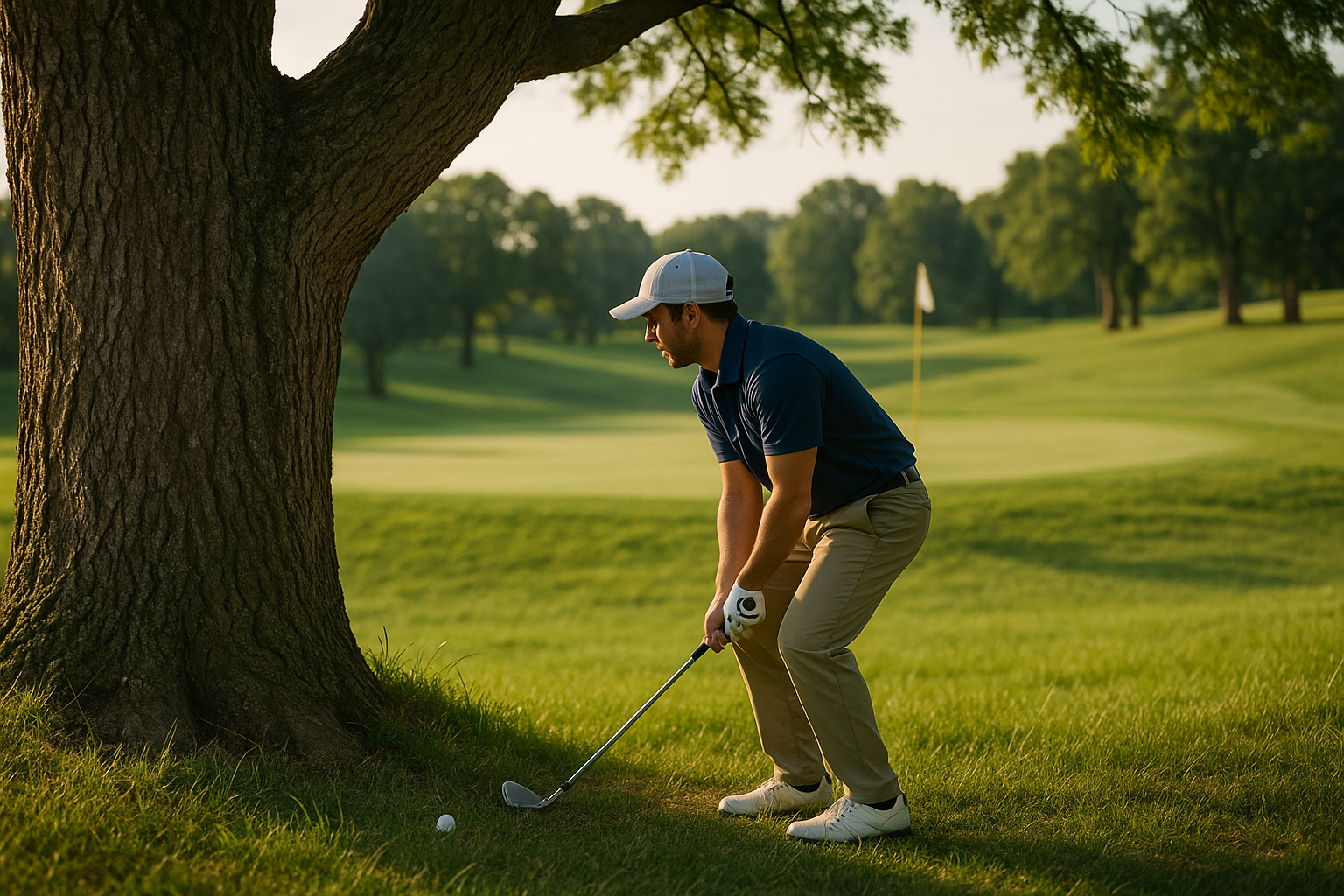
Behind a Tree? The Smart Recovery Shot Is Usually Not the Hero Shot
Your ball has found the rough, and a tree is blocking the direct route to the green. You can see just enough of the target to imagine a spectacular recovery shot: a low hook, a high slice, or a gap between two branches.
Sometimes that shot is possible. More often, it turns one bad shot into a much bigger number.
When you are behind a tree, your first goal is not to reach the green. Your first goal is to give yourself a realistic chance to save the hole.
Start by Finding the Safe Side
Stand behind the ball and look at the hole as a problem with two options: the aggressive route and the safe route.
The safe route may be back toward the fairway, sideways into an open area, or even away from the green. It might leave you with a longer approach, but it keeps the next shot simple.
Before choosing a club, ask:
- Where is the widest area I can hit?
- What happens if I miss my intended line?
- Is there water, out-of-bounds, or deep rough near the target?
- Can I reach the green with a shot I can actually control?
If the aggressive shot has to be nearly perfect just to avoid disaster, it is usually the wrong shot for a recreational golfer.
Use the Tree to Choose Your Shot Shape
You do not need to curve the ball dramatically. You only need to move it far enough around the obstacle to reach a safe landing area.
If the tree is directly in front of you, consider whether a small curve is enough. For example, a ball that needs to move only a few yards around the tree is very different from one that must bend 30 yards toward the fairway.
Choose the shot shape you naturally produce most often. If you occasionally hit a fade but rarely hit a hook, do not suddenly attempt a severe hook because the hole seems to demand one. Your “normal miss” is generally a better guide than a shot you have only practiced a few times.
Also consider the branches. A low punch under the branches may be safer than trying to curve the ball around the trunk. If the opening is small, aim for the middle of it rather than trying to clip the edge.
When a Punch-Out Is the Best Play
A punch-out is a low recovery shot played back toward safety. It is not exciting, but it is one of the most valuable shots in golf.
Choose a punch-out when:
- The tree blocks most of the green.
- The safe opening is wide enough to hit confidently.
- A failed recovery could bring penalty trouble into play.
- You are already in danger of making a big number.
Use a club that keeps the ball below the branches and leaves enough distance to reach your landing area. A long iron, hybrid, or fairway wood may be useful, but only if you can keep it low and controlled. There is no prize for using the longest club if it brings another tree or hazard into play.
Pick a specific target, such as a fairway bunker, a cart path, or the center of an open patch of rough. Do not simply aim “back toward the fairway.” A precise target improves your commitment.
Try This Decision-Making Exercise
During your next practice round, deliberately place three balls behind trees or other obstacles. For each ball, choose one of these options:
- Attempt to curve the ball around the obstacle.
- Play a low punch toward the fairway.
- Take the safest sideways or backward escape.
Before hitting, predict the score you could make from each choice. Then notice which option actually leaves you with the easiest next shot. This exercise teaches you to judge recovery shots by the next position, not by how impressive the shot looks.
Common Mistakes to Avoid
- Choosing the green instead of a landing area: Pick a place where the ball can finish safely.
- Ignoring the miss: Make sure a slight pull or push does not create a new problem.
- Trying a shot you have never practiced: Use a familiar ball flight whenever possible.
- Forgetting the lie: Thick rough, roots, and uneven ground may make a curved shot much harder.
One Thing to Remember
When trouble blocks the green, choose the shot that makes your next shot easiest—not the shot that looks most impressive.