
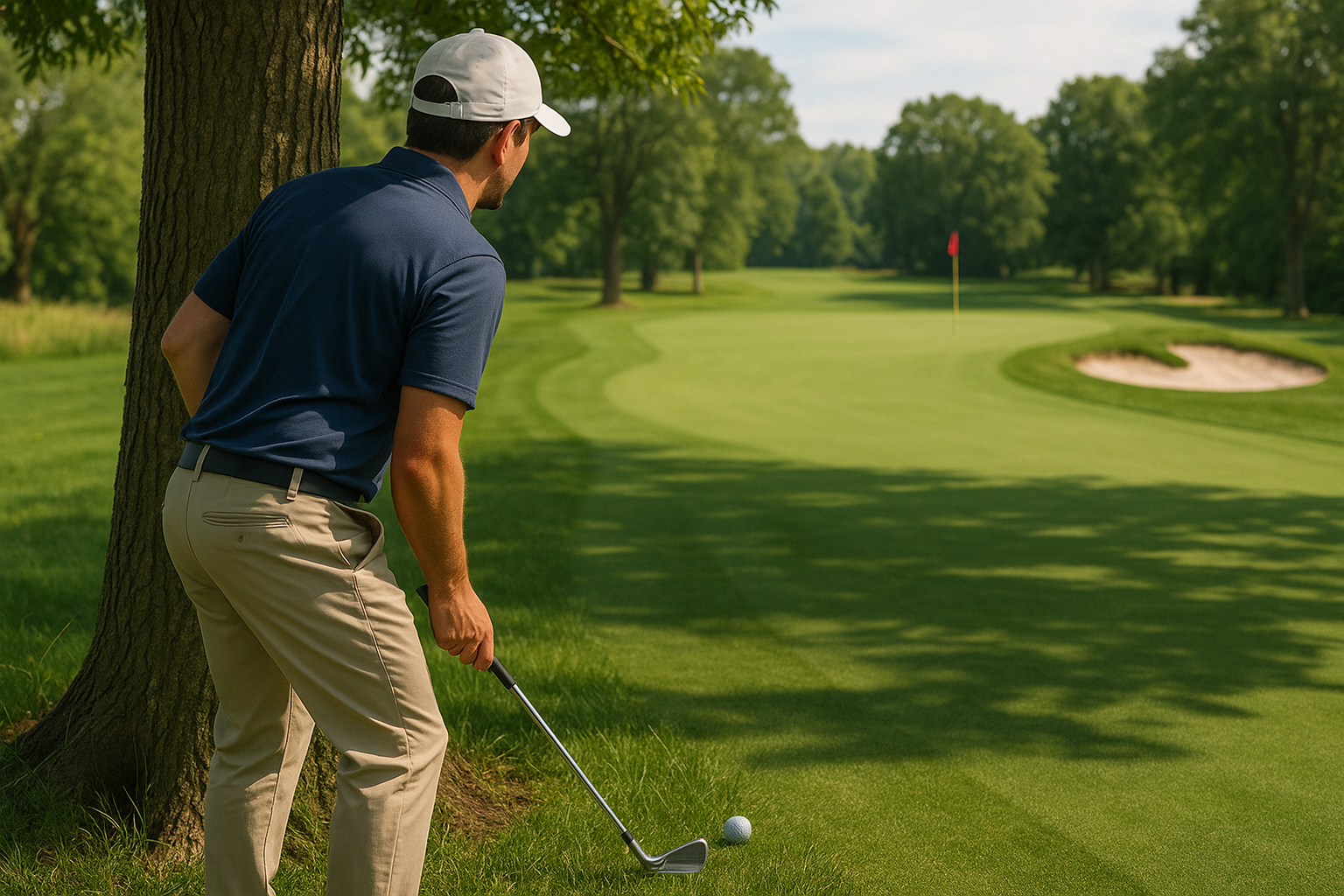
Behind a Tree? Use the Three-Question Test Before You Hit
Your ball has found the worst possible place: behind a tree, beside a bush, or in a patch of rough with only a narrow opening toward the green. You can see the flag, but the direct route is blocked.
This is where many golfers turn a difficult situation into a disastrous hole. They try to curve the ball around the obstacle, squeeze through a tiny gap, or hit a hero shot that has a very small margin for error.
Before choosing a club, ask yourself three simple questions. This quick test helps you decide whether to escape, advance, or take a calculated risk.
Question 1: What Is the Safest Place to Miss?
Start by looking beyond the tree or obstacle. Do not focus only on the target. Look at the areas surrounding it.
If your shot comes out lower or travels farther than expected, where will it finish? If it curves more than planned, what will it hit? Is there water, out-of-bounds, thick trees, or a deep bunker nearby?
Then identify the safest miss. That might be:
- The fairway beside the hole
- A wide area short of the green
- The side of the green away from a bunker
- A patch of rough that still leaves a simple next shot
Your safest option is not always the one that gets closest to the hole. It is the one that gives you the best chance of making your next shot without bringing a big number into play.
Question 2: What Shot Can You Actually Repeat?
Golfers often choose a shot based on what they can imagine rather than what they can reliably execute.
For example, you may picture a low hook around the tree. But when was the last time you intentionally hit that shot and watched it finish near your target? If the answer is “not recently,” it probably should not be your first choice during a round.
Consider the shots you already own:
- A normal punch shot that flies low and straight
- A chip or pitch back into the fairway
- A short iron played through a wide opening
- A sideways escape that removes the obstacle entirely
A shot does not have to look impressive to be useful. The best recovery shot is usually one you can start on the intended line with reasonable control.
Question 3: What Score Does the Situation Allow?
Once you are in trouble, par may no longer be the most realistic goal. That is not a failure—it is a chance to protect your score.
Suppose your ball is behind a tree 160 yards from the green. A risky shot might leave you short-sided, in a hazard, or still behind another tree. A sideways punch may leave you 100 yards away in the fairway. From there, you may still have a good chance to make bogey and perhaps save par with an excellent approach and putt.
The key question is not, “Can I reach the green?” Ask instead, “Which choice gives me the best chance of finishing the hole without another penalty or recovery shot?”
Taking your medicine does not mean giving up. It means choosing a shot that keeps the hole playable.
Try This: The Trouble-Shot Decision Drill
At the practice area, place a headcover or alignment stick on the ground to represent a tree. Then practice three options from a similar lie:
- Hit a low shot through the widest available opening.
- Play sideways to a safe target.
- Attempt your more aggressive recovery shot.
Hit five shots with each option and record where they finish—not just how good the best shot looks. Notice which choice produces the fewest dangerous misses.
This exercise gives you a realistic idea of which recovery shots belong in your on-course decision-making. It also builds confidence because you will have practiced escaping trouble before needing to do it during a round.
Common Mistakes to Avoid
- Choosing the shortest route automatically: The shortest route may have the smallest margin for error.
- Ignoring the next shot: A successful escape should leave you with a reasonable lie and angle.
- Trying a shot you rarely practice: Imagination is not the same as dependable skill.
- Forgetting the penalty area: A difficult lie is often better than a lost ball or penalty stroke.
One Thing to Remember
When you are behind a tree, choose the shot that gives you the best next shot—not the shot that looks most heroic.