
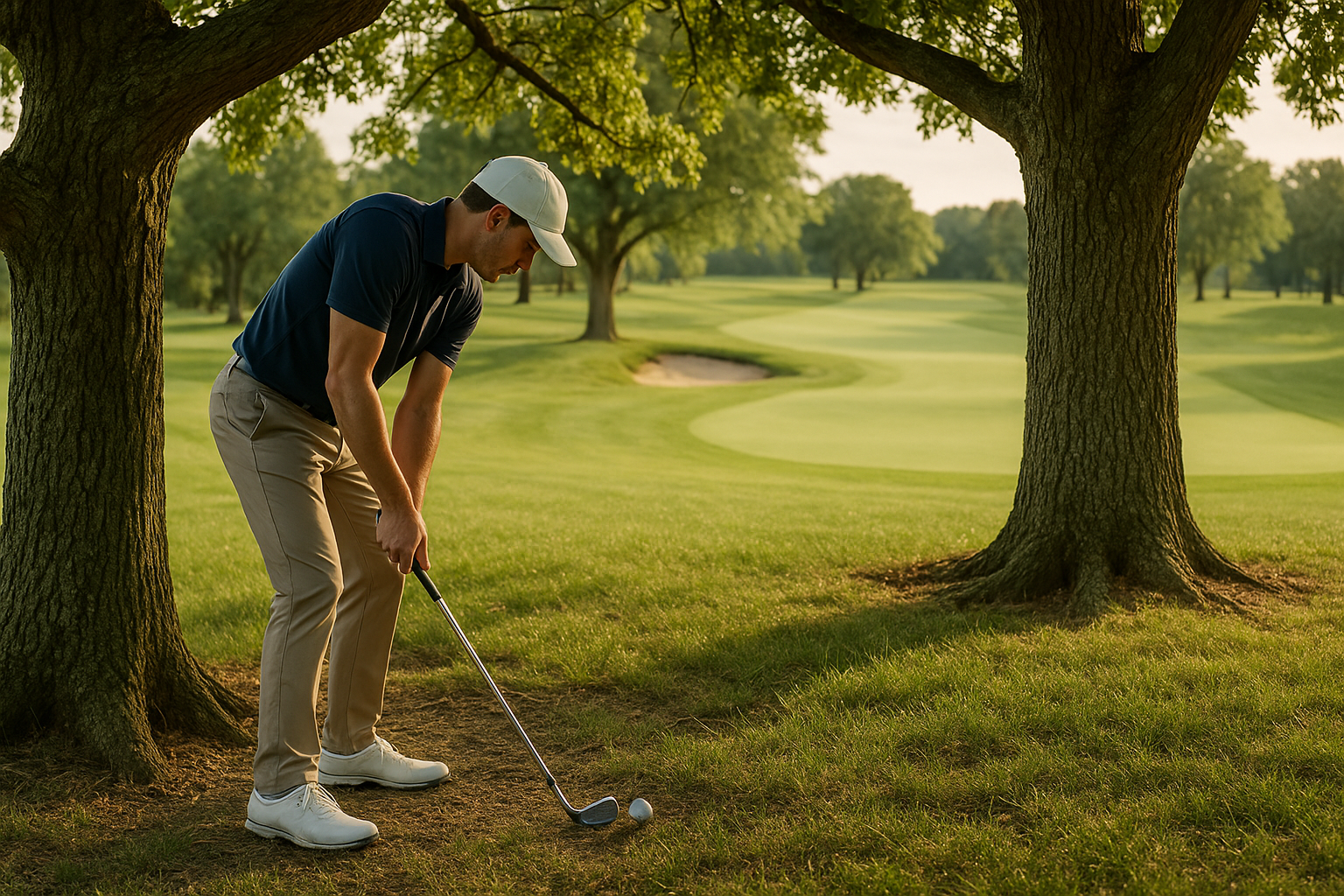
Behind a Tree? Use the 10-Second Recovery Shot Test
Your ball has missed the fairway and stopped behind a tree. The green is visible, but only through a narrow gap between branches. You could attempt a low hook, hit a high slice around the trunk, or thread a long iron through the opening.
This is where many golfers turn a manageable mistake into a big number. The problem is not usually a lack of skill. It is choosing a recovery shot because it is possible instead of choosing one because it is sensible.
The 10-Second Question
Before reaching for a club, ask yourself:
“If I had only 10 seconds to make this shot, would I still choose it?”
This quick test removes some of the emotion from the decision. After a poor drive, golfers often feel pressure to recover the entire hole with one impressive shot. That pressure encourages low-percentage choices.
Instead, decide whether the shot has a realistic chance of:
- Clearing the obstacle with room to spare
- Finishing somewhere safe if you miss slightly
- Advancing the ball enough to improve your next shot
If the answer to all three is no, the shot is probably a gamble rather than a recovery.
Look for the “Next Best Position”
You do not always need to hit toward the green. Your real target may be the fairway, a wider part of the hole, or a position with a clear shot on your next swing.
For example, imagine your ball is 150 yards from the green but blocked by a large tree. A low punch through a six-foot gap might reach the front of the green once in five attempts. A sideways shot back to the fairway may leave 120 yards for your next shot almost every time.
The second option feels less exciting, but it often gives you a better chance to make bogey—and sometimes save par.
Choose your target before your club
First decide where you want the ball to finish. Then choose the club and shot that give you the largest margin for error.
- Need to move the ball sideways? Use a short iron or wedge that you can control.
- Have a clear low opening? A hybrid or long iron may produce a useful punch shot.
- Have no safe route toward the green? Pitch back to the fairway or take an unplayable lie if necessary.
A shorter club is often better than a longer one because it reduces the chance of hitting branches, running through the fairway, or bringing another hazard into play.
Check the Lie and the Exit Route
Before playing, inspect the ground around your ball. Roots, stones, pine needles, thick rough, and sloping ground can change the shot completely.
Also examine what happens after the ball gets past the tree. A narrow opening may lead directly to out-of-bounds, a bunker, or another group of trees. A shot that clears the first obstacle can still be a poor choice if the miss is severe.
Try to identify your “safe miss.” If the ball does not follow your intended line, where will it go? The best recovery shot usually has a reasonably safe result on both sides.
Try This on Your Next Round
For one round, keep track of every shot played from trouble. Before each one, say your decision out loud:
- “My target is the right side of the fairway.”
- “My safest club is a seven-iron.”
- “If I miss, I still have a clear next shot.”
Do not judge the decision by whether the ball produces a perfect result. Judge it by whether you selected a shot with a sensible risk and a useful miss.
After the round, notice how many penalty strokes came from aggressive recovery attempts. Many golfers discover that their biggest problem is not poor execution—it is choosing shots that leave no room for error.
One Thing to Remember
When you are behind a tree, do not ask, “Can I reach the green?” Ask, “Where can I leave my next shot?”
A smart recovery may not look heroic, but it keeps one bad shot from becoming a disastrous hole.