
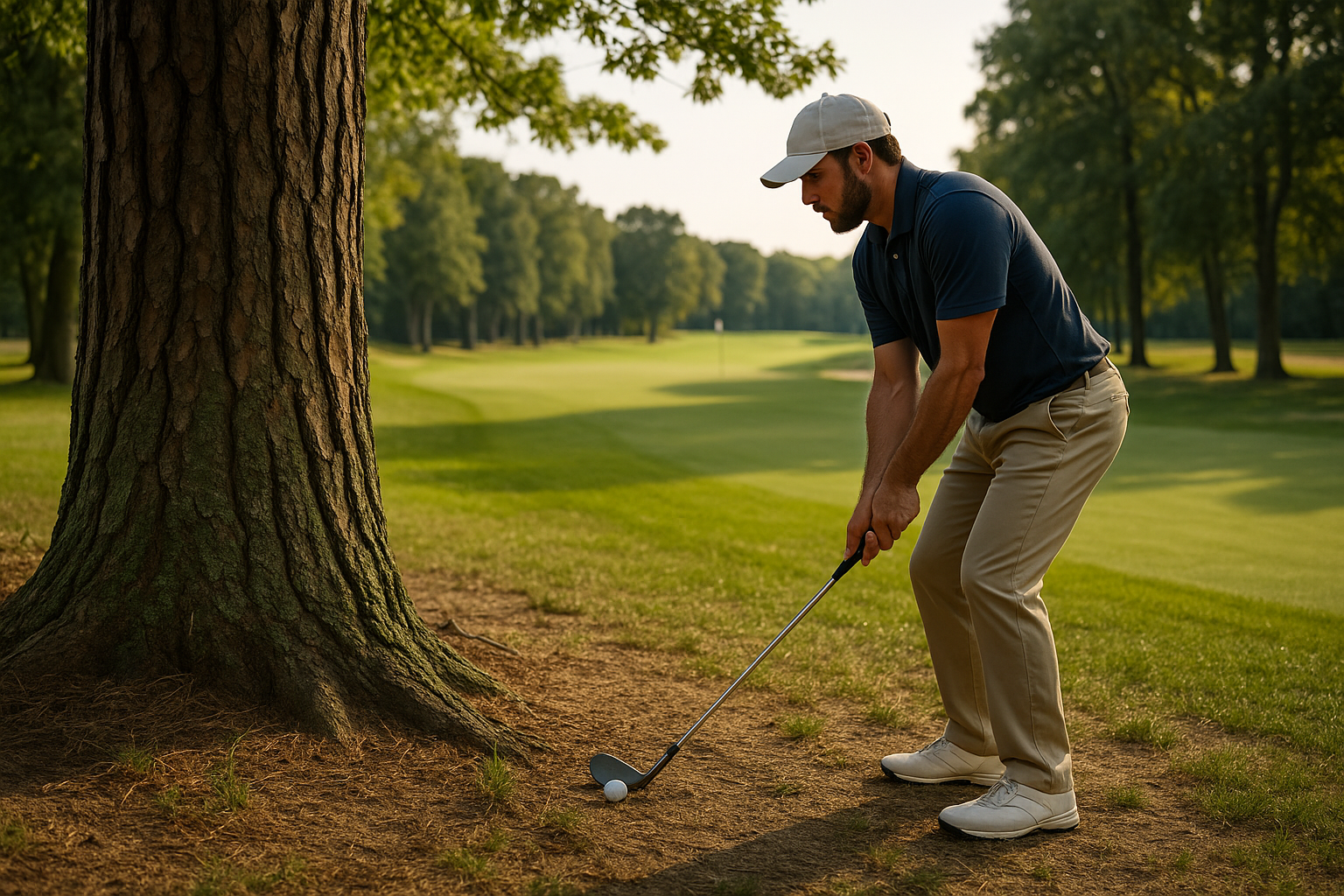
Behind a Tree? Use This Three-Shot Plan Instead of Trying the Hero Shot
Your drive clips a tree, the ball kicks sideways, and now you’re staring at a frustrating lie behind the trunk. The green is still visible, but only through a narrow gap—or not at all. This is where many golfers turn a difficult situation into a disaster.
The mistake is treating the shot as an opportunity to save par instead of recognizing it as a recovery problem. Your first job is not to reach the green. Your first job is to get back into the hole.
Start by Asking One Question
Before choosing a club, ask: Where can I safely advance the ball while keeping the next shot simple?
That answer may be sideways, backward, or low underneath the branches. A successful recovery does not always look impressive. It simply gives you a reasonable chance to reach the green with your next shot.
Look for:
- The widest opening, not necessarily the closest opening to the hole
- A landing area with short grass
- Enough room for the ball to finish without rolling into another hazard
- A distance that leaves you comfortable for the next shot
If the only route toward the green requires the ball to pass within inches of a tree, it is not a realistic route. Trees are much larger than they look from a distance, and even a good strike can catch a branch or trunk.
Use the Three-Shot Recovery Plan
Shot 1: Escape
Your first shot should move the ball into a safe, playable area. This might mean pitching sideways into the fairway or punching the ball back toward the tee if that is the only reliable option.
Choose a club that keeps the ball low and predictable when possible. A hybrid, long iron, or even a short iron can work, depending on the opening and the amount of grass available. You do not need maximum distance. You need control.
Pick a specific target, such as the center of the fairway or a clear patch of rough. Do not simply tell yourself to “get out.” A precise target improves your focus.
Shot 2: Reposition
After escaping, take a moment before rushing into the next shot. Measure the distance to the green and check the lie. Your ball may now be in a perfect position—or you may still have an awkward angle.
This is where the recovery often becomes successful. Instead of trying to make up every lost yard immediately, select the club that leaves the simplest approach. From 120 yards, a full wedge from the fairway is usually easier than a 170-yard shot from thick rough.
Shot 3: Play for the largest safe target
Once you have a clear approach, aim for the portion of the green that gives you the most room for error. If the flag is tucked near a bunker or water, use the center of the green as your target.
A good recovery may produce a bogey putt instead of a par putt. That is still a win compared with hitting a tree, losing another ball, or needing two more recovery shots.
Common Mistakes to Avoid
- Trying to curve the ball around the tree: Intentional hooks and slices are difficult to control, especially under pressure.
- Using too much club: A low punch that rolls 100 yards is often safer than a high shot that catches branches.
- Ignoring the next lie: Do not choose an escape route that leaves you behind another obstacle.
- Changing targets mid-swing: Decide on the safe route, commit, and accept the result.
Try This on the Course
For your next round, create a personal recovery rule: after one trouble shot, your goal is to be safely back in play within one swing.
When you find yourself behind a tree, take 20 seconds to identify the widest escape route and the best place for your next shot. Then choose the least ambitious club that can reach that target.
This simple routine helps remove emotion from the decision. You are no longer trying to erase the bad shot. You are building the next good one.
One Thing to Remember
When you are behind a tree, do not play the shot that looks heroic—play the shot that makes the next shot easy.