
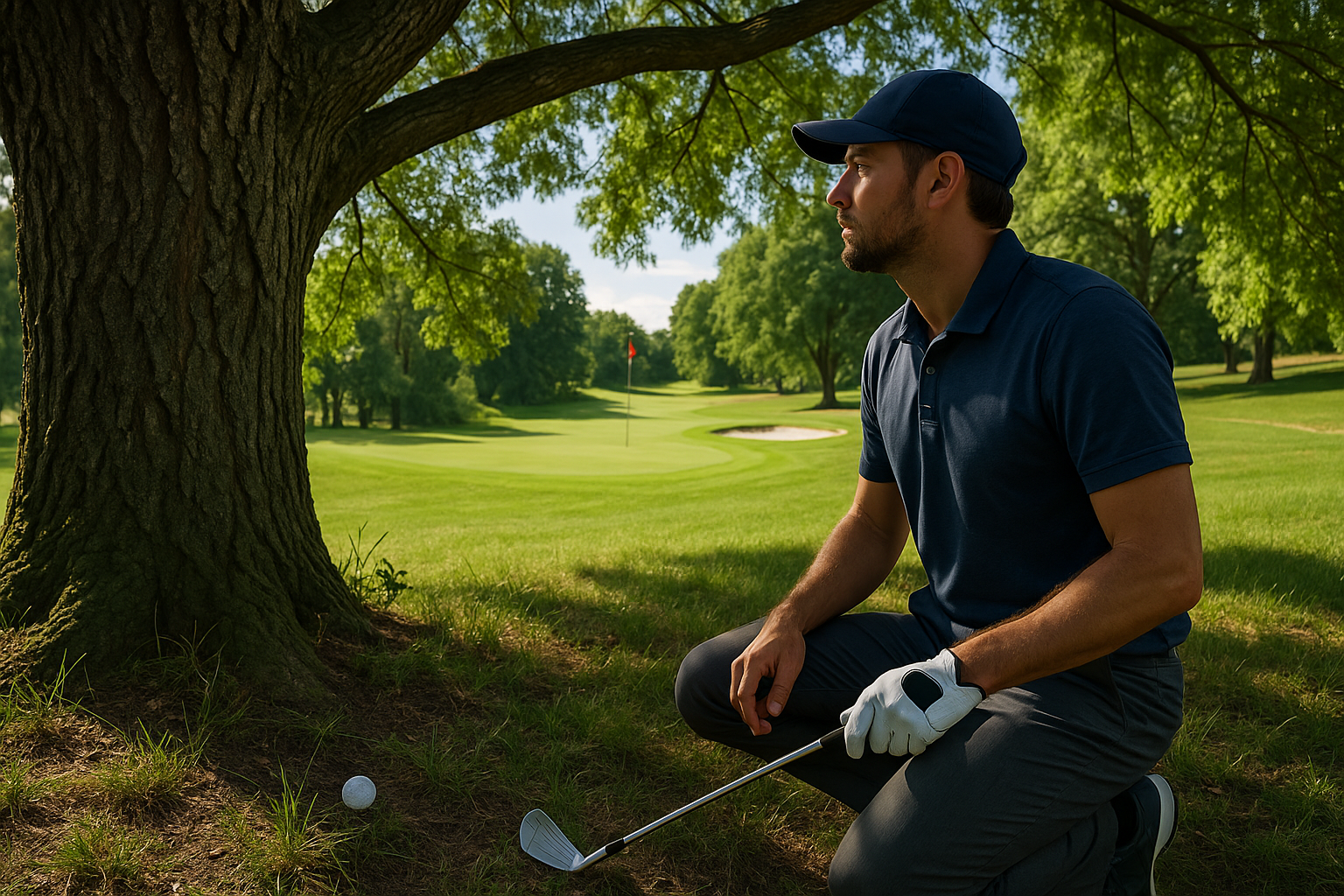
Behind a Tree? Choose Your Exit Before You Choose Your Target
Your ball misses the fairway and stops behind a tree. The green is still visible, but only through a narrow gap between branches. You can probably hit the shot—but “probably” is doing a lot of work.
This is where many golfers turn a manageable mistake into a double bogey. They focus on the flag, choose the most aggressive club, and hope the ball squeezes through the opening. A better approach is to choose your exit first.
What Does “Choosing the Exit” Mean?
Your exit is the safest place to get the ball back into the hole’s normal playing area. It might be the fairway, the front of the green, or an open section of rough. The goal is not always to reach the green immediately. The goal is to remove the obstacle and give yourself a realistic next shot.
Before selecting a club, ask:
- Where is the widest opening?
- What direction gives me the most room for error?
- What happens if I miss left or right?
- Can I advance the ball without bringing another hazard into play?
These questions shift your attention away from the flag and toward the part of the hole you can actually control.
Why the Hero Shot Is Usually Worse Than It Looks
A narrow gap makes the shot appear possible, especially if you have a club that can reach the green. But the opening may be smaller than it looks from your angle. Tree branches can also hang lower than expected, and the ball may need to travel through the gap before it begins curving toward the target.
Even a successful escape can leave you with a difficult putt or chip. A failed attempt, however, may leave the ball in another tree, out of bounds, or farther behind the original obstacle.
Think of the situation as a risk comparison:
- Safe escape: one shot back to an open area, then another shot toward the green.
- Hero attempt: a low-percentage shot that may save one stroke but can easily cost two.
If the safe escape still allows you to reach the green with your next shot, it is often the smarter play.
Pick the Club for the Shape of the Escape
Once you choose your exit, select the club that helps you reach it comfortably. You may not need your driver or longest iron. A hybrid, long iron, or even a wedge can be the right choice depending on the lie and the opening.
For a low shot under branches, use a club with less loft and make a controlled swing. Do not try to hit the ball as hard as possible. A shorter backswing and balanced finish help keep the shot low and reduce the chance of a wild miss.
If the ball is sitting in deep rough, prioritize contact over distance. Advancing the ball 100 yards into an open area is much better than attempting 170 yards and barely moving it.
Know When the Green Is Actually the Safe Exit
Sometimes the direct shot is reasonable. The key is whether the opening is generous enough and whether the consequences of a miss are acceptable.
Going for the green can make sense when:
- You have a clear path with plenty of room on both sides.
- The branches do not force you to manufacture a shot shape.
- A miss still leaves you in a playable area.
- You need to take a calculated risk late in a match or competition.
If you must curve the ball around the tree, hit it under a low branch, and stop it quickly, you are combining several difficult demands. Recreational golfers should be especially cautious when one shot requires multiple unusual skills at once.
Try This On Your Next Round
When you are blocked by a tree, pause for 10 seconds before touching your club. Point to the safest exit with your hand. Then name the worst likely result of both options: the safe escape and the aggressive shot.
This quick comparison prevents emotion from making the decision. You may still choose the aggressive option, but it will be a decision rather than a reaction.
One Thing to Remember
When trouble blocks your target, choose the safest exit before choosing the shot. Getting back into play is not giving up—it is often the fastest way to make your next good score possible.