
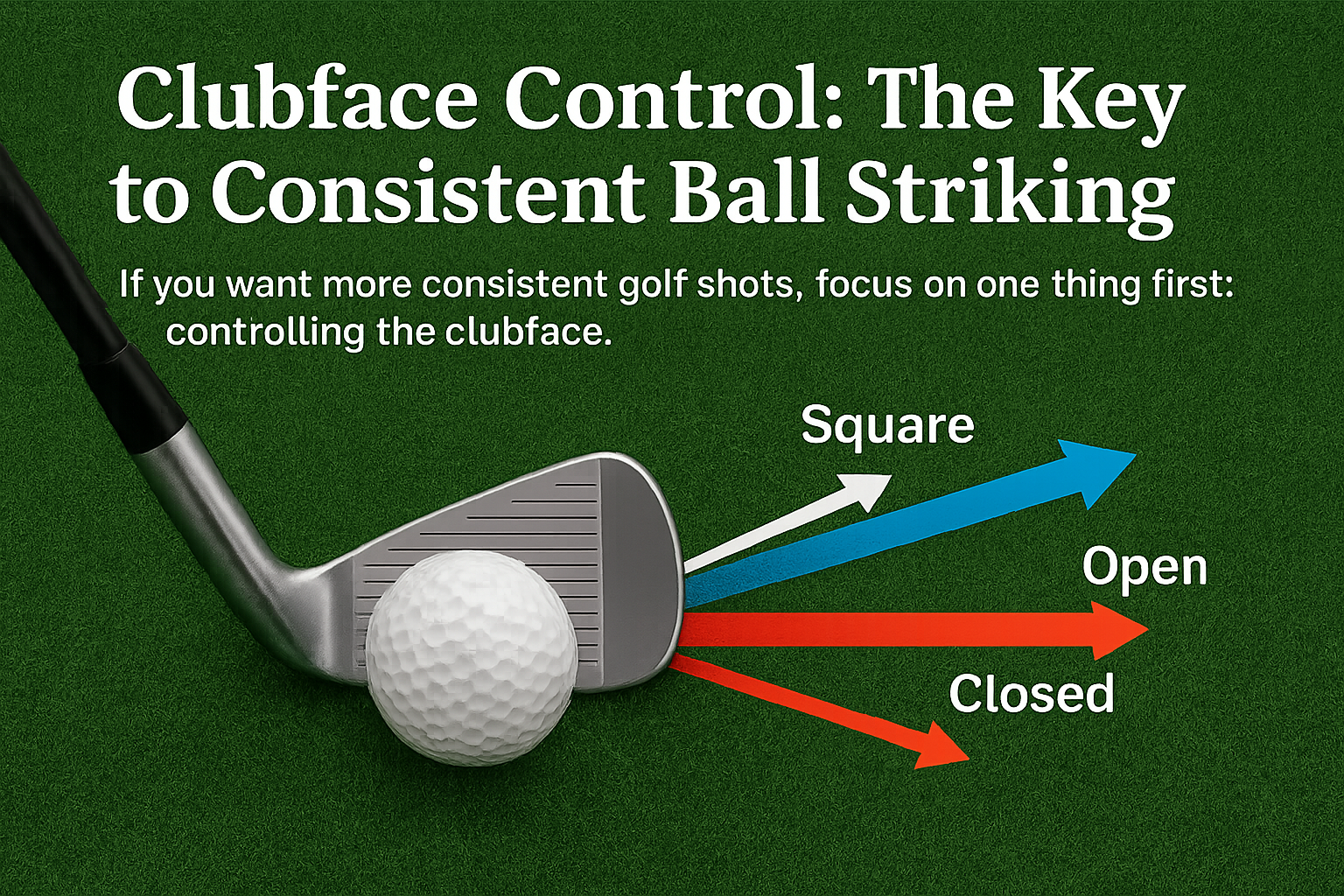
Clubface Control: The Key to Consistent Ball Striking
If you want more consistent golf shots, focus on one thing first: controlling the clubface.
The clubface largely determines where the ball starts and how it curves. You can make a beautiful-looking swing, but if the clubface is open or closed at impact, the ball will not travel where you intended.
What Is Clubface Control?
Clubface control is your ability to return the clubface to the ball in a predictable position at impact. For a right-handed golfer:
- A clubface pointing generally toward the target sends the ball relatively straight.
- An open clubface tends to send the ball to the right.
- A closed clubface tends to send the ball to the left.
The clubface does not need to be perfectly square throughout the entire swing. In fact, it naturally rotates. The goal is to control that rotation so the face returns consistently at impact.
Why Clubface Control Matters
Small changes in the clubface angle can create large differences in ball flight. A face that is only slightly open can produce a push, a slice, or a weak fade depending on your swing path and speed.
When you control the clubface, you gain better control over:
- Starting direction
- Shot curvature
- Distance control
- Contact quality
- Confidence over the ball
Good clubface control also reduces the need to make last-second corrections with your hands. That makes your motion simpler and more repeatable.
What Should You Feel?
When the clubface is being controlled correctly, your hands should feel quiet but responsive. You should not feel as though you are aggressively flipping the clubhead at the ball.
At impact, many golfers feel that the lead wrist is relatively firm and that the clubface is being delivered by the rotation of the body and arms—not by a sudden hand action.
The sensation may feel slightly different at first. Your shots might start straighter but feel less “manipulated.” That is a positive sign.
Common Mistakes and Simple Fixes
1. Weak or Inconsistent Grip
A grip that changes from shot to shot makes the clubface difficult to control. A grip that is too weak can also encourage the face to remain open.
Fix: Place the handle more in the fingers of your lead hand. You should generally be able to see two or three knuckles when looking down at your lead hand. Keep the trail-hand grip comfortable rather than overly tight.
2. Trying to Square the Face With a Fast Hand Flip
Many golfers sense an open clubface and try to rescue the shot by rapidly rolling or flipping their hands through impact. This often produces hooks, thin shots, or inconsistent contact.
Fix: Make three-quarter swings at 50–60 percent speed. Focus on turning your chest through the shot while keeping your wrists relaxed and stable.
3. Holding the Face Open Through Impact
Some players are afraid of hitting a hook, so they consciously keep the clubface facing the target for too long. This usually leaves the face open and creates a slice or push.
Fix: Allow the clubface to rotate naturally after impact. The toe of the club should gradually move past the heel as the club travels toward the finish.
Practice Drill: The Half-Swing Face-Control Drill
- Use a short iron and place a ball on a tee.
- Make a backswing only to waist height.
- Swing through to a waist-high finish.
- Keep the motion smooth and hit shots at half speed.
- Watch where the ball starts before worrying about its curve.
Begin with short shots of 30–50 yards. Your goal is to start the ball on a narrow target line. If it starts far right, check your grip and avoid holding the face open. If it starts left, reduce excessive hand action.
Remember: Consistent ball striking does not require a perfect swing. It requires a clubface that returns to the ball in a predictable way. Build that control with a comfortable grip, quiet hands, and slow, purposeful practice.