
Introduction
You have your grip dialed in. Your stance and posture look athletic and balanced. But there is one more setup detail that can make or break your contact: where the ball sits in your stance.
Ball position affects the angle of attack, the loft at impact, and the direction the ball starts. Get it wrong, and even a good swing produces poor results. This lesson gives you simple, reliable rules for placing the ball correctly with every club.
What You're Going to Learn
- Why ball position matters for contact and ball flight
- Where to place the ball for drivers, irons, and wedges
- How stance width and ball position work together
- How to check your ball position before every shot
- Common ball position errors and how to fix them
Why Ball Position Matters
During your swing, the clubhead travels on an arc — descending as it approaches the ball, bottoming out at a low point, then ascending through the follow-through. Where the ball sits relative to that low point determines how cleanly you hit it.
If the ball is too far forward, you catch it on the upswing — great for a driver, terrible for an iron. Too far back, and you dig the club into the ground.
The Basic Rule: Move the Ball With the Club
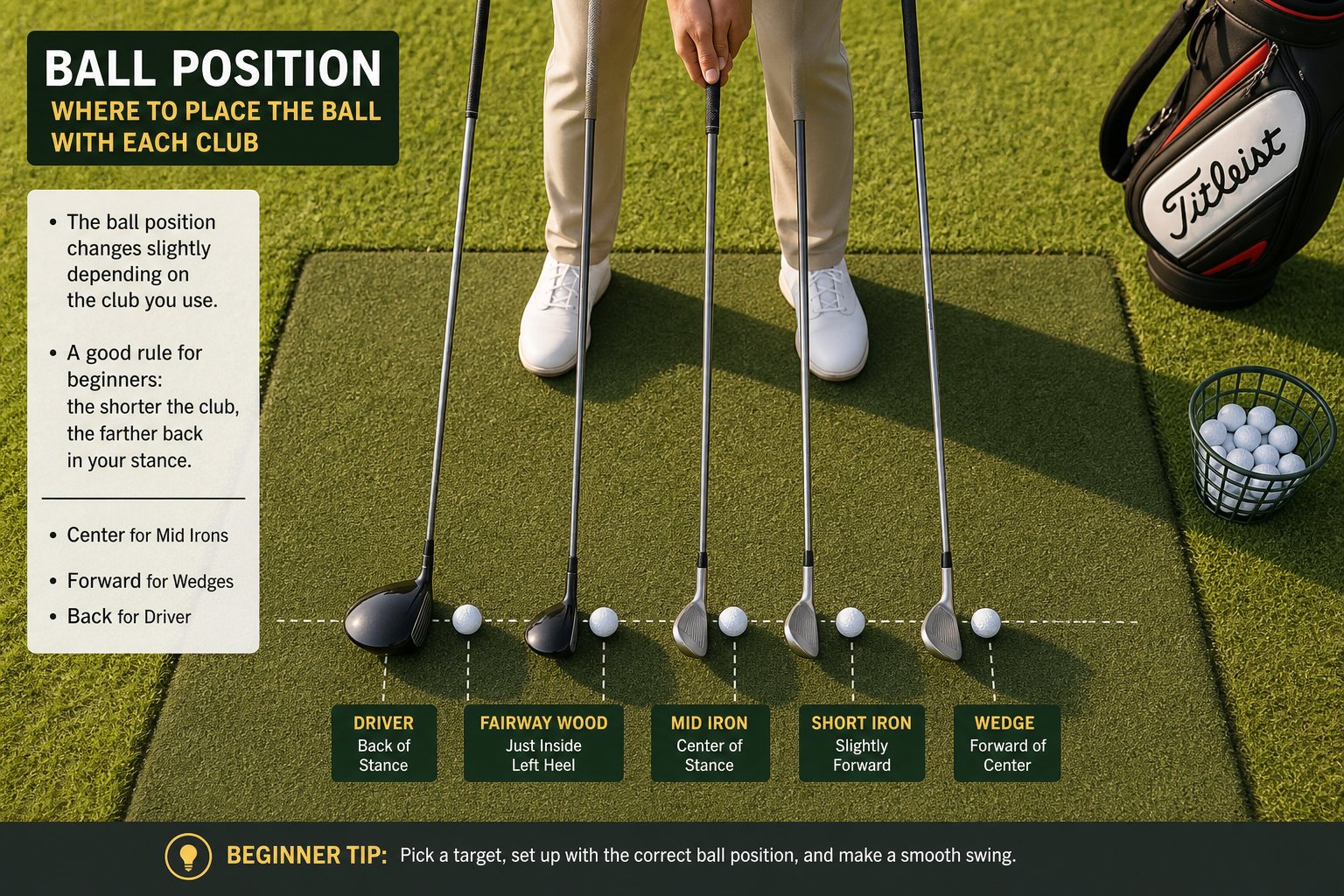
Think of your stance as having three zones: back (closer to your trail foot), center, and forward (closer to your lead foot). Here is where the ball goes for each club:
- Driver: Inside your lead heel, or just inside the lead foot. You want to catch the ball on the upswing for maximum distance.
- 3-wood and hybrids: Just inside your lead heel, slightly back from the driver position.
- Long irons (4, 5, 6): A ball-width forward of center.
- Mid-irons (7, 8): Center of your stance.
- Short irons and wedges (9, PW, SW): Center or slightly back of center.
- Putter: Slightly forward of center, directly below your lead eye.
The pattern is simple: longer clubs move the ball forward, shorter clubs keep it centered or slightly back. As the club gets longer, your stance gets wider and the ball moves forward.
How to Find Your Ball Position Every Time
Instead of guessing each time, use your feet as a reference. Here is a quick method:
- Stand with your feet together and the ball aligned with the center of your stance.
- For a mid-iron, take equal steps with each foot to shoulder width. The ball stays centered.
- For a driver, take a small step back with your trail foot and a larger step forward with your lead foot. The ball is now inside your lead heel.
- For a wedge, take a small step forward with your trail foot. The ball moves slightly back of center.
Practice this footwork at the range until it becomes automatic.
Special Cases: Chips and Pitches
Around the green, ball position controls trajectory. Ball back produces a lower, running shot. Ball forward produces a higher, softer landing. Start centered for most chips.
Why It Matters
Ball position is one of the simplest setup adjustments with the biggest impact. Many thin, fat, or inconsistent shots trace back to ball position.
What Should It Feel Like?
With the ball positioned correctly, contact should feel clean and effortless. For irons, you should feel like you are hitting the ball first and then brushing the turf. For a driver, contact should feel light and upward — almost like you are launching the ball rather than hitting it.
If you feel like you are reaching, leaning back, or digging, check your ball position first before changing your swing.
Common Beginner Mistakes
Playing Every Ball in the Center
Placing every ball in the center of your stance is the most common error. It works for mid-irons, but it produces thin, low shots with a driver and overly steep contact with wedges. Match the ball position to the club every time.
Moving the Ball Too Far Forward with Irons
Some beginners hear "ball forward" and push everything toward the lead foot. With irons, this causes thin contact and weak, floating shots. Keep mid-irons centered and short irons slightly back. Only the driver and woods need the ball forward.
Not Adjusting for Uneven Lies
On a slope, your normal ball position may not apply. When the ball is above your feet, choke down on the club and stand taller. When it is below your feet, bend a little more and widen your stance. Adjust for the lie, then trust your setup.
Try This Simple Drill
At the range, place three alignment sticks or clubs on the ground. One marks your lead foot position, one marks center, and one marks your trail foot position. Hit five balls with each club in your bag, placing the ball in the correct position for that club.
Pay attention to contact quality. You should notice cleaner strikes when the ball is in the right spot.
One Thing to Remember
Ball position is not complicated once you learn the pattern: longer clubs forward, shorter clubs centered or back. Check it before every shot, keep it consistent, and your contact will improve faster than you expect.