
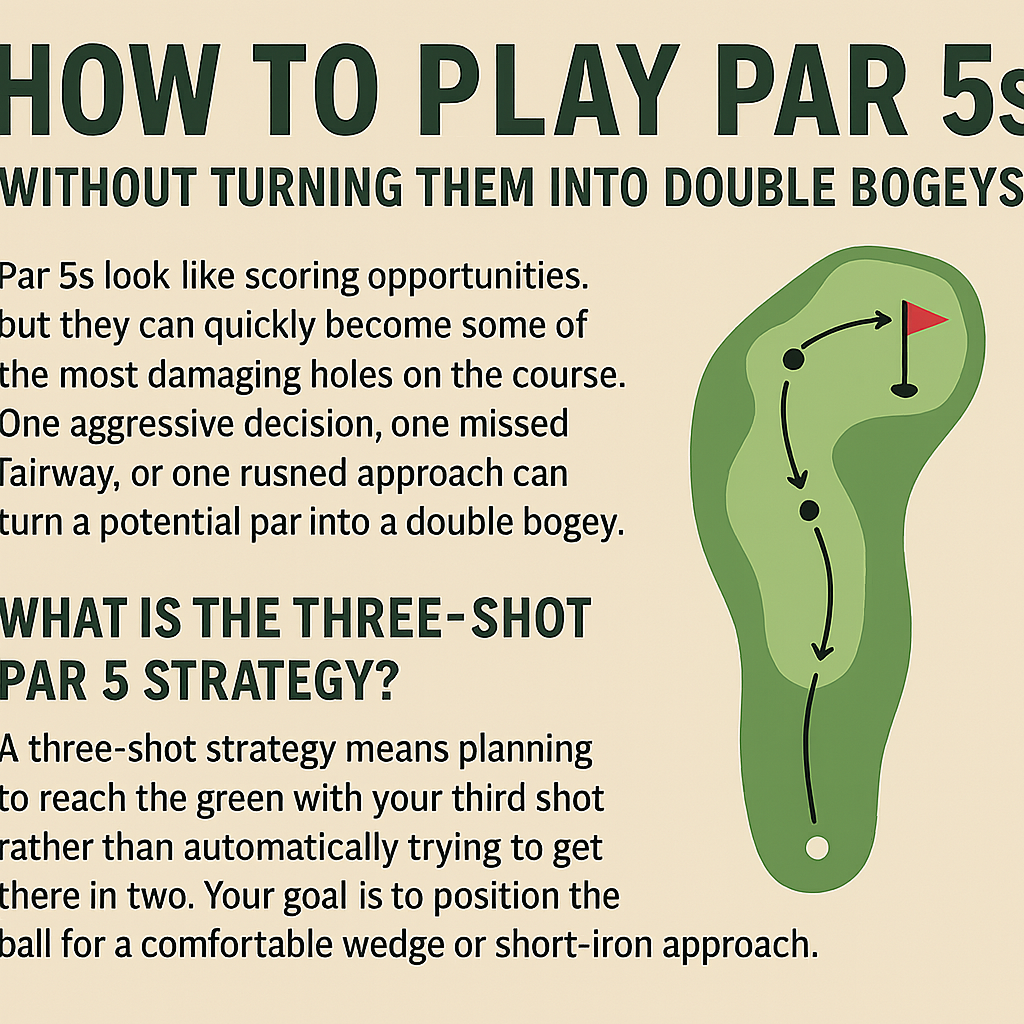
How to Play Par 5s Without Turning Them Into Double Bogeys
Par 5s look like scoring opportunities, but they can quickly become some of the most damaging holes on the course. One aggressive decision, one missed fairway, or one rushed approach can turn a potential par into a double bogey.
The key is to stop treating every par 5 as a hole you must reach in two shots. Instead, play it as three manageable shots. You may still make birdie, but you will give yourself a much better chance of avoiding big numbers.
What Is the Three-Shot Par 5 Strategy?
A three-shot strategy means planning to reach the green with your third shot rather than automatically trying to get there in two. Your goal is to position the ball for a comfortable wedge or short-iron approach.
For example, instead of hitting a fairway wood toward a narrow green surrounded by hazards, you might hit a reliable club to a safe area, then lay up to a favorite wedge distance. Your third shot may be 80 to 110 yards instead of a difficult long-iron or hybrid shot.
This does not mean you should never go for a par 5 in two. It means you should decide based on the situation rather than emotion.
Why Does It Matter?
Smart par-5 management helps in several important ways:
- Fewer penalty strokes: You avoid unnecessary attempts over water, bunkers, or out-of-bounds areas.
- Better contact: A comfortable wedge is usually easier to strike than a forced long shot.
- More predictable distances: You can choose a layup yardage that fits a club you trust.
- Lower scores: Eliminating double bogeys often helps your score more than chasing extra birdies.
- More confidence: A clear plan keeps one poor shot from turning into several rushed decisions.
How to Make Better Decisions on Par 5s
1. Start with the tee shot
Your first question should not be, “How far can I hit this?” Ask, “Where do I need to be for my next decision?”
If the fairway narrows near your maximum driver distance, consider using a club that leaves you in a wider landing area. A slightly shorter tee shot from the fairway is often more useful than a longer shot from the rough or trees.
2. Check the second-shot risk
Before choosing a fairway wood or hybrid, look carefully at the area around the green. Consider:
- Where is the trouble?
- What happens if you miss left or right?
- Is the green wide enough for your current club?
- Can you reach the putting surface comfortably, or are you forcing the shot?
If a miss brings water, out-of-bounds, or a nearly impossible recovery into play, laying up is often the better choice.
3. Choose a layup distance you trust
Do not lay up simply to a random number. Choose a distance that gives you a comfortable third shot.
Some golfers prefer a full wedge, while others hit their best shots with a three-quarter swing. If you are more consistent from 90 yards than 50 yards, do not automatically lay up as close to the green as possible. Leave yourself the distance that produces your most reliable contact and control.
4. Aim for the center of the green
When you reach your approach shot, forget the flag unless the situation is clearly favorable. The center of the green gives you the largest margin for error and usually leaves a manageable first putt.
On a par 5, a safe approach that finishes on the green can still set up a birdie putt. A risky approach that misses into trouble may lead to bogey or worse.
Common Mistakes
The Mistake: Automatically hitting driver and the longest club
What Happens: You may find trouble off the tee or leave yourself an awkward second shot.
Simple Fix: Choose the tee-shot club that gives you the best combination of distance and accuracy.
The Mistake: Going for the green because you are “supposed” to
What Happens: You force a low-percentage shot and bring hazards into play.
Simple Fix: Only go for the green when you have a reasonable chance of reaching it and a safe miss.
The Mistake: Laying up too close
What Happens: You leave yourself an uncomfortable half-swing or delicate pitch.
Simple Fix: Lay up to a known, comfortable wedge distance rather than chasing the shortest possible approach.
Try This: Make a Par-5 Plan Before Your Round
Before playing, choose one par 5 on the course and make a simple plan:
- Select your preferred tee-shot club.
- Choose a comfortable layup distance.
- Pick a safe side of the green for your approach.
- Commit to the plan unless conditions change dramatically.
During the round, judge the strategy by the quality of the decision—not only by the final score. A well-played three-shot par 5 may still produce a par, even if the birdie putt does not fall.
One Thing to Remember
Par 5s are scoring opportunities, not mandatory birdies. Choose the safest route that gives you a comfortable approach.