
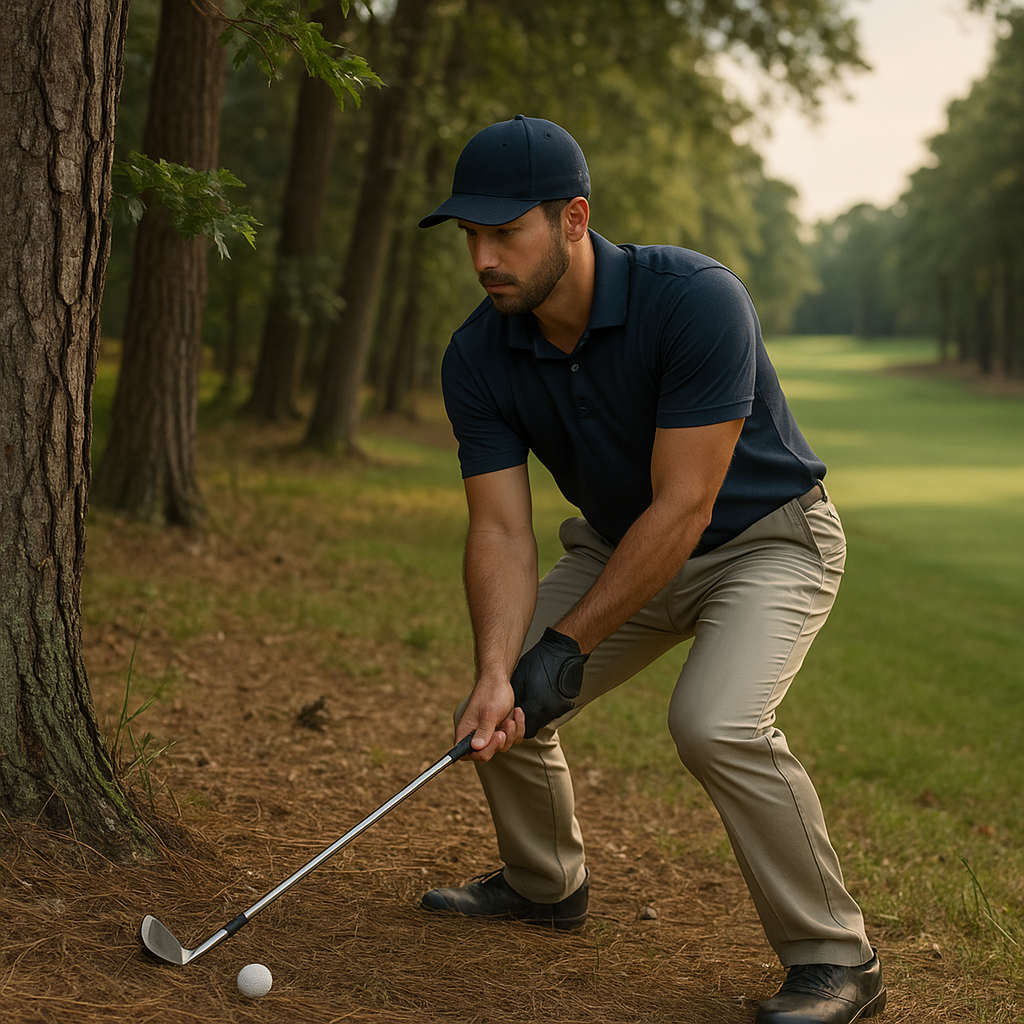
Behind a Tree? The Smart Way to Play a Punch-Out Shot
Your ball has found the trees, but you still have a clear path back toward the fairway. The green is somewhere in the distance, and part of you is wondering if you can thread a low shot through the branches.
That is usually the moment when golfers turn a simple recovery into a much bigger problem.
A good punch-out shot is not about showing off. It is about getting the ball back into play, avoiding the next penalty, and giving yourself a realistic chance to save bogey. The best decision is often less exciting than the risky one—but it usually produces a better score.
First, Find the Safest Exit
Before choosing a club, walk backward from your ball and look for the widest opening. Do not automatically aim toward the hole. Your first question should be:
Where can I send the ball that gives me the most room for the next shot?
Look for:
- The widest gap between trees
- The shortest route back to the fairway
- An area without deep rough, bunkers, or hazards
- A direction that leaves a reasonable next shot
If the only route to the green requires the ball to pass through a narrow gap, over a branch, or beside an out-of-bounds fence, take your medicine. A sideways or slightly backward shot may be the smartest play.
Choose the Club for Height, Not Distance
When you need to keep the ball under branches, use a club with less loft. A long iron, hybrid, or fairway wood can work well, depending on how much room you have and how low the shot needs to stay.
Do not simply grab the longest club in the bag. The best club is the one that produces the right combination of control, rollout, and confidence.
- Low branches: Use a long iron or hybrid and keep the ball very low.
- A little more room above you: A middle iron may be easier to control.
- Very little space: Use a short iron and focus on getting back to safety.
Remember that a punch shot often rolls much farther than expected. A low shot with a hybrid may travel 40 percent through the air and 60 percent along the ground. Account for that rollout before you swing.
Make a Controlled Swing
You do not need a complicated technique. Set up with the ball slightly farther back than normal, narrow your stance, and make a smooth three-quarter swing.
Keep your hands slightly ahead of the ball at impact, but do not try to force them dramatically forward. The goal is solid contact and a low launch—not a violent swing.
A few simple adjustments help:
- Grip down slightly on the club.
- Stand a little closer to the ball.
- Keep your weight balanced, with a touch more pressure on your front foot.
- Finish with your hands below shoulder height.
- Maintain a steady tempo rather than trying to hit the ball hard.
A common mistake is swinging too aggressively. That can cause the club to strike the ground early, send the ball into another tree, or produce a hook that misses the opening completely. A smooth swing gives you a much better chance of controlling the starting direction.
Do Not Ignore the Lie
Check the ground before you commit to the shot. A ball sitting in pine straw, thick grass, or loose leaves may not come out cleanly. If the ball is sitting down, choose more loft and accept less distance. If it is on a firm, bare lie, be especially careful not to dig the club into the ground.
Also check your stance. Roots, uneven ground, and branches behind you can change your balance. If you cannot make a comfortable rehearsal swing, the shot may be more difficult than it first appears.
Try This Practice Exercise
At the range, choose a target 50 to 100 yards away and place a towel or alignment stick several feet in front of the ball as a height barrier. Practice hitting low shots that pass beneath the barrier and land short of the target, then roll toward it.
Use different clubs and notice how far each shot rolls after landing. This teaches you the most important part of a punch-out: choosing a club based on trajectory and rollout instead of distance alone.
One Thing to Remember
When you are in trouble, choose the shot that gives you the best next shot—not the shot that reaches the green.