
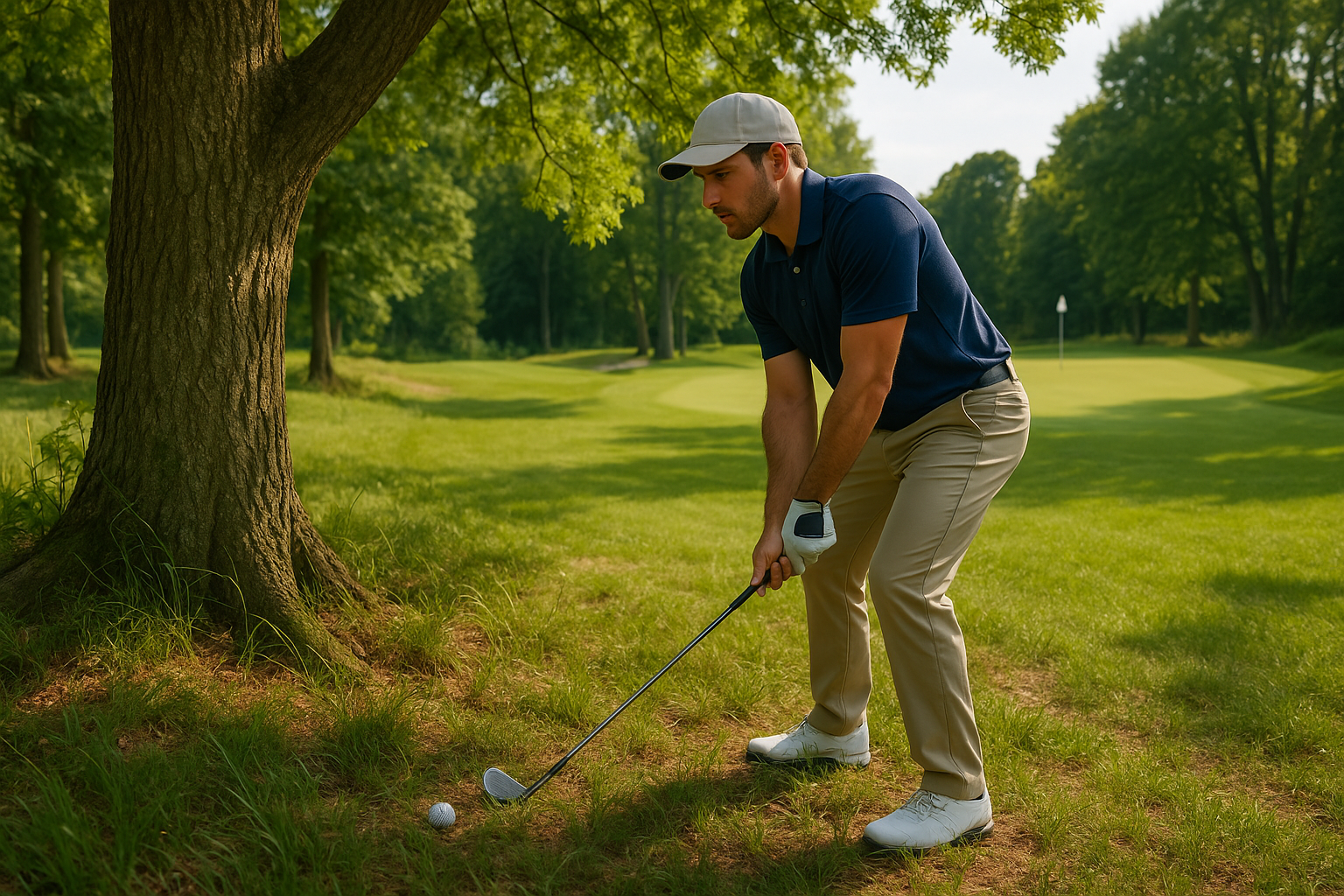
Should You Punch Out or Try the Hero Shot?
Your drive clips a tree, your ball rolls into the rough, and now you are staring at a narrow gap between branches. The green is still visible. Maybe you can reach it. Maybe you can hit the perfect low hook around the trunk.
This is where many golfers turn a manageable mistake into a big number. The problem usually is not a lack of skill. It is choosing a shot that has too little margin for error.
Knowing when to take your medicine and punch the ball back into play can save more strokes than hitting one extra good drive.
What “Taking Your Medicine” Means
Taking your medicine means choosing the safe recovery shot instead of attempting a difficult shot that could make the situation worse. From behind a tree, that might mean hitting sideways or backward into the fairway rather than trying to reach the green.
A punch-out does not feel exciting, but it often gives you a clear next shot. A hero shot may save a stroke if executed perfectly, yet a small mistake can send the ball deeper into trouble, out of bounds, or into another hazard.
Ask Three Questions Before Choosing
1. How much of the target can you actually see?
If you can see only a small portion of the fairway or green, your usable landing area is probably even smaller than it appears. Trees, branches, slopes, and hazards can turn a decent-looking gap into a very low-percentage shot.
Do not ask, “Can I hit this shot?” Almost any shot is possible occasionally. Ask, “Can I hit this shot often enough for it to be a smart choice?”
2. What happens if the ball misses?
Imagine the most likely miss, not your perfect result. If the ball misses by 10 or 15 yards, will it still be in play? Or will it hit another tree, enter water, go out of bounds, or leave you with an even worse lie?
A recovery shot is usually a good choice when the miss still leaves you with a reasonable next shot. A hero shot is dangerous when the miss creates a penalty or another impossible decision.
3. What score are you trying to save?
If your ball is in trouble after a poor tee shot, you may already be unlikely to make par. That does not mean the hole is ruined. Your new goal might be to make bogey and avoid double bogey.
From the trees, a punch-out followed by a solid approach may give you a chance to two-putt for bogey. Trying to reach the green through a tiny gap might produce a double bogey or worse.
When the Hero Shot Makes Sense
This does not mean you should always hit sideways. An aggressive recovery can be reasonable when:
- The opening is wide enough to provide a real margin for error.
- The ball is sitting cleanly.
- You have a clear idea of the shot shape and trajectory.
- The hazards around the target are not severe.
- You need the risk because the situation requires it, such as late in a match or when trying to make up ground.
Even then, choose the safest aggressive version. For example, aim at the largest part of the green instead of the flag, or use a club that produces a lower, more predictable flight.
How to Hit a Simple Punch-Out
Once you decide to escape, keep the shot uncomplicated:
- Choose a wide section of fairway, even if it points away from the hole.
- Select enough club to reach that area without forcing the shot.
- Move the ball slightly back in your stance.
- Make a compact swing and finish low.
- Accept that your next shot may be longer than you hoped.
The goal is not to hit a perfect low bullet. The goal is to return the ball to a safe place.
Try This Decision Exercise
During your next practice round, deliberately imagine that three of your tee shots have finished behind trees. Before choosing a club, say out loud:
- My best realistic result is...
- My most likely miss is...
- If I make that miss, my next shot will be...
This takes only a few seconds, but it trains you to evaluate consequences instead of reacting emotionally to the trouble.
One Thing to Remember
When a recovery shot has a small window and a big penalty, choose the shot that keeps your next shot easy.