
Stop Aiming at Every Flag: A Smarter Way to Play Par 3s
Par 3s look simple: hit one shot toward the green, then putt. But many golfers turn them into difficult holes by aiming directly at every flag, even when the pin is near trouble. A better plan can help you avoid big numbers without changing your swing.
What Is the Concept?
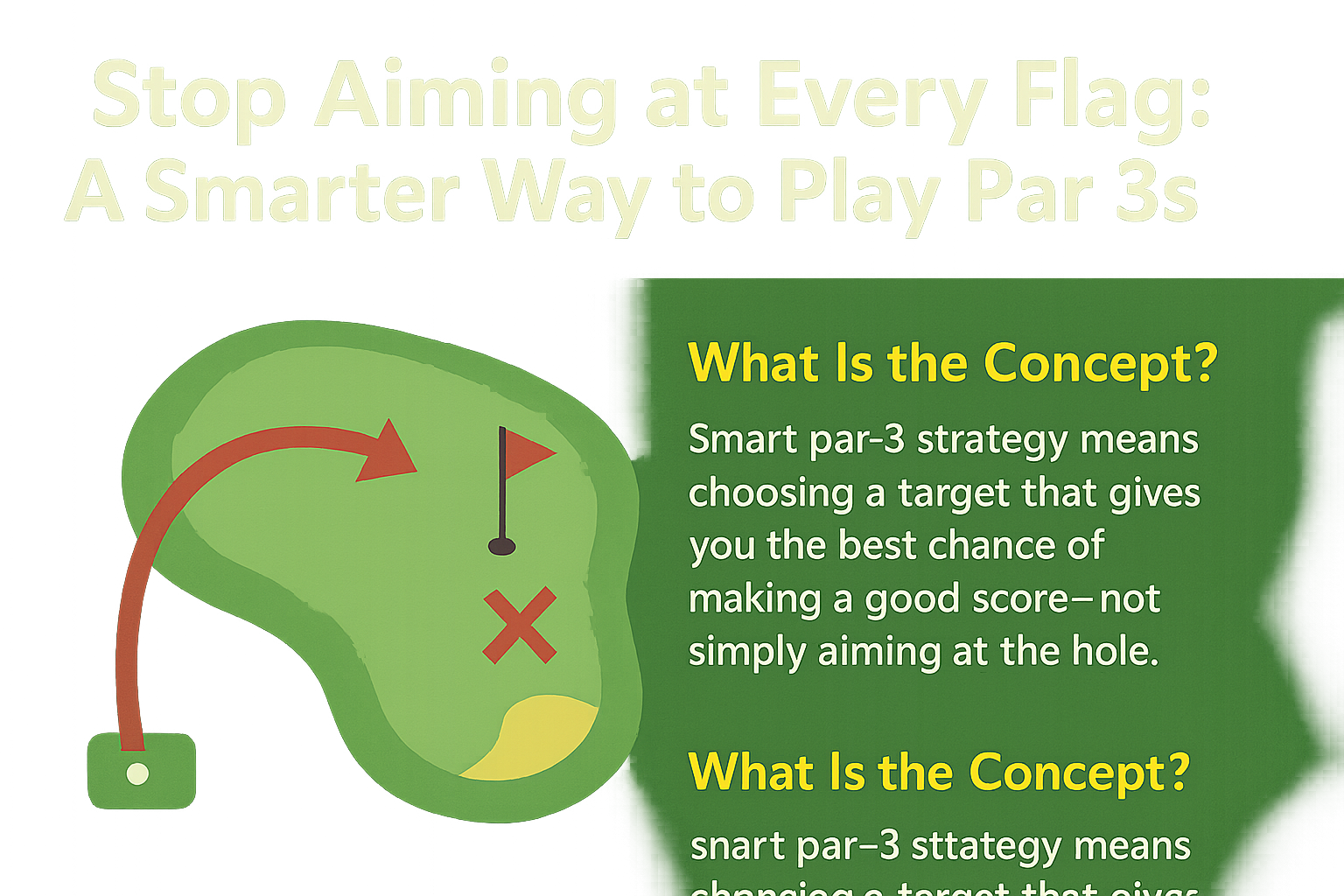
Smart par-3 strategy means choosing a target that gives you the best chance of making a good score—not simply aiming at the hole.
Before selecting a club, look at the entire hole. Notice where the hazards, bunkers, slopes, and out-of-bounds areas are located. Then decide which part of the green gives you the largest margin for error.
For example, if the flag is tucked behind a bunker on the right side, your target may be the center or left side of the green. If the flag is near the front edge, you may choose the middle of the green rather than trying to land the ball close to the pin.
This is sometimes called playing to the fat side. The “fat side” is the larger, safer area around the target.
Why Does It Matter?
Par 3s often punish small mistakes. A shot that finishes 20 feet from the hole may leave you a reasonable chance at par. A shot that misses by the same amount toward a bunker or hazard may lead to bogey, double bogey, or a penalty stroke.
Choosing a safer target helps you:
- Avoid penalty strokes and difficult bunker shots.
- Keep more tee shots on the putting surface.
- Leave yourself easier first putts.
- Reduce the number of double bogeys.
- Play with more confidence over the ball.
You do not need to hit every par 3 close to the flag to score well. You need to avoid turning one imperfect shot into a major mistake.
How to Play a Smarter Par 3
1. Identify the biggest danger
Start by asking, “Where can a slightly poor shot cause the most damage?” This might be water, out of bounds, a deep bunker, or a severe slope that sends the ball away from the green.
Do not focus only on the flag. The most important feature of the hole may be 20 yards away from it.
2. Choose your safe target
Pick a specific target on the green or near the green. Avoid vague decisions such as “somewhere left.” Instead, choose a clear target like:
- The center of the green.
- The left half of the green.
- A point just short of the pin.
- The side farthest from the water.
Your target should allow for your typical miss. If you usually miss right, do not aim at the right edge of the green. Give that miss room to exist.
3. Select the club for the safe target
Choose a club based on the distance to your target—not always the distance to the flag.
If the flag is at the very back of the green, you may only need to carry the front or middle section. If the pin is at the front, use enough club to avoid coming up dangerously short, especially when there is trouble between you and the green.
Also consider wind, elevation, temperature, and the lie of the ball. When in doubt, favor the club that reaches the safer part of the green.
4. Commit to the decision
Once you choose your target and club, commit to it. Do not stand over the ball thinking about the flag, the bunker, and the water all at once.
Take one final look at your target, make a smooth swing, and accept that the shot does not need to be perfect. A solid shot toward a safe target is usually a successful par-3 strategy.
Common Mistakes
The Mistake: Aiming directly at every flag
What Happens: Your normal miss finds the nearest hazard or bunker.
Simple Fix: Aim at the largest safe section of the green, especially when the pin is near trouble.
The Mistake: Choosing a club only by the flag distance
What Happens: You may hit a good shot but finish in a dangerous area, or come up short of the safe landing zone.
Simple Fix: Pick your target first, then choose the club that reaches it.
The Mistake: Ignoring your usual miss
What Happens: You aim at a target that leaves no room for your common slice, hook, thin, or pull.
Simple Fix: Build your target around the shot you are most likely to hit—not your perfect shot.
Try This
During your next round, play every par 3 using the safe-side challenge. Before each tee shot, identify the most dangerous area and choose a target that keeps that trouble out of play.
After the round, count how many par 3s you completed without a penalty stroke or a lost ball. Do not judge success by birdies. Judge it by how often your strategy kept the hole manageable.
One Thing to Remember
On a par 3, aim for the safest part of the green—not automatically at the flag.