
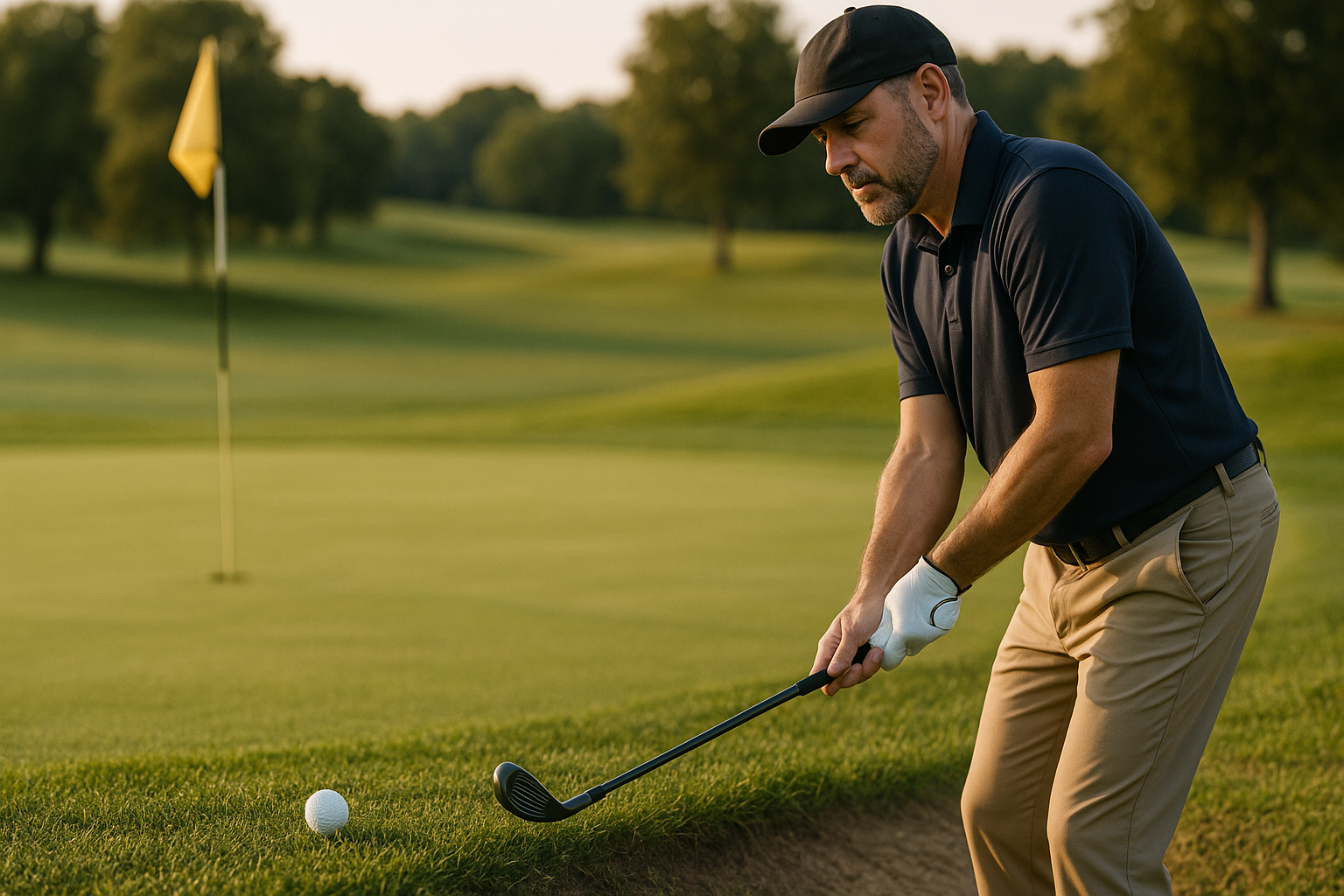
When Should You Use a Hybrid Around the Green?
You have short-sided yourself, the rough is thin, and there is plenty of green between your ball and the hole. You could reach for a wedge—but a hybrid may give you a much larger margin for error.
Using a hybrid around the green is not a trick shot. It is a practical option when you want the ball to get moving quickly, avoid a chunked chip, and take some of the guesswork out of a difficult lie.
What Makes a Hybrid Useful Near the Green?
A hybrid has a rounded sole and a low center of gravity. That means it can slide through short grass more easily than a wedge, especially when you are not striking the ball perfectly.
Instead of sending the ball high into the air, you are using the hybrid like a putter with loft. The ball starts rolling almost immediately, usually carrying only a few feet before releasing toward the hole.
This can be helpful when:
- The grass between your ball and the green is short and reasonably smooth.
- You have plenty of green to work with.
- The flag is not close to the edge of the green.
- You are uncomfortable hitting a delicate wedge shot.
- A poor strike with a wedge could leave the ball short or chunked.
When It Is Better Than a Wedge
The hybrid is especially useful when the lie is slightly unpredictable. A wedge can dig into soft ground or catch heavy grass behind the ball. A hybrid’s wider sole is more forgiving and helps the club move through the turf.
It can also be a smart choice for golfers who tend to hit chips too softly. Because the hybrid sends the ball forward with a putting-style motion, you do not need to create much speed. The ball will roll over the fringe and continue across the green.
Think of the shot as a long putt with a small amount of carry, not as a miniature golf swing.
When You Should Not Use It
A hybrid is not the right answer for every short-game situation. Choose a wedge when you need the ball to stop quickly or fly over an obstacle.
Avoid the hybrid if:
- You need to carry a bunker, rough, or sloping section of ground.
- The flag is close to the edge of the green.
- The green slopes sharply downhill.
- You have very little room for the ball to roll.
- The ground between the ball and green is thick, tangled, or uneven.
Also be careful when the green runs away from you. A hybrid can produce more roll than expected, turning a reasonable recovery into another difficult putt.
How to Hit the Shot
Use a simple setup:
- Grip down slightly on the club.
- Stand with your feet close together.
- Position the ball just back of the center of your stance.
- Keep your hands slightly ahead of the clubhead.
- Make a short putting-style stroke with quiet hands.
The length of your stroke controls distance. Do not try to lift the ball into the air. Let the club’s loft do that naturally.
Pick a landing spot several feet onto the green, then imagine the ball rolling like a putt from there. Your target is not necessarily the hole—it is the patch of green where the ball should first land.
Try This: The Hybrid Landing-Zone Challenge
During your next practice session, place three balls just off the green. Choose a landing zone two or three feet onto the putting surface and try to stop all three balls within a six-foot circle around the hole.
Use the same hybrid and the same putting-style motion each time. Then repeat the challenge with a wedge. You may discover that the hybrid gives you better distance control, even if it does not look like the traditional short-game choice.
Common Mistakes
- Trying to help the ball into the air: This often causes poor contact. Keep the motion low and smooth.
- Using too much wrist action: Extra hand movement makes distance control difficult.
- Ignoring the rollout: Plan for the ball to roll much farther than it carries.
- Choosing it automatically: A hybrid is a useful option, not a mandatory club.
One Thing to Remember
When you have plenty of green and little need for height, treat your hybrid like a putter with loft. A simple rolling shot can be safer—and more consistent—than forcing a delicate wedge.