
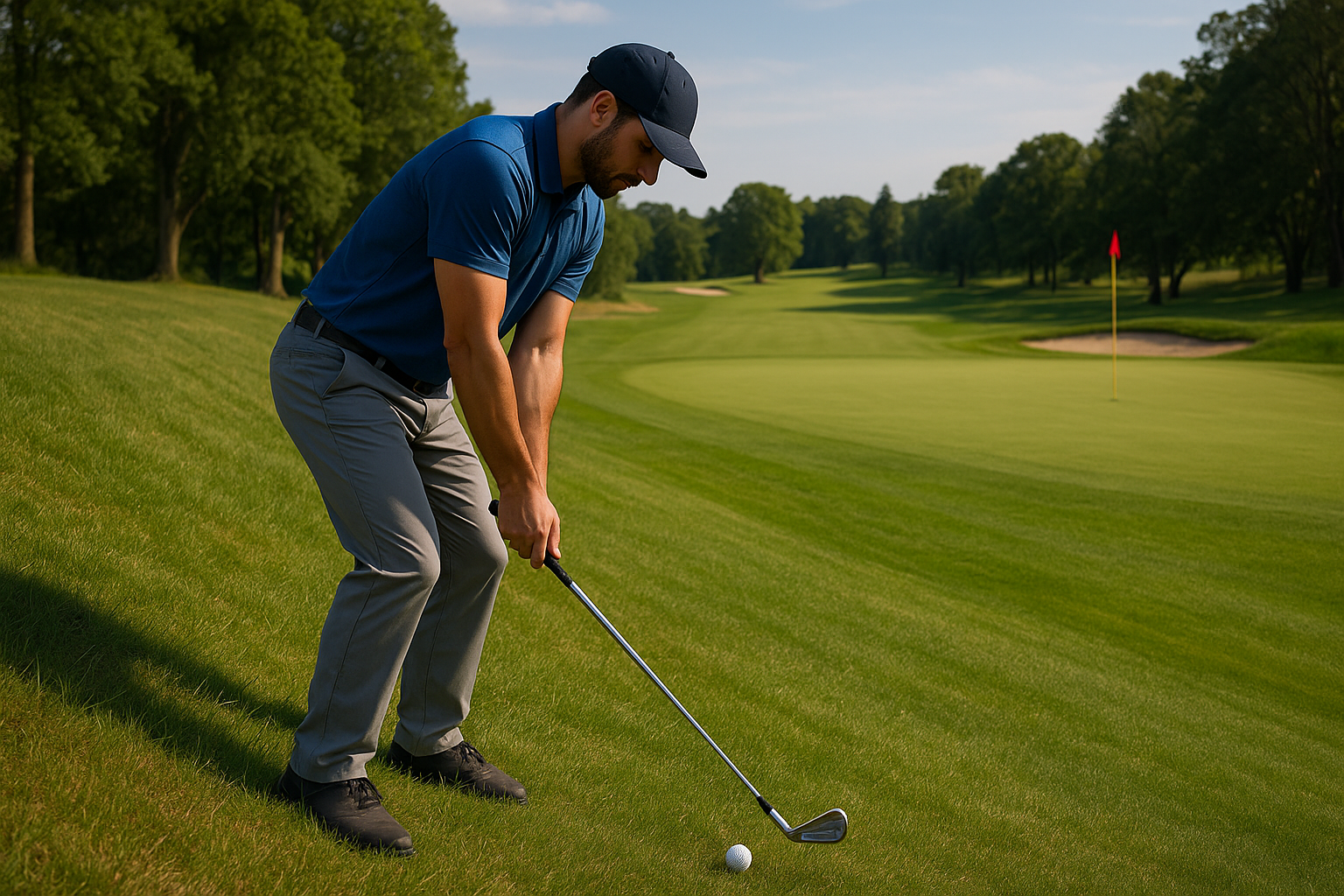
Why Sidehill Lies Make the Ball Curve More—and How to Adjust
You hit a solid iron from the fairway, but the ball starts farther left or right than expected. The swing felt normal, the clubface looked square, and yet the shot misses the target by 20 yards.
The problem may not be your swing. It may be the slope beneath your feet.
A sidehill lie changes the angle of the clubface relative to the ground and affects the direction the ball naturally wants to travel. Once you understand which way the slope sends the ball, you can make a simple target adjustment instead of trying to force a perfect swing.
When the Ball Is Above Your Feet
When the ball is above your feet, the slope effectively makes the club more upright. The toe of the club sits higher, and the ball usually wants to start and curve to the left for a right-handed golfer.
The steeper the slope, the stronger this effect can become.
Many golfers make the mistake of aiming directly at the target and then trying to hold the ball straight. That usually creates tension and inconsistent contact. A better approach is to accept the natural curve.
What to do
- Take one club less if the slope is significant. The ball may fly higher and shorter.
- Grip down slightly to improve control and prevent the club from feeling too long.
- Stand comfortably and allow your knees to match the slope.
- Aim farther right to allow for the expected curve to the left.
- Make a smooth swing rather than trying to hit hard.
For example, if the flag is near the center of the green, your starting target might be the right edge. You are not trying to hit the ball to the right of the green. You are choosing a starting line that gives the ball room to curve toward the target.
When the Ball Is Below Your Feet
When the ball is below your feet, the club sits flatter than usual. For a right-handed golfer, the ball commonly starts and curves to the right.
This lie also makes balance more difficult. Golfers often lose their posture during the swing, stand up through impact, or reach toward the ball. Those compensations can lead to thin shots, weak contact, and even more curve.
What to do
- Use one more club if needed because the ball often flies lower and shorter.
- Bend your knees more and feel stable before starting the swing.
- Grip down slightly, but do not reach for the ball.
- Keep your balance centered throughout the swing.
- Aim left to allow for the ball’s expected movement to the right.
Do not try to swing harder to overcome the slope. A firm, controlled swing usually produces a better result than an aggressive one that causes you to lose balance.
How Much Should You Aim?
There is no single adjustment that works for every sidehill lie. The amount of curve depends on the slope, the club, your swing, and the quality of contact.
Start with a modest adjustment. For a gentle slope, aim only a few yards away from the target. For a severe slope, you may need to aim toward the opposite side of the green or choose a safer target altogether.
Also consider the trouble around the green. If a shot from a ball-above-feet lie is likely to curve left toward a bunker, aim farther right than you might normally choose. If missing the green on the safe side leaves an easy chip, that may be the smartest target.
Try This Sidehill Practice Exercise
At the range, find a slight slope or place one foot a little higher than the other. Hit five balls with the ball above your feet and five with it below your feet.
Before each shot, predict the curve and choose a target that allows for it. Do not worry about hitting the exact target. Your goal is to learn how much the slope affects your ball flight.
After each shot, ask:
- Which direction did the ball start?
- Which direction did it curve?
- Was my target adjustment large enough?
This turns an unpredictable lie into useful information you can apply on the course.
One Thing to Remember
Do not fight the slope—aim for the curve. When the ball is above your feet, expect movement to the left. When it is below your feet, expect movement to the right. Make a small target adjustment, stay balanced, and let the shot happen.