
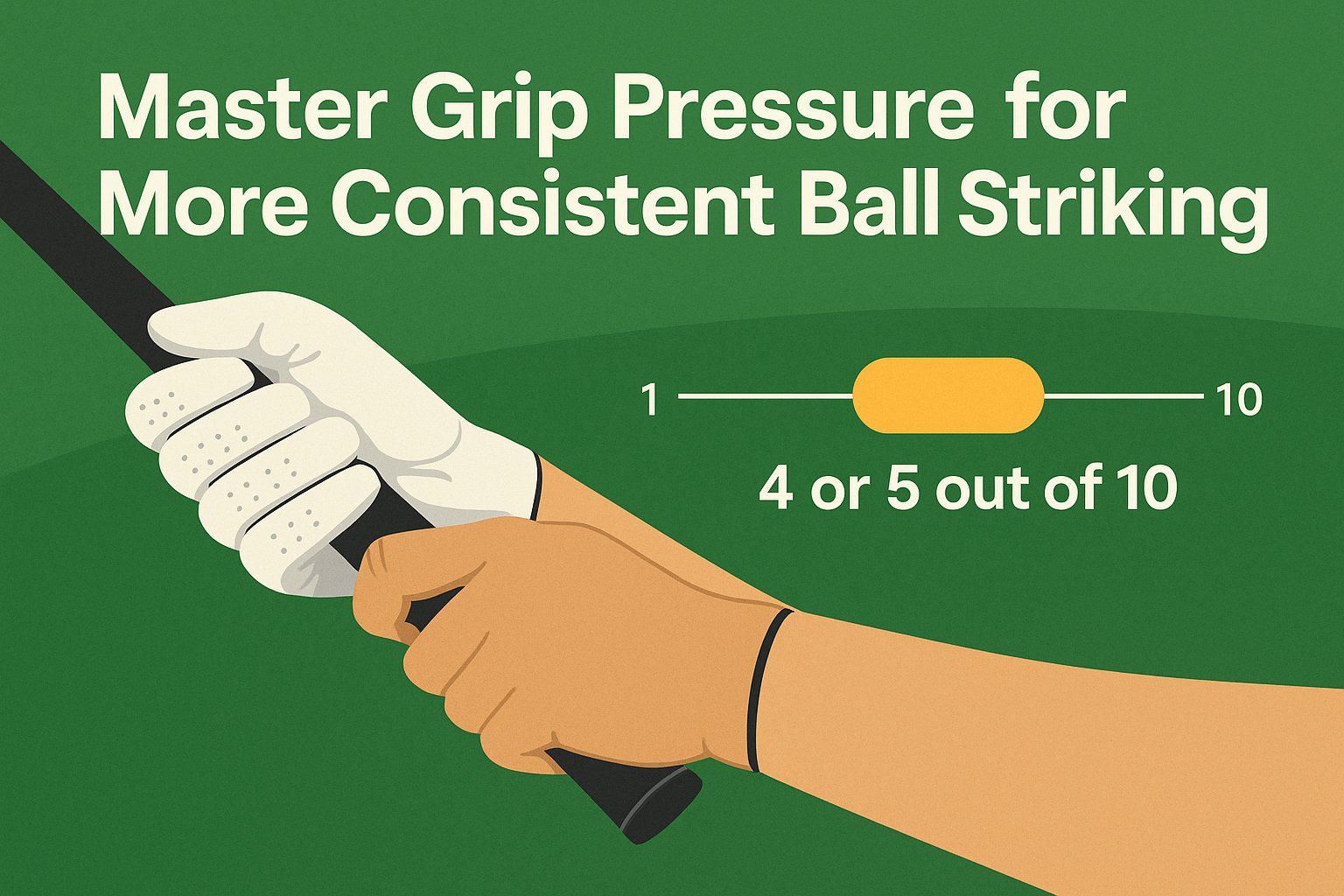
Master Grip Pressure for More Consistent Ball Striking
One of the simplest ways to improve your golf swing is to control your grip pressure. Many golfers hold the club too tightly, especially when they are nervous or trying to hit the ball harder. That extra tension can make the clubface harder to control and prevent the swing from moving smoothly.
Good grip pressure does not mean holding the club loosely or letting it move around. It means applying enough pressure to control the club while keeping the hands, wrists, and forearms relaxed.
What Is Proper Grip Pressure?
Imagine your grip pressure on a scale from 1 to 10:
- 1: The club would easily slip from your hands.
- 10: You are squeezing the club as hard as possible.
- Ideal pressure: Approximately 4 or 5 out of 10.
Your fingers should hold the club securely, while your wrists and forearms remain soft enough to move naturally. The grip should feel firm enough for control, but not so tight that your hands become tense.
Why Grip Pressure Matters
Grip pressure directly influences clubface control. When you squeeze the club too tightly, tension travels up your forearms and into your shoulders. This can restrict the natural movement of your wrists and make it difficult for the clubface to return squarely to the ball.
Excessive pressure can also encourage a quick, jerky takeaway and a rushed transition. The result is often inconsistent contact, a loss of distance, or shots that curve more than expected.
With the correct pressure, the club can move with better rhythm. Your hands stay responsive, your arms remain relaxed, and the clubface has a better chance of returning to a consistent position at impact.
What You Should Feel
When grip pressure is correct, you should feel:
- A secure connection between your hands and the club
- Relaxed wrists and forearms
- Minimal tension in your shoulders
- That the club is swinging rather than being forced
A useful checkpoint is to briefly wiggle the clubhead before starting your swing. If the club feels completely locked in your hands, you are probably gripping too tightly. If it feels unstable, add a small amount of pressure.
Common Mistakes and Simple Fixes
1. Squeezing harder when trying to hit the ball farther
The mistake: Many golfers believe more grip pressure creates more power. Usually, it creates more tension and slows the clubhead.
The fix: Keep your grip pressure at 4 or 5 out of 10, even when hitting a driver. Focus on making a balanced, smooth swing instead of trying to overpower the ball.
2. Holding the club tightly in the trail hand
The mistake: A dominant trail hand can take over, causing excessive tension and making it harder to control the clubface.
The fix: Allow the lead hand to provide most of the club’s support. Keep the trail-hand fingers connected, but avoid squeezing with the trail thumb and palm.
3. Changing grip pressure during the swing
The mistake: Some golfers start relaxed, then tighten their hands during the backswing or at impact.
The fix: Set your pressure before the takeaway and maintain a steady feeling throughout the swing. It is fine for pressure to change slightly, but avoid sudden tightening.
At-Home or Range Drill: The “Hold and Swing” Drill
- Grip a short iron with your normal setup.
- Reduce your grip pressure to about 3 out of 10.
- Make three slow practice swings, stopping if the club feels unstable.
- Increase the pressure slightly to 4 or 5 out of 10.
- Hit five half-shots, focusing on relaxed forearms and smooth contact.
After several repetitions, gradually lengthen your swing while keeping the same pressure. Your goal is to learn that solid contact comes from a secure, relaxed grip—not from squeezing the club as hard as possible.
Remember: Grip pressure is the club’s connection to your body. Keep it controlled and relaxed, and you will give your swing a better chance to produce consistent ball striking.