
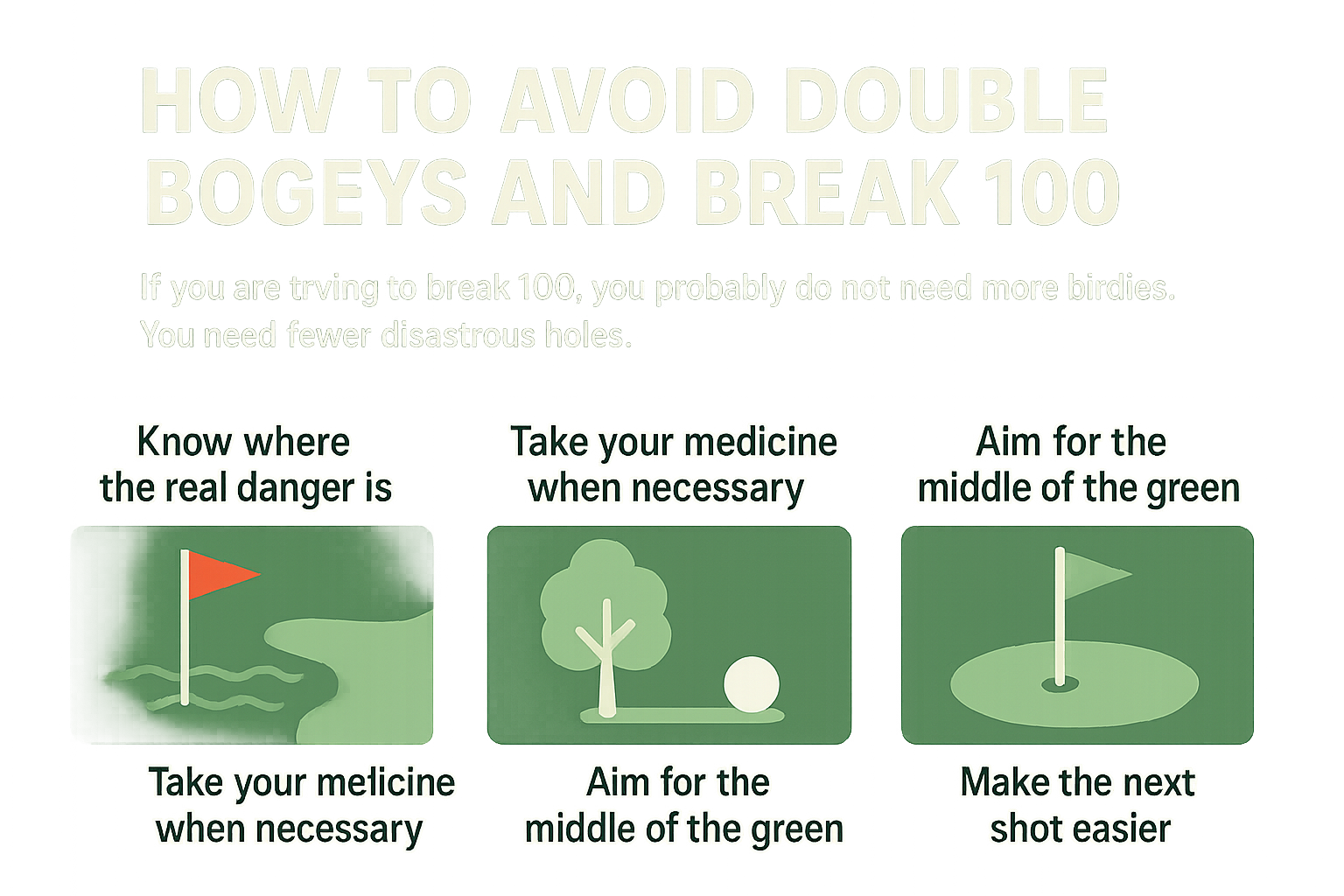
How to Avoid Double Bogeys and Break 100
If you are trying to break 100, you probably do not need more birdies. You need fewer disastrous holes.
A lost ball, a penalty, a risky recovery shot, or three poor decisions in a row can turn an ordinary hole into a double bogey or worse. The good news is that breaking 100 is often less about hitting perfect golf shots and more about limiting damage.
What Is the Concept?
The goal is to play for your next best shot, not to immediately recover everything you lost.
When a hole starts badly, many golfers try to “make up” for the mistake with a low-percentage shot. They attempt to carry a hazard, hit through a narrow gap, or attack a flag from a difficult lie. Sometimes it works, but often the result is another penalty or a shot that creates an even bigger problem.
Instead, adopt a simple rule: once you are in trouble, choose the shot that gives you the best chance of getting back into position safely. A bogey is usually a much better result than a double bogey.
Why Does It Matter?
Double bogeys add up quickly. On an 18-hole course, making five double bogeys adds five extra strokes compared with making bogey on those holes. Eliminating just a few big numbers can make a noticeable difference without changing your swing.
Smart damage control helps with:
- Scoring: Fewer double bogeys make breaking 100 more realistic.
- Confidence: One bad shot does not have to ruin an entire hole.
- Decision-making: You start choosing shots based on percentage rather than hope.
- Consistency: Safe choices give you more chances to keep the ball in play.
How to Avoid Big Numbers
1. Know where the real danger is
Before each shot, identify the trouble that can create the biggest penalty. This might be out of bounds, a water hazard, deep rough, or a bunker that leaves you with a difficult next shot.
You do not have to aim at the center of the fairway every time. Simply make sure your target gives you room for a small miss. If trouble is left, choose a target that favors the right side of the hole, provided that side is safe.
2. Take your medicine when necessary
If your ball is behind a tree, in thick rough, or blocked by a hazard, do not automatically attempt the hero shot.
Ask yourself:
- What is the safest way to get the ball back into play?
- Can I advance the ball without bringing another hazard into play?
- Where will my next shot come from if this plan works?
Sometimes the correct play is a short sideways punch-out. It may feel disappointing, but one recovery shot can prevent two or three additional mistakes.
3. Aim for the middle of the green
When approaching the green, use the center as your default target unless the flag is clearly safe to attack. The middle of the green gives you more margin for error and usually leaves a manageable first putt.
For example, if the flag is tucked beside a bunker, do not let the flag choose your target. Aim away from the bunker and accept a longer putt. A two-putt from the middle of the green is often better than a bunker shot followed by another missed opportunity.
4. Make the next shot easier
Good course management is not always about getting as close to the hole as possible. It is about leaving a shot you can handle.
On a par 5, a layup short of trouble may leave you a comfortable wedge. On a short par 4, a three-wood or hybrid may leave a longer approach but keep the ball in play. Choose the option that reduces the chance of a penalty or an awkward recovery.
Common Mistakes
The Mistake: Chasing a lost shot
What Happens: After a poor drive, you try to reach the green through a tiny opening and bring trees or hazards into play.
Simple Fix: Play back to a safe area and focus on making your next shot easier.
The Mistake: Always attacking the flag
What Happens: You aim at a difficult pin and turn a routine approach into a bunker shot or short-sided chip.
Simple Fix: Aim for the center of the green when the flag is near trouble.
The Mistake: Using the longest club automatically
What Happens: You choose a driver or fairway wood even when it brings hazards or narrow landing areas into play.
Simple Fix: Choose the club that leaves the largest safe landing area, not always the longest distance.
Try This: The Bogey-Saver Challenge
During your next round, pick three holes that usually cause trouble. Before playing each one, decide on a conservative plan. Choose a safe tee-shot target, identify the main danger, and select a target for the approach that avoids the worst miss.
Your goal is not to make par. Your goal is to finish each hole without a double bogey. Write down how you played the hole and whether your decisions helped. This builds the habit of thinking one shot ahead.
One Thing to Remember
When a hole goes wrong, stop trying to save par and start trying to save the hole.