
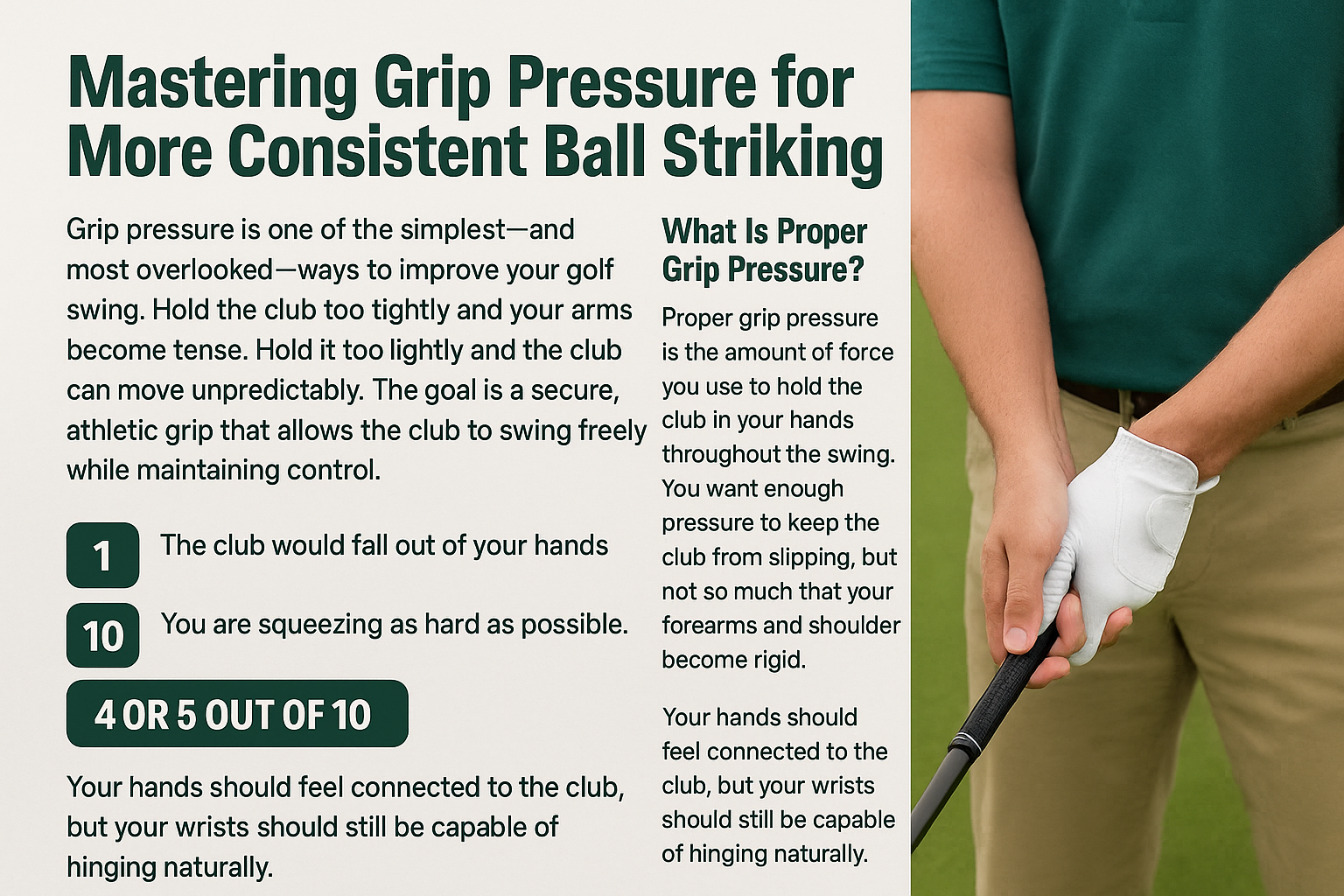
Mastering Grip Pressure for More Consistent Ball Striking
Grip pressure is one of the simplest—and most overlooked—ways to improve your golf swing. Hold the club too tightly and your arms become tense. Hold it too lightly and the club can move unpredictably. The goal is a secure, athletic grip that allows the club to swing freely while maintaining control.
What Is Proper Grip Pressure?
Proper grip pressure is the amount of force you use to hold the club in your hands throughout the swing. You want enough pressure to keep the club from slipping, but not so much that your forearms and shoulders become rigid.
A helpful scale is to imagine grip pressure from 1 to 10:
- 1: The club would fall out of your hands.
- 10: You are squeezing as hard as possible.
- Ideal: Approximately 4 or 5 out of 10.
Your hands should feel connected to the club, but your wrists should still be capable of hinging naturally.
Why Grip Pressure Matters
The hands are the golfer’s only connection to the club. If that connection is tense, the rest of the swing often becomes tense as well. Excessive pressure can restrict wrist movement, slow the clubhead, and make it difficult to return the clubface squarely to the ball.
On the other hand, a relaxed but secure grip helps your arms stay soft and allows the club to release naturally. This can improve contact, clubhead speed, and direction without requiring you to swing harder.
Grip pressure also affects your ability to repeat the swing. If your pressure changes dramatically from shot to shot, the club may feel different in your hands, making consistent ball striking much more difficult.
What Should Proper Grip Pressure Feel Like?
When you are doing it correctly, your hands should feel firm but relaxed. The last three fingers of your lead hand and the middle two fingers of your trail hand should provide most of the support.
You should feel that:
- Your forearms are relaxed rather than tight.
- Your wrists can hinge without strain.
- You can maintain control of the club without squeezing.
- The club feels like it is swinging, not being forced.
Common Mistakes and Simple Fixes
1. Squeezing the Club Too Tightly
The mistake: Many golfers tighten their grip when they want more power or feel nervous over the ball. This creates tension in the hands, forearms, and shoulders.
The fix: Before starting the swing, gently squeeze the club and then reduce the pressure by about 20 percent. Take a slow breath and make one relaxed practice swing before hitting the shot.
2. Holding the Club Too Loosely
The mistake: A grip that is too light may allow the club to shift during the swing, especially near impact.
The fix: Keep the club secure with the correct fingers. Focus on the last three fingers of the lead hand and the middle two fingers of the trail hand. The palms should not do all the gripping.
3. Changing Pressure During the Swing
The mistake: Some golfers start with a relaxed grip, then suddenly tighten their hands during the downswing.
The fix: Maintain steady pressure from address through impact. You do not need to freeze your hands—just avoid a sudden squeeze. Think, “same pressure, smooth swing.”
Easy Practice Drill: The Two-Finger Swing
At home or at the range, grip a short iron with only the thumb and index finger of each hand. Make slow half-swings, brushing the ground gently.
This drill teaches you to keep the arms and wrists relaxed. If you squeeze too hard, the club will feel awkward and difficult to control. After 10 slow swings, return to your normal grip and make five regular swings while trying to recreate that same relaxed feeling.
Your goal is not a weak grip—it is a controlled, tension-free grip. When your hands remain secure and relaxed, the club can move more naturally, giving you a better chance of finding the center of the clubface consistently.