
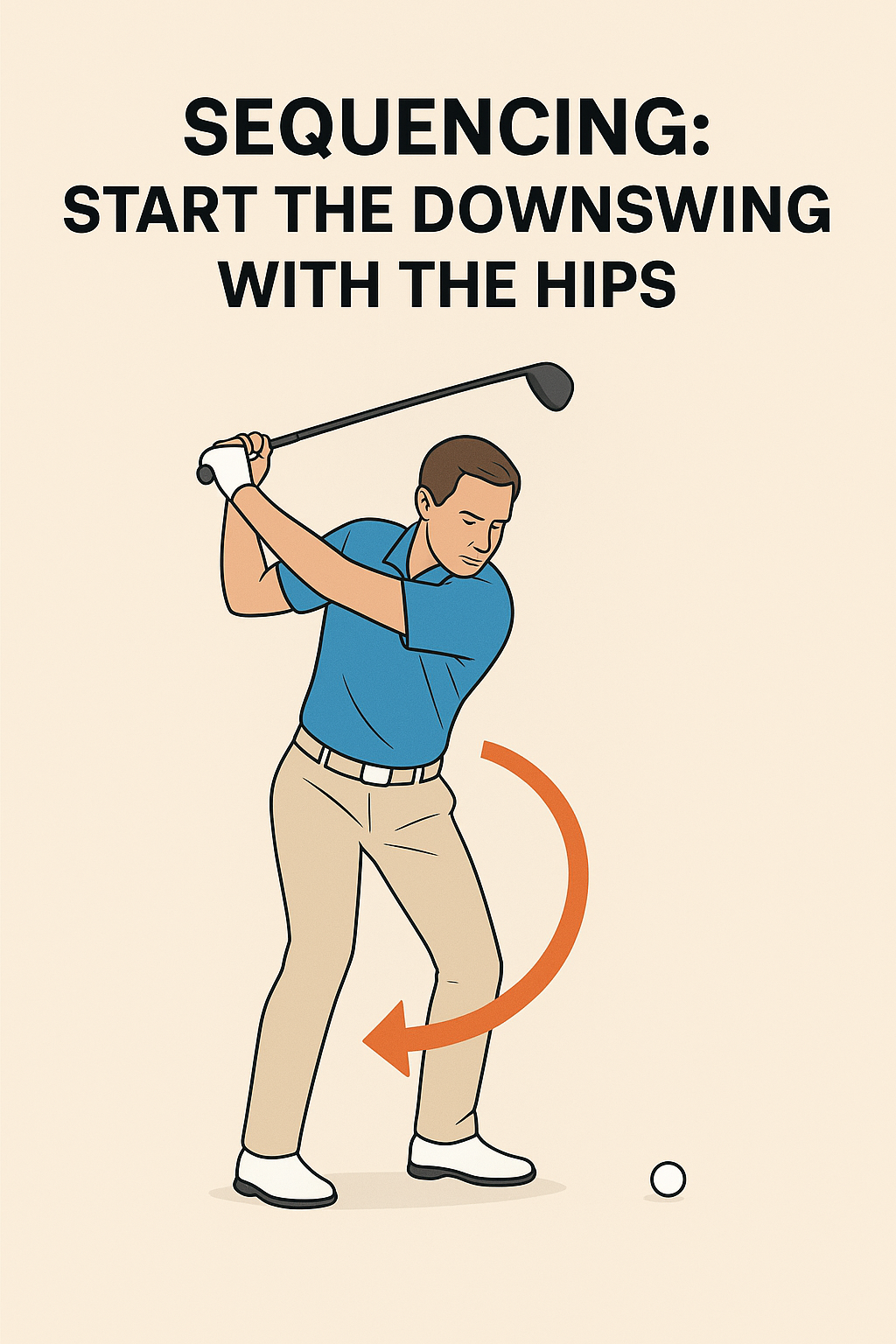
Sequencing: Start the Downswing with the Hips
As a PGA teaching professional, I see almost every consistent ball strike issue traced back to one thing: sequencing. In simple terms, sequencing is the order in which your hips, torso, and arms move during the downswing and through impact. When the lower body leads correctly, the arms and hands follow smoothly, and the clubface meets the ball on the intended line with solid contact.
What the concept is
- The ideal sequence begins with the hips, rotating toward the target first, then the torso, and finally the arms/hands. This creates a natural energy transfer from the ground up (a kinetic chain) that powers the clubhead.
- Maintaining posture and spine angle while this sequence unfolds is essential. If the upper body gets out ahead, the swing loses lag and contact quality suffers.
Why it matters to the golf swing
- Better contact and compression on the ball, resulting in more consistent ball speed and distance.
- More on-plane moves, reducing common misses like hooks, slices, and fat/thin shots.
- Improved balance through impact, making it easier to control direction and shot shape.
What you should feel when doing it correctly
- Feel your hips rotate toward the target first, as if you’re initiating the downswing with your belt buckle.
- Feel the chest and shoulders stay connected and stacked over your hips, not flying open too early.
- Feel weight shift toward the lead foot as you rotate, with your spine staying angled rather than collapsing toward the ball.
- Wrist hinge remains relatively intact until late downswing, so you don’t “cast” the clubhead early.
2–3 common mistakes golfers make with this concept
Mistake 1: Upper body leads the downswing; hips lag or stall
Fix: Initiate the downswing by rotating the hips toward the target first, then allow the torso to follow. Keep the chest quiet enough to feel the lower-body turn taking control.
How to feel it: On a practice swing, imagine you’re squeezing your belt buckle toward the target. Your shoulders and arms should naturally follow after a brief moment of hip-first movement.
Mistake 2: Early release / casting the wrists
Fix: Maintain the hinge in your wrists longer by delaying release until late downswing. Think “hold the angle” where appropriate, then release through impact.
How to feel it: Keep your lead wrist firm for a split second after you start the downswing, then allow a smooth release as the hips and torso complete their rotation.
Mistake 3: Swaying or reversing spine angle (over-rotation of the hips with backward tilt)
Fix: Rotate around a stable spine angle. Don’t let the head and upper body shift excessively away from the target; this disrupts sequencing and clubface control.
How to feel it: Maintain a tall posture from feet to shoulders and rotate the hips without letting your upper body collapse toward the ball or slide toward the ball line.
One easy practice drill you can do at home or on the range
- Step Drill (hip-first sequencing drill): Start with your feet together. Take a backswing as normal, then as you start the downswing, step toward the target with your lead foot while rotating your hips first. The step makes the hip-led sequence obvious and helps you feel the correct order.
- Practice slowly at first: 6–8 reps, then build speed while maintaining the same sequence. Focus on keeping your spine angle and resisting early arm movement.
Tip: Use a mirror or video yourself from down the line to verify that your hips rotate first, your torso follows, and your arms stay in control through impact. When sequencing is solid, your practice translates into more consistent, solid contact on the course.
Sequencing: Start the Downswing with the Hips
Why hip-first sequencing matters in the golf downswing
In a well-timed golf swing, the hips don’t just move—they initiate the kinetic sequence that carries energy from the ground up to the club. Starting the downswing with the hips creates a smooth transfer of torque through the pelvis, core, torso, and shoulders, leading to better lag, more consistent ball striking, and increased clubhead speed without overloading the arms.
- Optimal energy transfer: The hips set the direction and pace of the entire sequence, helping to load the ground-reaction forces efficiently.
- Cleaner arc and pronunciation of clubface: Hip initiation helps maintain spine angle and reduces early casting or flipping.
- Injury resilience: Proper sequencing reduces excessive stress on the wrists and elbows by balancing the load through the core and legs.
What is sequencing in the golf swing?
Sequencing refers to the order in which body segments contribute to the swing. The ideal kinematic sequence in a classic full swing resembles a chain: the legs and hips unload first, followed by the torso, then the arms and hands delivering the clubhead. When you “start the downswing with the hips,” you place the pelvis and lower body at the forefront of this chain to maximize timing and power.
Key concepts to understand
- Ground reaction forces: The feet push against the ground, and the hips convert this raw energy into rotational torque.
- Pelvis-to-torce ratio: Hip rotation should precede the torso rotation to preserve lag and avoid early uncocking.
- Torque transfer: The energy stored in your pelvis and core is released as you rotate through impact.
Biomechanics of hip initiation: how it effectively works
Understanding the biomechanics behind hip initiation helps you train effectively. The hips act as a hinge and a pivot point, guiding the lower spine’s angle and sequencing the turn from ground contact through to impact.
Pelvis rotation and weight shift
- On the downswing, the trail hip (the right hip for right-handed players) starts by rotating slightly inward and closing toward the target line while weight shifts toward the lead side.
- As hips rotate, the lead knee flexes modestly and the trail knee settles, promoting a stable base and stored rotational energy.
Core engagement and torso sequencing
- A connected core transfers the energy from hip rotation to the torso without excessive lateral movement.
- Excess torso early rotation can steal lag; hip-first sequencing maintains lag and helps the hands deliver the club at the right moment.
Hands, arms, and the club
- Only after the hips and torso are on their way should the arms release the club, producing a clean strike and solid impact.
Benefits of hip-initiated downswing
- Increased consistency: A reliable sequencing pattern reduces timing errors and improves strike quality.
- Higher clubhead speed: Efficient energy transfer from ground up adds speed without sacrificing control.
- Better on-center contact: Proper hip initiation helps align the body with the ball at impact.
- Versatility across clubs: Whether you’re hitting drivers or irons, hip-first sequencing adapts to various swing planes.
- Lower fatigue and reduced tension: A well-timed sequence minimizes overuse in the hands and forearms.
Common faults and how to fix them
Fault: Early arm-dominant downswing
Symptom: The arms move too soon, causing loss of lag and inconsistent contact.
Fix: Feel the hips initiating first by practicing slow-motion reps, focusing on hip rotation and weight shift before the arms accelerate.
Fault: Over-rotation of the hips without upper-body tempo
Symptom: Over-rotating hips can throw off the spine angle and produce a hook or fat shots.
Fix: Integrate a controlled torso turn after the hips begin; maintain a stable spine angle and avoid excessive lateral shift.
Fault: inadequate sequencing with short game or chips
Symptom: Hip initiation images don’t translate to the shorter swings; feel inconsistent impact.
Fix: Use limited-motion drills that reinforce hip-start cues in a compact arc, then apply to full swings gradually.
Drills to train hip-first sequencing
Ease into hip-first sequencing with drills that emphasize pelvic initiation, weight transfer, and torso timing. Practice with a mirror or video to confirm the sequence remains consistent.
| Drill | Focus | How to Do | Common Mistakes |
|---|---|---|---|
| Hip-Start Wall Drill | Pelvis initiation | Stand with your back toe touching a wall. from address,initiate the downswing by rotating the hips toward the wall while keeping the upper body quiet. | Arms rushing, hip rotation without spine angle control |
| T-Drill with Tempo | Kinematic sequence with tempo | Set up a T at belt height. slow-motion reps: hips start, then torso, then arms. increase speed only after the sequence remains clean. | Fast reps without sequence fidelity |
| shadow Swing with Weight Shift | Weight transfer and hip engagement | Without a club, practice a 3-step move: hip turn, weight shift to lead side, then reach through with hands as if striking a ball. | Stiff hips, no ground feel |
| Bedroom Lag Drill (With a Tee) | Maintaining lag through impact | place a small tee just outside the ball line. Initiate the downswing by hips, aiming to strike the tee with the club shaft lag intact. | Closing the clubface early or flipping |
First-hand experience: a practical case study
Player A, a 12 handicap, struggled with consistent contact and distance. After 6 weeks of a hip-first sequencing program, combined with the drills above and video feedback, the player saw measurable improvements.
- Average carry increased by 8-12 yards due to better contact and increased dispersion control.
- Clubhead speed rose by approximately 4–6 mph by preserving lag and improving sequencing timing.
- On-center hits improved from 48% to 65% across practice sessions,translating to more consistent ball flight.
Key takeaway: when the hips reliably initiate the downswing, the body remains connected through impact, which makes it easier to repeat your swing under pressure. Real progress comes from disciplined practice,honest self-evaluation,and drills that reinforce tasteful timing rather than brute force.
Practical coaching tips for on-course and practice submission
- Start each practice session with hip-first tempo reps at 50% effort to engrain the correct sequencing before hitting harder shots.
- Use video capture to verify that the pelvis leads the downswing and that torso rotation follows in a controlled manner.
- Integrate hip initiation into different shot shapes—draws, fades, and straight shots—to ensure the sequencing holds under varying club paths.
- During rounds, perform a speedy rehearsal just before stepping into the ball: a two-second hip rotation, a moment of weight shift, then swing through.
- Paint cues: “hips first, arms follow,” or “rotate from the floor up” to remind yourself of the sequence at impact.
Club-specific considerations
Different clubs may demand subtle adjustments in your sequencing cues, but the core idea remains the same: hip initiation should be the first move in the downswing nonetheless of the club you’re swinging.
- Drivers: Emphasize a smooth, powerful hip sequence to maximize distance while keeping the head still and the spine angle stable.
- Irons: A clean hip start helps maintain a shallow attack angle and consistent strikes more easily.
- Wedges: Short swings benefit from controlled hip initiation to preserve feel and precision around the greens.
Training progression and programming
A practical progression helps you internalize hip-first sequencing without becoming overwhelmed.
- Week 1–2: Hip initiation focus,15–20 minutes per session,slow tempo,50–60% effort.
- Week 3–4: Add torso sequencing cues, maintain hip-first trigger, 60–75% effort with feedback from video.
- Week 5–6: Full-speed practice with drills integrated into 18-hole play, assess consistency, and fine-tune cues.
Frequently asked questions
Is hip initiation suitable for beginners?
Yes, but beginners should start with very controlled movements, focusing on the feel of the sequence rather than speed. Build awareness of the hips moving first, then gradually add power.
Can hip-first sequencing help with injuries?
in many cases, yes.A well-coordinated hip-to-shoulder sequence reduces abnormal stress on the wrists and elbows by distributing load through the larger kinetic chain. Always consult a clinician if you have a history of injuries.
how long does it take to see results?
Most players notice improvements after 4–6 weeks of consistent hip-first practice, especially when combined with video feedback and targeted drills.
Notes for ongoing betterment
Sequencing is situational and personal. The hips should start the downswing, but you may need to adapt cues to your body type, swing plane, and club choice. The goal is repeatable timing, not a one-size-fits-all motion.
- Keep a neutral spine angle as you initiate with the hips.
- Remember to stay relaxed in the shoulders and grip; tension disrupts sequencing.
- Regularly check your tempo to avoid rushing the downswing—your hips want to move first, but not too quickly.