
Should You Putt, Chip, or Use a Hybrid From Just Off the Green?
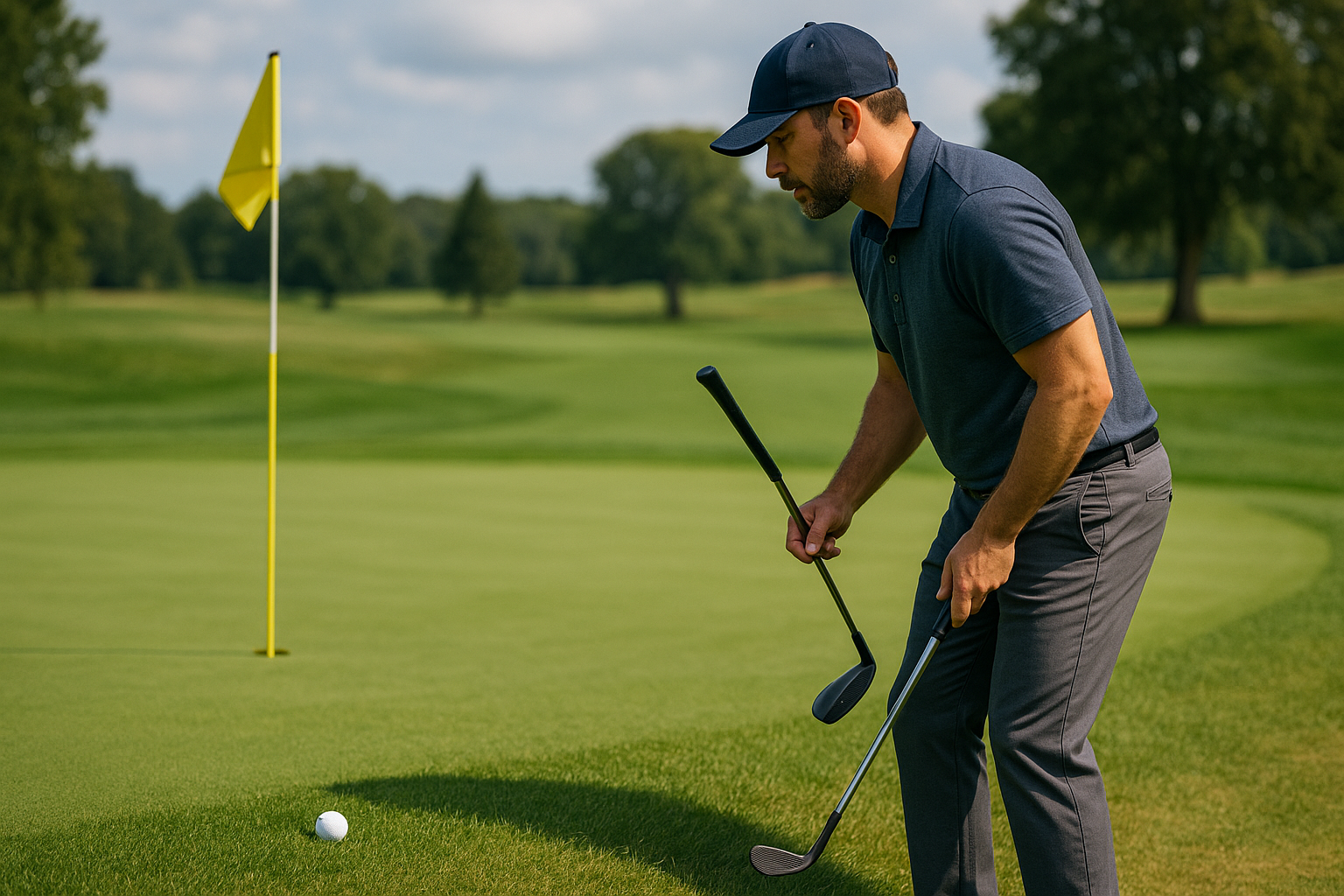
Your ball is sitting a few feet off the green. The grass is short, the flag is nearby, and you have several choices: putter, wedge, or perhaps a hybrid. Many golfers automatically grab a wedge, only to catch the ball thin, leave it short, or watch it race across the green.
From just off the green, the best club is usually the one that removes the most trouble. That often means choosing the simplest shot—not the most impressive one.
Start by Looking at the Ground
Before choosing a club, examine the lie and the path to the hole. You are trying to answer three questions:
- Is the grass around the ball short and even?
- Is there anything between the ball and the green, such as thick grass or a bare patch?
- How much green do you have available for the ball to roll?
If the ball is sitting cleanly and the ground is fairly level, a putter is often your safest option. If the ball is in light rough or you need to carry a small amount of fringe, a chip may be better. A hybrid can be useful when you want the ball to behave more like a putt but the lie makes putting difficult.
When the Putter Is the Best Choice
Use the putter whenever the ball is sitting well and you can get it rolling without crossing a problem area. A putt from just off the green is generally more predictable than a chip because the clubhead travels close to the ground and there is little chance of hitting the ball thin.
However, the fringe can slow the ball down. If your putter must travel through several inches of longer grass before reaching the green, allow for the ball to lose speed. A useful approach is to imagine the ball landing on the green a few feet beyond the fringe, then choose a pace that gets it there.
When a Chip Makes More Sense
A chip is a short shot designed to fly a little and roll a lot. Use one when the ball is sitting down, the fringe is too thick for a putter, or you need to carry over a patch of rough.
Choose a club with enough loft to lift the ball over the trouble, but avoid automatically reaching for your most lofted wedge. A pitching wedge, 9-iron, or 8-iron often produces a lower flight and more predictable roll.
The key is to pick a landing spot, not just stare at the flag. Decide where you want the ball to land, then let it roll like a putt from there.
Why a Hybrid Can Be Surprisingly Useful
A hybrid can work well from just off the green when the grass is slightly rough but the ground underneath is firm. Its wider sole helps it glide through the grass, and the low-lofted club sends the ball forward with a gentle, putting-like motion.
To play the shot, grip down slightly, place the ball near the center of your stance, and make a short putting-style stroke. Keep your hands quiet and avoid trying to lift the ball into the air. The hybrid’s loft will do that for you.
This shot is not ideal when you must carry over a bunker, rough, or a steep slope. It is best when there is a clear route to the hole and plenty of green for the ball to roll.
A Simple Practice Test
Next time you practice, place three balls just off the green and try three different clubs: putter, pitching wedge, and hybrid. Use the same target and count how many balls finish inside a three-foot circle.
Do not judge the shots by appearance. Judge them by distance control and how often they finish close. You may discover that your most reliable club is not the one you normally choose.
Common Mistakes to Avoid
- Using a wedge by default: More loft creates more chances for a poor strike.
- Ignoring the lie: Thick grass or a bare patch can change the correct shot completely.
- Landing the ball too close to the hole: Give the ball enough room to roll out.
- Trying to make a perfect swing: Around the green, a short, controlled motion is usually enough.
One Thing to Remember
Choose the club that keeps the ball on the ground for the longest time while avoiding trouble. From just off the green, the simplest shot is often the one that saves the most strokes.