
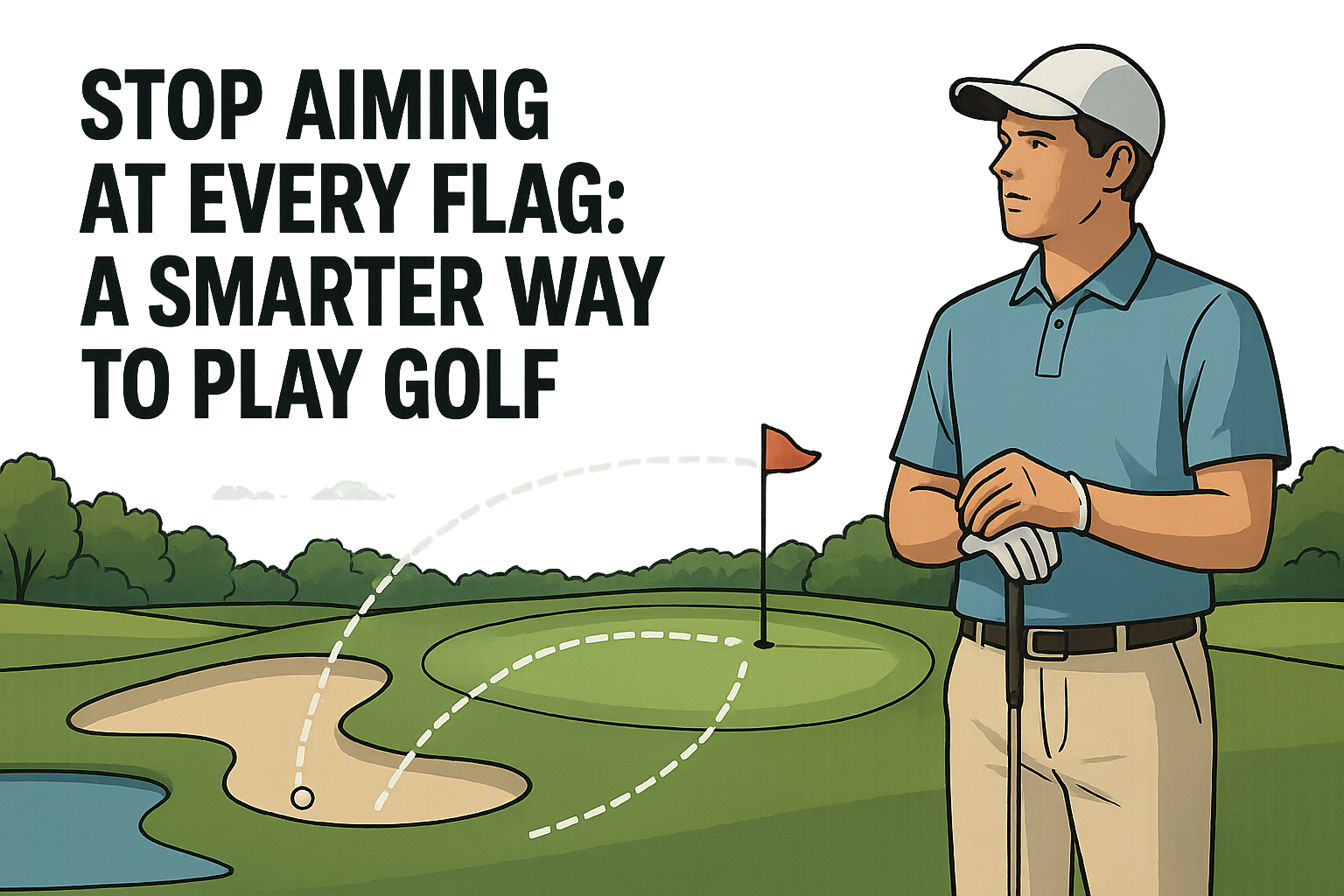
Stop Aiming at Every Flag: A Smarter Way to Play Golf
Have you ever hit a great-looking approach shot, watched it fly toward the flag, and then watched it finish in a bunker, hazard, or difficult rough? Many golfers assume the goal of every approach is to get as close to the hole as possible. In reality, smarter targets often lead to lower scores—even when the ball finishes farther from the flag.
What Is Targeting the Safe Side?
Targeting the safe side means choosing a landing area that gives you the best chance of avoiding trouble and leaving a manageable next shot. Instead of automatically aiming at the flag, you consider the entire hole:
- Where are the bunkers, water, and out-of-bounds areas?
- Which side of the green gives you the easiest chip or putt?
- Where is the flag located on the green?
- How much room do you have around the target?
For many approach shots, the safest target is the center of the green. This does not mean you can never attack a flag. It means you should earn the right to attack it when the risk is reasonable.
Why It Matters
Most beginner and intermediate golfers lose more shots through avoidable mistakes than through a lack of distance. Aiming at a dangerous flag can turn a simple approach into a difficult recovery—or even a penalty stroke.
Choosing a safer target can help you:
- Hit more greens or leave easier misses
- Avoid penalty strokes and short-sided chips
- Reduce the number of double bogeys
- Give yourself more realistic par and bogey opportunities
- Build confidence by making fewer reckless decisions
Remember that a 25-foot putt from the middle of the green is usually a better result than a 10-foot putt from beside a bunker—or a pitch from a downhill lie in thick rough.
How to Choose a Better Target
1. Find the trouble first
Before selecting your club, identify the places you absolutely do not want to miss. Look for water, deep bunkers, out-of-bounds, trees, and steep slopes. These hazards should influence your aim more than the flag does.
If the flag is tucked near the right edge of the green with a bunker beside it, aim toward the left-center. If the left side has a severe drop-off but the right side is open, favor the right.
2. Use the center of the green as your default
When you are unsure, the center of the green is a reliable target. It gives you the most margin for error and removes much of the pressure from the shot.
This is especially useful when:
- You are between clubs
- The lie is poor
- The wind is difficult to judge
- You are playing a course for the first time
- You need a steady hole after making a mistake
3. Consider the next shot
Do not judge an approach only by how close it finishes to the hole. Think about the shot that follows. A putt from below the hole is often easier than a downhill putt. A chip with plenty of green to work with is better than a short-sided chip where the ball must stop quickly.
Your best target is often the part of the green that leaves the easiest two-putt, not the shortest possible first putt.
Common Mistakes
The Mistake: Aiming directly at every flag
What Happens: A small miss can become a bunker shot, penalty, or difficult recovery.
Simple Fix: Pick your target after identifying the biggest hazard. If trouble is close to the flag, aim away from it.
The Mistake: Ignoring the pin location
What Happens: You may hit a technically good shot to the wrong part of the green and leave a difficult putt.
Simple Fix: Notice whether the flag is front, middle, or back, then choose a target that gives you room beyond or beside it.
The Mistake: Choosing a target that requires a perfect shot
What Happens: You add pressure and may make a poor swing trying to force the ball toward a small landing area.
Simple Fix: Choose a target that allows for your normal miss. Plan for the shot you usually hit, not the perfect shot you hope to hit.
Try This: The Center-of-Green Challenge
During your next round, choose three approach shots where you normally would aim at the flag. Instead, aim for the center of the green or the safest large section of it.
After each shot, record the result:
- Did you avoid a major hazard?
- Was your next shot manageable?
- Did you make a better score than usual?
Do not judge the strategy by whether you made a birdie. Judge it by whether you removed unnecessary trouble and gave yourself a realistic chance to finish the hole well.
One Thing to Remember
The goal is not always to hit the flag—it is to leave yourself the easiest next shot.