
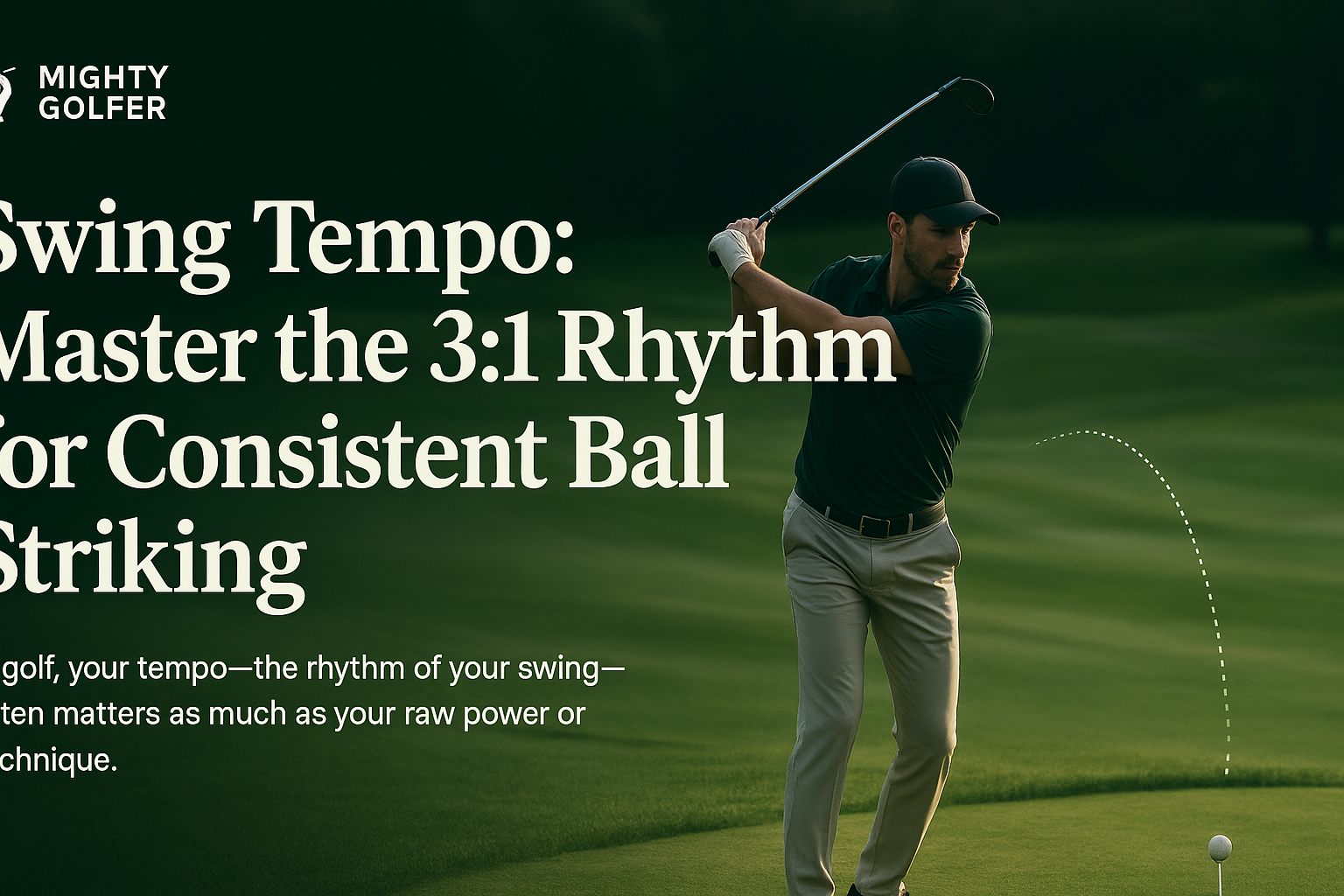
Swing Tempo: Master the 3:1 Rhythm for Consistent Ball Striking
In golf, your tempo—the rhythm of your swing—often matters as much as your raw power or technique. Focusing on a clear, repeatable tempo helps you deliver the clubface consistently, strike the ball more cleanly, and control distance. This post stays focused on one topic: swing tempo and the idea of a smooth, repeatable rhythm (a practical 3:1 feel) that beginner-to-intermediate players can adopt right away.
What the concept is
- Tempo is the timing balance between the backswing and the downswing. A simple, repeatable rhythm makes the club move efficiently through the hitting area.
- Many teachers advocate a rhythm near a 3:1 ratio: the backswing takes about three parts of the movement, the downswing about one part. The exact timing can vary by person, but the goal is a smooth, unhurried transition from takeaway to impact.
Why it matters to the golf swing
- Consistent tempo helps you arrive at impact with the clubface in a predictable position, which improves direction and contact.
- Good rhythm reduces the tendency to “hit at” the ball with the arms and instead promotes a coordinated turn of hips, torso, and arms.
- When your tempo is stable, distance control becomes more reliable because your releasing action and acceleration through the ball unfold smoothly, not erratically.
What the golfer should feel when doing it correctly
- You feel a calm, flowing motion from takeaway to impact—not a fast, jerky rush.
- Shoulders and hips rotate at a steady pace; the hands remain passive relative to the larger body movement.
- The downswing starts with the lower body (hips), not by “pulling” with the arms, and the club accelerates smoothly through the ball.
2–3 common mistakes golfers make with this concept
- Mistake 1: Rushing the downswing — the lower body doesn’t lead; the arms take over and you lose timing.
- Mistake 2: Backswing is too fast or too long — you over-swing, then try to “catch up” on the way down, which wrecks the 3:1 rhythm.
- Mistake 3: Inconsistent tempo from swing to swing — you’re sometimes smooth, sometimes hurried, especially under pressure or when swinging hard at a target.
Simple, actionable fixes for each mistake
- Pause briefly at the top and start the downswing with the hips rotating toward the ball. A small delay helps the arms stay connected to the larger whole-body rhythm.
- Slow the backswing to a comfortable, “three-beat” tempo. Think: take the club back steadily, pausing slightly at the top, then move into a decisive, one-beat downswing.
- Use a tempo cue during practice to lock in consistency. One reliable method is a four-beat cycle where the backswing covers beats 1–3 and the downswing begins on beat 4, repeated for 10–15 swings per set.
One easy practice drill you can do at home or on the range
- Pause-at-the-top with a 3:1 rhythm drill
- HOW: Take your normal stance and swing back to a comfortable top of the backswing. Pause for about 0.5 seconds at the top. Then start the downswing with a deliberate hip turn and allow the arms to release naturally through impact.
- DO: Repeat 10–15 reps, focusing on a calm, quiet transition from backswing to downswing. If you can, use a metronome set to a slow tempo (for example, around 60–70 BPM) and count a four-beat cycle (1–2–3–4) with each swing. Aim to have the downswing begin on beat 4 and complete smoothly by beat 1 of the next cycle.
- WHY: The pause trains your brain to respect the rhythm, and the metronome gives you a repeatable cadence you can carry to the course.
Progress with tempo comes from mindful repetition. Practice with intention, keep the feel of a steady, unhurried backswing, and let the downswing begin with your body’s rotation. Before long, you’ll notice more solid contact, cleaner ball flights, and more consistent distance—without trying harder.
Swing tempo: Master the 3:1 Rhythm for Consistent Ball Striking
What is the 3:1 swing tempo?
The 3:1 swing tempo is a rhythm guideline used by players across ball-striking sports to structure the sequence from the start of the backswing to the moment of impact. In a typical 3:1 tempo, the backswing unfolds over three equal time segments, followed by a single, distinct moment of impact. This creates a predictable rhythm that helps synchronize the body, the arms, and the club or bat, reducing tension and promoting a clean, repeatable strike.
Why the 3:1 tempo matters for consistency
- Improved timing: Breaking the swing into a clear 3:1 rhythm makes it easier to feel when the handle, wrists, and hips are in sync at impact.
- Reduced tension: A measured tempo lowers unneeded tension in the hands and shoulders, leading to crisper contact.
- Better distance control: consistent tempo translates into reliable swing speed, which helps with distance and dispersion control.
- More repeatable mechanics: A stable rhythm minimizes swing faults caused by rushing or stalling during the transition.
Key elements that define a 3:1 rhythm
- Backswing length versus downstrike: the backswing is three times the duration of the moment of impact (counting process or timing unit).
- Breath and pulse coordination: Slow, controlled breathing during the backswing helps maintain rhythm; a speedy exhale at impact keeps the body relaxed.
- Ground reaction and hip turn: The three-part backswing should prep a smooth,linear transfer of energy from the ground up through the hips and torso to the arms.
- Rhythmic cueing: Mental anchors like “back, back, back… strike” can reinforce the 3:1 timing when practicing alone or with a coach.
Practical drills to develop a reliable 3:1 tempo
drill 1: Metronome Back-and-Strike (3:1 request)
- Set a metronome or tempo app to a comfortable beat (start around 60 BPM; you can adjust as you progress).
- Count aloud: “Back, back, back, strike” aligning the three “back” cues with the three segments of the backswing and the “strike” cue with impact.
- Begin with half-swings in front of a mirror. Focus on feeling three equal micro-motions in the backswing before the impact cue.
- As you gain comfort, taper the backswing to full swings while maintaining the same three-count rhythm.
Drill 2: Countdown Drill with a pause
- Take your stance and address the ball. Use a countdown: 3 – 2 - 1 - strike.
- During countdown,keep your tempo smooth and relaxed; never rush back. The pause at the top should feel purposeful, not forced.
- repeat with gradual speed increases only after you are fully comfortable with the rhythm.
Drill 3: Slow-Motion Tempo with Video Feedback
- Record a few slow-motion swings focusing on the timing of the backswing and the instant of impact.
- Use a simple ruler or line on the screen to visualize the three segments of the backswing,ensuring they resemble equal durations.
- Identify any deviations-over-rotation, early release, or rushed transition-and correct them in the next set.
Drill 4: Feel-Based Tips to Lock in the 3:1 Rhythm
- Use a light grip pressure and breathe out on impact to keep the arms and shoulders relaxed.
- Feel the hips turning earlier in the backswing to create a smooth energy flow into the arms.
- Keep the head steady and eyes on the ball until after the strike-avoid lifting prematurely during the three-back phase.
Drill 5: efficiency Drill for All Sports
- For golf: Practice with a single-armed reach drill to emphasize the postural stability and controlled sequencing from the lower body to the hands.
- For tennis: Use a foam ball and light racquet to focus on the timing, ensuring three deliberate back movements before contact.
- For baseball/softball: Use a tee and a smaller bat to emphasize a compact,three-beat backswing followed by a crisp,decisive contact.
Common mistakes when learning the 3:1 tempo and how to fix them
- mistake: Rushing the backswing or impact.
- Fix: Slow down the initial phase; count out loud and reset if you feel rushed. Use longer backswing counts during early practice, then shorten gradually as control improves.
- Mistake: Inconsistent wrist hinge.
- fix: Maintain a slight but controlled wrist hinge during the backswing and release at impact in a timely manner aligned with the 3:1 rhythm.
- Mistake: Over-rotation and body movement that disrupts balance.
- Fix: Focus on stable leg drive and hips initiating the turn, with the upper body following in a controlled sequence.
- Mistake: Breath-holding during the swing.
- Fix: Practice nasal breathing during the backswing and light exhalation through impact to stay relaxed and precise.
First-hand experiences: real-world insights from players who adopted 3:1 tempo
Players across golf, tennis, and baseball have reported tangible improvements after committing to a 3:1 rhythm. Here are several summarized anecdotes and practical takeaways:
“I used to feel like I was rushing the moment of impact. After incorporating the 3:1 tempo with a metronome, contact became noticeably cleaner and more repeatable.The rhythm gave me a reliable timing cue, and the ball started going straighter more consistently.”
– Golf enthusiast, mid-40s
“In tennis, rhythm matters as much as power. The 3:1 approach helped me balance my forehand timing with smoother racquet acceleration. My shots became more predictable and depth control improved.”
– Weekend tennis player
“baseball swings can get hurried, especially with high-velocity pitches. the 3:1 tempo gave me a mental framework to separate my loading phase from the swing, leading to cleaner contact and fewer weak hits.”
– Recreational baseball player
Tempo progression plan: how to practice over weeks
- Week 1-2: Establish the 3:1 concept with metronome drills and slow, controlled backswing; focus on rhythm clarity rather then power.
- Week 3-4: Introduce full swings at a comfortable pace; move from a single sport to cross-training with minor adjustments for the specific sport.
- Week 5-6: Increase real-swing practice with full speed targets; monitor contact quality, ball flight, and consistency.
- Ongoing: Use video feedback monthly to refine timing, while maintaining a consistent tempo in practice and competition.
Tempo training plan table for quick reference
Use this as a quick-reference guide to align your practice sessions with the 3:1 rhythm.The values are guidelines; adjust to your comfort and sport-specific needs.
| Sport | Backswing duration (approx.) | Impact duration (approx.) | Recommended tempo range (BPM) | Notes |
|---|---|---|---|---|
| Golf | 3 units | 1 unit | 50-70 | Prioritize smoothness; feel the three-beat backswing. |
| Tennis | 3 units | 1 unit | 60-90 | Balance racket path with a confident impact cue. |
| Baseball/Softball | 3 units | 1 unit | 60-80 | Compact swing, quick but controlled contact. |
How to measure progress and know you’re improving
- Track contact quality: consistent solid hits vs.off-center contact.
- Monitor dispersion: reduced miss-miles and tighter shot patterns with similar power.
- Use video compare: side-by-side with an ideal 3:1 rhythm to visualize the pace of the backswing and the moment of impact.
- Record feel notes: what does the backswing “feel like” compared to the impact? A clear,repeatable sensation is a strong indicator of progress.
Advanced tips: integrating 3:1 tempo with athletic training
- Breathing mechanics: Use a controlled exhale through impact to sustain rhythm and reduce tension. A calm exhale aligns with the moment of contact and the brief pause after impact helps reset for the next swing.
- Core and leg engagement: Develop a stable base by integrating planks and rotational core work. A solid trunk supports the timing of a three-beat backswing and clean contact.
- Grip pressure: Maintain light grip pressure in the backswing; avoid squeezing during the 3:1 cycle. Excess grip pressure disrupts timing and creates stiffness.
- Visual and cognitive cues: Use a simple cue like “3 to 1” or a physical marker (alignment stick) to remind yourself of the rhythm during practice and competition.
Case studies: adapting the 3:1 tempo across sports
Case studies illustrate how the 3:1 rhythm translates across different contexts:
- : A teaching professional integrated the 3:1 tempo into initial lessons with beginners and observed faster acquisition of repeatable swing paths, especially for players who struggled with early or late timing.
- Club competition: A tennis player who adopted a 3:1 cadence reported improved forehand reliability under pressure, particularly when strings were under heavy stress during rallies.
- Local baseball program: Youth batters who practiced the 3:1 rhythm demonstrated improved swing consistency and better pitch-to-pitch timing, contributing to a higher on-base percentage after several weeks of training.
Frequently asked questions (FAQ)
Is 3:1 tempo rigid,or can it be adjusted?
The 3:1 tempo is a guideline,not a rigid rule. It provides a framework for rhythm and timing. Depending on individual differences in height, flexibility, and strength, you may slightly adjust the duration of the backswing while preserving the overall 3:1 feel.
Can I use a longer backswing and still maintain a 3:1 rhythm?
Yes, but ensure the three-beat rhythm remains proportional to the hit. If the backswing becomes too long, it may lose it’s musicality and balance. Aim for a smooth, controlled three-part backswing with a decisive, compact impact.
How long does it take to master the 3:1 tempo?
Most players begin to notice improvements within 4-6 weeks of consistent practice,especially when combining tempo drills with video feedback and mindful execution. Progress varies based on prior technique and training frequency.
Conclusion-free closing note: focusing on the rhythm that fuels your swing
Mastering the 3:1 swing tempo is about building a reliable rhythm that aligns your body,your club,and your intention at impact. By practicing with metronome-based drills, countdowns, slow-motion analysis, and sport-specific applications, you establish a repeatable cadence that translates to consistent ball striking. Whether you’re refining a golf swing, sharpening a tennis stroke, or improving a baseball swing, the 3:1 rhythm provides a clear, actionable path toward better contact, greater confidence, and more predictable outcomes on the course, court, or field.