
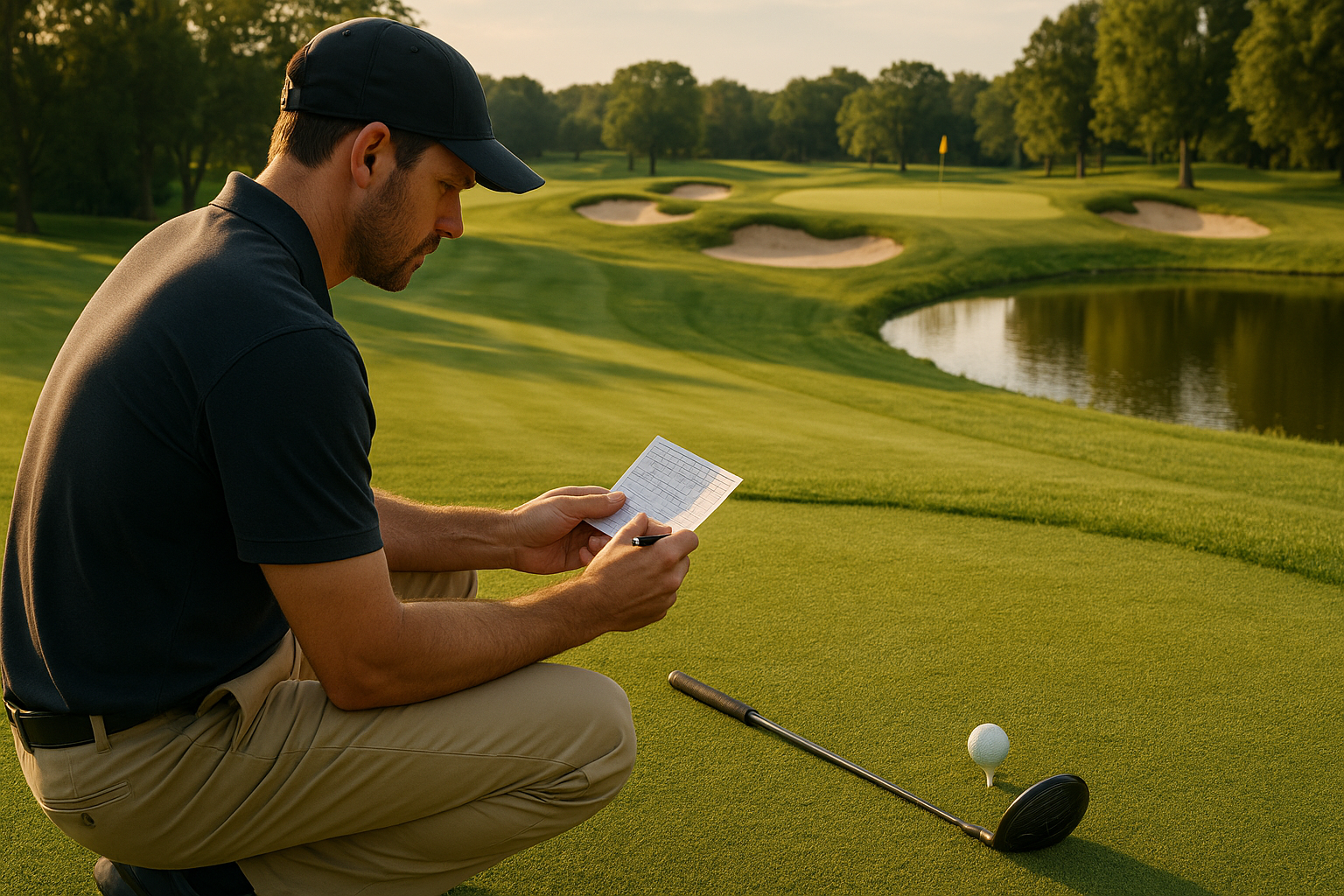
The One-Minute Scorecard Plan That Can Save You Strokes Before You Tee Off
Many golfers study the scorecard only after the round, when they are adding up the damage. Try using it before the round instead. A quick look at each hole can help you avoid the one bad decision that turns an ordinary hole into a double or triple bogey.
You do not need a detailed strategy for every shot. You only need to identify where trouble is most likely and decide what you will do before standing over the ball.
Find Your “No Big Number” Holes
Look over the scorecard and mark two or three holes that deserve extra caution. These might be:
- A narrow par 4 with out-of-bounds close to the fairway
- A par 5 with water near the layup area
- A short hole with a deep bunker beside the green
- A hole where the green slopes sharply toward trouble
- A long hole that you cannot realistically reach in regulation
These are not necessarily the hardest holes by handicap rating. A hole can be relatively short but still create problems if the penalty area is in exactly the wrong place for your usual miss.
The goal is to decide: What is the easiest way for me to make bogey here if something goes wrong?
Choose a Safe Miss Before You Choose a Club
Most golfers choose a club first and think about danger second. Reverse that process.
Suppose a par 4 has water along the right side and plenty of room left. If your normal miss is a slice, driver may bring the water into play. A three-wood, hybrid, or even an iron might leave you farther from the green, but it can keep your ball in play.
That does not mean you should always hit the shortest club. It means the club should match the hole and your current shot pattern.
Ask yourself three questions:
- Where is the worst place to miss?
- Where is the safest place to miss?
- Which club gives me the best chance of avoiding the worst place?
Notice that this is different from simply asking, “What is the longest club I can hit?”
Plan the Hole in Sections
For each trouble hole, break the strategy into small decisions.
Off the Tee
Pick a target that gives you room for your common miss. If you tend to hit the ball left, do not aim at the left edge of the fairway just because the pin is on the left. Start the ball toward the safer side and accept a less aggressive angle.
For the Approach
Look at the green as a whole, not just the flag. Decide which half of the green is safest. If the flag is tucked near a bunker or water, aim toward the middle or opposite side.
A shot that finishes 35 feet from the hole is usually much better than a shot that finishes in a hazard five feet from the hole.
After a Poor Shot
Have a recovery rule ready. For example:
- If the ball is blocked by trees, pitch back to the fairway.
- If you cannot reach the green without carrying trouble, lay up.
- If the ball is in a difficult lie, choose the club that gets the ball safely advancing.
This prevents you from inventing a hero shot under pressure.
Try This Before Your Next Round
Before teeing off, spend one minute marking three holes on the scorecard. For each hole, write one short note such as:
- “Hybrid, miss left.”
- “Middle of green.”
- “Lay up short of water.”
- “Bogey is fine.”
Keep the notes simple enough to remember. You are not creating a professional yardage book. You are giving yourself a decision before emotions and pressure arrive.
During the round, follow the plan unless the conditions change significantly. A strong wind, unusual lie, or temporary pin position may require an adjustment, but do not abandon a sensible strategy just because you feel eager to attack.
One Thing to Remember
Before choosing the shot you want to hit, decide where you cannot afford to miss. Avoiding one penalty or disastrous recovery each round can save more strokes than chasing a few extra birdie chances.