
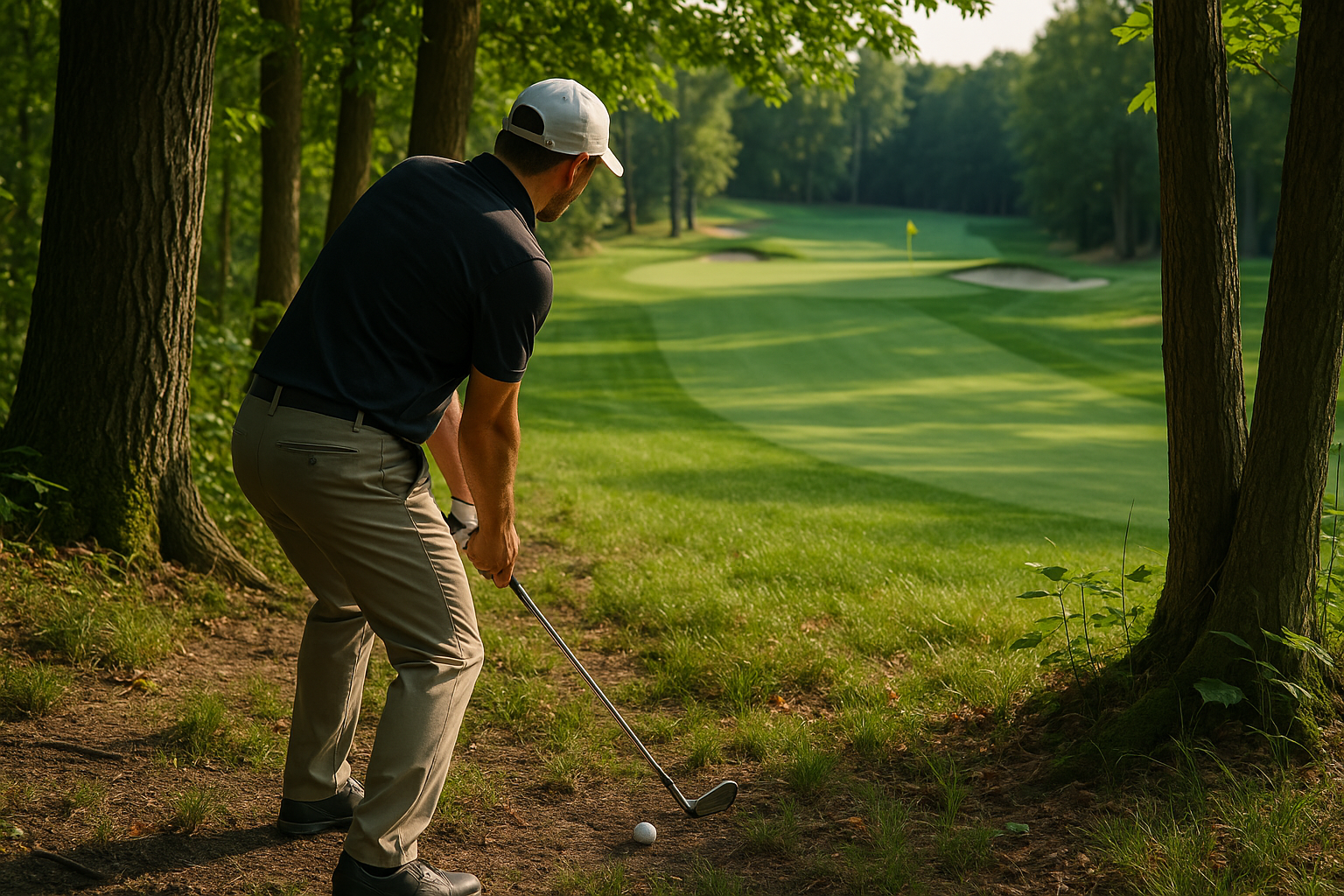
The One Question to Ask Before Trying a Hero Shot
Your tee shot has disappeared behind a wall of trees. The green is visible through a narrow gap, and somehow the flag looks closer than it really is. You can see the shot in your mind: a low, curving recovery that lands safely on the putting surface.
But before you reach for the longest club in your bag, ask one question:
“What is the worst realistic result if I miss?”
This simple question can save more strokes than another hour of range practice. It helps you decide whether a risky recovery shot is worth attempting—or whether the smarter play is to take your medicine and keep the hole alive.
Why Hero Shots Cause Big Numbers
A difficult recovery often looks easier than it is because you focus on the opening instead of everything surrounding it. You may have a six-yard gap between trees, but the ball still has to start on the correct line, curve the right amount, fly under branches, and stop near the target.
Even if you hit the shot well, the result may not be good. A low punch could roll through the green, find another bunker, or leave you with an even harder pitch. A high shot might clip a branch and come straight back to your feet.
The biggest mistake is judging the shot by its best possible outcome. Good course management judges it by the likely outcome and the damage caused by a miss.
Use the “Miss Test”
Before choosing a recovery shot, quickly consider three possible results:
- Best case: Where does the ball finish if everything works?
- Most likely case: What usually happens when you attempt this shot?
- Worst realistic case: Could the ball go out of bounds, hit a hazard, or force you to play another recovery shot?
If the worst realistic result is another difficult shot, a lost ball, or a penalty, the hero shot probably does not deserve your attention—especially when you are still early in the hole.
On the other hand, if a missed attempt simply leaves you in the same general area, the risk may be acceptable. The key is not avoiding every risky shot. It is understanding the price of failure.
Look for the “Wide-Side” Recovery
When you decide not to attack the green, do not automatically hit backward toward the fairway you just left. Instead, find the largest safe area that gives you a reasonable next shot.
For example, if the green is blocked by trees on the right, the fairway may open up to the left. A low punch toward that space could leave you 80 yards from the green instead of 30 yards behind a tree. That may feel like giving up, but it often gives you the best chance to make bogey—or even save par.
Choose a target that:
- Has plenty of room on both sides
- Keeps the ball away from hazards and out-of-bounds areas
- Leaves a shot you are comfortable hitting next
- Does not require perfect contact or extreme curve
A Simple On-Course Decision Routine
When you are stuck, take 20 seconds and follow this routine:
- Stand behind the ball and identify the safest direction.
- Check for trees, branches, hazards, out of bounds, and awkward lies.
- Ask what happens if you miss the intended shot.
- Pick the club that reaches the safest area—not necessarily the green.
- Commit fully to that conservative target.
That last step matters. A smart decision does not help if you make a nervous swing while hoping the ball somehow finds the target. Pick the safe shot, then play it with confidence.
Try This Practice Exercise
During your next nine holes, make a note every time you face a recovery decision. Write down whether you attacked, played sideways, or chose a safer angle. Then record the result.
After the round, compare the decisions—not just the scores. You may discover that your “boring” recovery shots regularly leave you with manageable bogey putts, while aggressive attempts create double bogeys and penalty strokes.
One Thing to Remember
Do not judge a recovery shot by how good the best result looks. Judge it by how much trouble the worst result creates. When the penalty for missing is severe, the safest route is often the most aggressive way to protect your score.