
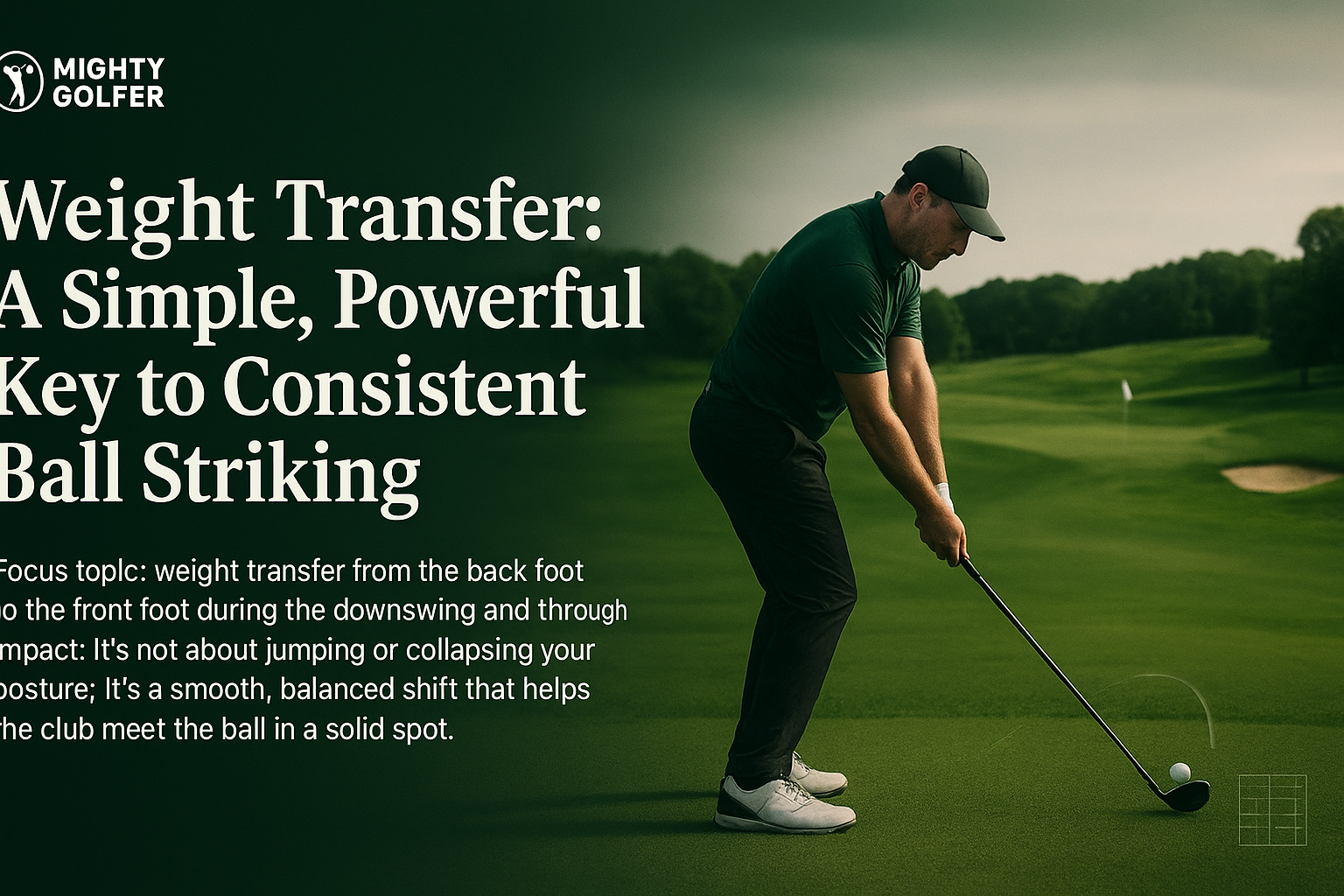
Weight Transfer: A Simple, Powerful Key to Consistent Ball Striking
Focus topic: weight transfer from the back foot to the front foot during the downswing and through impact. It’s not about jumping or collapsing your posture; it’s a smooth, balanced shift that helps the club meet the ball in a solid spot.
What the concept is
Weight transfer is the deliberate movement of your body weight from the trail leg (the back leg) toward the lead leg (the front leg) as you swing down and through the ball. Proper transfer keeps your spine angle intact, allows the hips and torso to rotate, and helps the hands release the club at the right moment.
Why it matters to the golf swing
- Promotes solid contact by ensuring contact happens with the center of the clubface.
- Helps you compress the ball and maintain a consistent strike pattern instead of thin or fat shots.
- Supports a controlled release, distance, and accuracy by coordinating lower-body movement with the upper body.
- Maintains balance through impact, reducing over-rotation or excessive swaying.
What the golfer should feel when doing it correctly
- During the downswing, you feel your weight gradually move off the trail foot and onto the lead foot.
- Lead foot pressure increases as you approach impact, while the trail knee softens and stabilizes.
- Your hips and chest rotate toward the target in sync with the weight shift, and your head stays relatively steady over the spine.
- Finish with most of your weight on the lead foot and a balanced, comfortable pose.
2–3 common mistakes golfers make with this concept
- Staying back on the trail foot at impact, so weight never fully shifts toward the target.
- Shifting weight too early in the downswing, which robs the swing of timing and leads to fat shots.
- Excessive lateral slide or swaying, which disrupts spine angle and alignment.
Simple, actionable fixes for each mistake
- Staying back: Use the cue to “push off the trail foot gently” and “feel the lead foot start to carry the rhythm.” A towel under the lead armpit can reduce upper-body sway and keep the lower body moving first. Practice with a small step drill to train forward weight shift (see drill below).
- Early weight shift: Emphasize loading into the back leg on the backswing and unloading toward impact. Keep hips quiet until the club reaches the bottom of the swing. A step drill helps by forcing a controlled, timed transfer rather than a push-forward before contact.
- Swaying: Stand with your back against a wall or place a light object at hip height behind you to remind yourself not to slide laterally. Maintain a stable spine angle by keeping eyes on a fixed point and focusing on feeling the chest turning toward the target rather than moving the torso too far sideways.
One easy practice drill you can do at home or on the range
Step-Through Drill (great for training the transfer sequence):
- Stand with feet close together, weight balanced.
- Take a short backswing, then as you begin the downswing, step your lead foot forward toward the target.
- Finish with most of your weight on the lead foot and the trail foot relaxed behind you.
- Repeat for 2–3 sets of 8–12 swings, focusing on a smooth, gradual weight shift rather than a quick jump or slide.
Tip: start with a mid-iron and swing at a comfortable tempo. As you feel the transfer more clearly, gradually increase speed while preserving the sense of weight moving forward through impact.
Weight Transfer: A Simple, Powerful Key to Consistent Ball Striking
Weight transfer is more than shifting your body.It’s a precise,rhythmic sequence that connects your setup,your swing,and your contact point with the ground. When you master weight transfer, you’ll notice cleaner contact, more speed through the ball, and tighter dispersion. this article breaks down what weight transfer really is,why it matters for consistent ball striking across sports,and how you can train it with practical drills,cues,and real-world examples.
Understanding weight transfer in diffrent sports
Although the specifics vary by sport, the underlying principle is the same: your body must move weight efficiently from the back side toward the forward side at the right moment to maximize energy delivery to the ball.Here’s how it looks in a few common ball-striking disciplines:
- Golf: The swing starts with your weight stored on the trail foot. At or just before impact, you shift onto the lead foot, using ground reaction forces to accelerate the clubhead through the ball.
- Tennis: A accomplished groundstroke uses a sequence that moves from the back foot through the middle of the stance,then to the front foot,timing hip rotation and shoulder alignment to boost racket speed at contact.
- Baseball/Softball: Hips and shoulders rotate in a controlled order while the weight moves forward, enabling a powerful, consistent swing path through the ball.
- Other contexts: In sports like field hockey or lacrosse, a clean weight transfer helps with stick or shaft speed and ensures the pad of the contact point meets the ball with the intended angle and speed.
Why weight transfer matters for consistent ball striking
Consistency in ball striking comes from repeatable mechanics. When weight transfer is well-timed and balanced, you get:
- Better contact quality: Moving weight forward helps the club or racket meet the ball near the sweet spot and reduces mishits.
- Increased clubhead or bat speed: The ground reaction force generated by a intentional weight shift adds momentum without forcing the body to overwork.
- Improved accuracy and dispersion: A controlled weight transfer stabilizes the swing plane,reducing wobble on off-center hits.
- Reduced injury risk: Proper sequencing protects the joints by distributing load through the kinetic chain rather than concentrating it in a single joint.
- Greater consistency under pressure: In competitive situations, repeatable weight transfer helps you maintain rhythm and timing despite nerves or fatigue.
The science behind weight transfer in swing
Weight transfer is rooted in fundamentals of biomechanics and physics. here’s what to know in plain terms:
- Center of mass and balance: Your body’s center of mass shifts as you transfer weight. Maintaining upright posture and a stable trunk helps you control this shift rather than letting it wobble.
- Ground reaction force (GRF): The force the ground exerts upward on your body, especially the trail foot pushing off the ground, powers the acceleration of the swing. Efficient transfer uses this force to propel the ball forward.
- Sequencing and timing: The kinetic chain-feet, ankles, knees, hips, core, shoulders, arms-must work in a coordinated sequence. Poor sequencing can waste energy and degrade contact.
- Angular momentum: Early weight shift sets the hips and torso to rotate in a way that preserves angular momentum, helping you deliver speed through impact without sacrificing control.
Common mistakes and how to fix them
New movers frequently enough stumble on weight transfer. Here are frequent issues and practical fixes:
- Hanging back (too much weight on the trail side at impact): Start with a slightly wider base and feel the front foot engage pressure earlier in the swing. Practice with slow, deliberate tempo to train the sensation of transferring forward.
- Rushing the front foot without loading the trail leg: Focus on the loading phase-imagine your trail knee quietly buffering energy before it moves toward the lead foot.
- Early extension or loss of spine angle: Maintain posture by keeping your head steady over the ball and using core activation to stabilize your spine during the transition.
- Over-rotation without forward weight shift: pair hip rotation with a purposeful forward weight transition; avoid spinning without driving weight toward the target.
- inconsistent tempo: Use a rhythmic tempo (e.g., 3:1 or 2:1 swing-to-impact ratio) to synchronize weight transfer with swing speed.
Benefits and practical tips
- Better ball compression: As weight moves forward, contact is more centered, often resulting in crisper feel and better feedback from the clubface or racket.
- Improved distance control: Efficient transfer unlocks more energy at impact without over-swinging,which helps with both distance and control variation.
- Adaptability across surfaces: Ground reaction forces differ by surface, but sound weight transfer remains a reliable cue across turf, court, or field.
- Scalable for all skill levels: Beginners can learn the basic sequence, while advanced players refine timing and load distribution for even greater consistency.
- Injury prevention: Balanced loading protects the lower back, knees, and shoulders by distributing stress more evenly along the kinetic chain.
Drills and practice routines
These drills emphasize feel, pace, and balance. Practice them slowly at first, then gradually increase speed as your control improves.
Drill 1: slow-Mo Weight Shift (Golf/Tennis/Batting)
- Stand with feet shoulder-width apart, light knee bend, and a slight forward tilt from the hips.
- Without hitting a ball,slowly shift weight from the back foot to the front foot while maintaining posture and a steady trunk. Hold for 2-3 seconds at the point of maximum forward weight.
- Return to the starting position with a controlled, deliberate reverse motion. Focus on keeping contact points consistent with the ball’s intended contact spot.
Drill 2: Step-Through Progression
- Place a soft target on the ground about 6-8 feet ahead of you.
- Begin with your weight on the trail foot. Step forward with your lead foot, transferring weight through the step and finishing with the chest facing the target.
- Repeat in a continuous cycle, focusing on a smooth, even transfer rather than speed.
Drill 3: Stop-and-Feel Balance Drill
- Perform a half-swing or light contact with a short club or racket.
- In the moment of impact, pause for a breath and feel the balance shift from trail foot to lead foot.
- Resume with the next attempt, trying to replicate the same balance feel.
Drill 4: Ground Reaction Footwork
- set up a line of taped markers or cones across your stance. Begin with light steps to the line, placing emphasis on weight transfer through each step.
- Progress to a short, controlled swing after each step, ensuring the weight shift aligns with the swing mechanics.
Case studies: real-world examples of weight transfer in action
Below are concise, anonymized case studies illustrating how deliberate weight transfer improvements translated to better performance. These are representative examples you might encounter in coaching sessions or on practice grounds.
| Sport | Athlete | Focus Area (Weight Transfer) | Outcome |
|---|---|---|---|
| Golf | Amateur male, 20 handicap | Improved trail-to-lead weight shift timing during impact; emphasized early loading of the back knee and a steady trunk | |
| Tennis | Female junior, U14 | Consistent transfer of weight through the rally; avoided falling back on the back foot during forehands | |
| Baseball | Club player, 12-year-old | Balanced weight transfer during the swing with a more direct path to contact |
First-hand experience: coaches and players share insights
Practitioners often report that the simplest cues yield the biggest changes in weight transfer performance.Here are some succinct, practical insights from real-world coaching conversations:
- Coach insight: “Think of weight transfer as a forward-leaning push rather than a spin of the hips. The momentum should feel like a controlled forward drive, not a quick sideways shuffle.”
- Player outlook: “When I focus on keeping my chest over the ball a beat longer, my momentum carries me smoothly into impact rather of dumping energy on the trail foot.”
- Coach tip: Use tempo bands (e.g., 3-count swing, 1-count impact) to rhythmically coordinate weight shift with the swing arc.
Practical cues: quick reference for players and coaches
- Load then explode: Load weight on the trail foot during the backswing, then explode forward through impact.
- Lead with the hips, not the arms: Initiate momentum from the hips while allowing the arms to follow, ensuring the hands meet the ball in line with the body’s rotation.
- stay centered: Keep your head and torso over the midline; avoid too much side-to-side sway.
- Ground contact as feedback: Feel the pressure shift through the soles; a smoother transition often mirrors better contact.
- Drill a smooth tempo: Use a metronome or a counting rhythm to internalize consistent timing between loading and release.
Drills at a glance: quick-reference table
| Drill | What it trains | How to perform |
|---|---|---|
| slow-Mo Weight Shift | Forward weight transfer, posture control | Shift weight slowly from back foot to front foot; hold briefly at peak forward weight, then return |
| Step-Through Progression | Sequencing, balance, forward weight transfer | Step forward with lead foot, transfer weight through the step, finish facing the target |
| Stop-and-Feel Balance | Contact stability, balance at impact | Make light contact, pause, feel balance shift to lead foot, resume |
Putting it all together: a simple 6-step routine
- Set up with a solid base and balanced posture.
- Weight rests on the trail foot in the backswing.
- initiate the forward transfer as you begin the downswing,engaging the hips and core.
- Keep contact points consistent and allow the hands to follow through toward the ball.
- Finish with weight fully transferred to the lead foot and a stable, balanced finish.
- Review impact feedback (ball flight,contact quality) and adjust drill focus accordingly.
Common questions about weight transfer
- Is weight transfer the same as transfer of weight in the feet? It’s related, but weight transfer encompasses how you load your legs, hips, and torso to generate energy efficiently, not just how your feet move.
- Can I overdo weight transfer? Yes. Excessively rushing forward or leaning too aggressively can disrupt swing plane.the goal is controlled, timed transfer that aligns with your natural tempo.
- Does equipment matter? Shoes with appropriate grip, properly fitted clubs or rackets, and court or field surface conditions can influence how smoothly you can transfer weight and maintain balance.
Technical tips for different sports
- Golf: Focus on a slight knee flex in the backswing, then a smooth, down-sequence shift. Avoid lifting the head too soon; keep eyes on the ball through contact.
- Tennis: Use the split-step as a cue to initiate weight transfer, then drive through the shot with a stable base.
- Baseball/Softball: Emphasize hip rotation coupled with forward weight transfer to prevent the barrel from dragging behind.
Measurement and feedback: how to monitor progress
While professional analysis is ideal, there are practical, low-cost ways to gauge progress at home or on the practice ground:
- Record slow-motion swings or hits to observe how your weight shifts from back to front and how your trunk rotates.
- Balance checks: Use a simple balance drill-stand with one foot, perform a short swing, and notice how your balance holds or shifts.
- Contact quality: Track improvements in center hits, even dispersion, and solid contact signs like a consistent sound or feel at impact.
- Tempo consistency: Listen for a steady rhythm in your swing or stroke and adjust until the cadence becomes uniform.
Conclusion (not a separate section): integrating weight transfer into your daily practice
To make weight transfer a true habit, weave practical cues and drills into your routine. Start with slow, deliberate practice to embed the sequencing, then gradually raise tempo as your control improves. Whether you play golf, tennis, baseball, or any other ball-striking sport, consistent weight transfer is a simple, powerful key that unlocks reliable contact, speed, and accuracy. By understanding the science, avoiding common mistakes, and following a structured practice plan, you’ll build a repeatable, athletic transfer that transfers directly into better performance on the field, court, or course.