
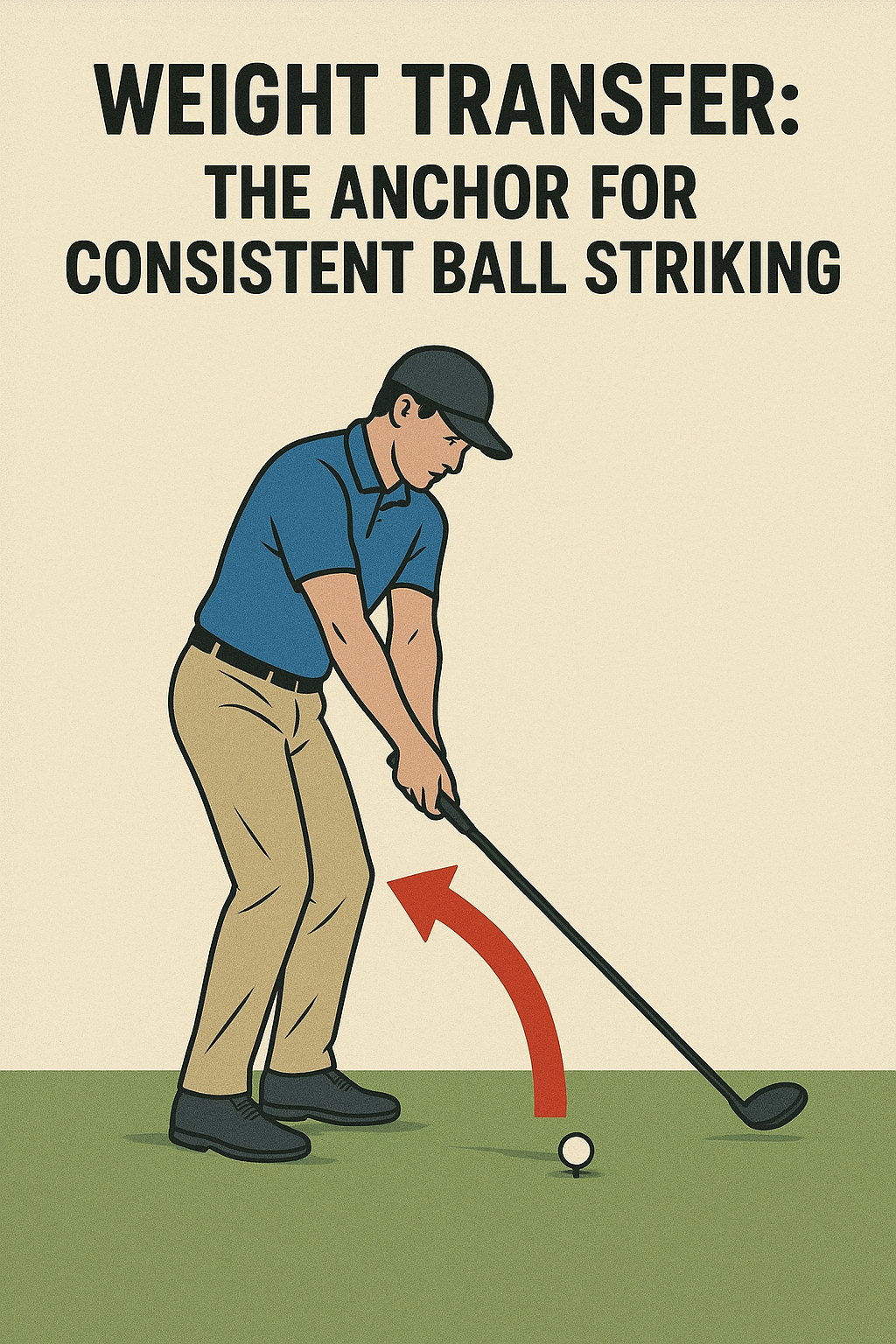
Weight Transfer: The anchor for consistent ball striking
In your golf swing, how your weight moves from your back foot to your front foot through impact largely determines how cleanly you strike the ball. When you master this single concept, you’ll notice tighter contact, better distance control, and a more stable finish—even on off-center hits.
What the concept is
- Weight transfer means shifting your body’s center of mass from the trail (back) foot to the lead (front) foot as you swing through the ball, especially from late backswing into impact. Think of it as a controlled slide of weight rather than a jump or a stumble.
- It helps maintain spine angle and balance, preserves lag in the downswing, and delivers the clubface to the ball with solid timing.
Why it matters to the golf swing
- Better contact: a gradual, forward transfer makes it easier to strike the ball on the center of the face.
- More distance consistency: predictable weight shift reduces fat (hitting it thin) and blocks (pushing it right for right-handers).
- Improved direction control: finishing with weight onto the lead foot helps the clubface square up at impact.
What the golfer should feel when doing it correctly
- Mid-swing feeling of pressure across the inside of your lead foot (left foot for right-handed players) as you approach and through impact.
- A slight, athletic “step” of the lead foot as you rotate toward the target—without hopping or sliding your head forward.
- Spine angle stays mostly constant; you rotate around your spine rather than leaning toward the ball.
2–3 common mistakes (and quick fixes)
- Mistake 1: Weight stays on the back foot through impact, so the shot lacks power or ends up short.
- Fix: Feel a gradual shift into the lead foot as you approach impact. Practise with a small step forward after contact to reinforce the transfer. Keep your head steady and your lead knee slightly flexed to support the move.
- Mistake 2: Early extension — your hips slide toward the target and your spine angle breaks down.
- Fix: Maintain your spine angle by rotating the hips and torso toward the target rather than sliding forward. A simple wall drill can help: place your back a couple of inches from a wall and rotate into impact without letting your chest or hips press into the wall.
- Mistake 3: Over-rotation or rushing the transfer, causing you to lose balance or hit inconsistent shots.
- Fix: Create a smooth tempo: shift weight to the trail foot on the backswing, then deliberate, not abrupt, transfer to the lead foot through impact. Keep your head relatively still and let the rotation guide the transfer.
One easy drill you can do at home or on the range
Step-Through Weight Transfer Drill
- Stand with your feet about shoulder-width apart. Take a comfortable, half to three-quarter backswing.
- During the transition to downswing, plant your lead foot (left foot for right-handers) a step toward the target and softly step through as you finish the swing. Think of planting and pushing off that lead foot into the finish.
- Finish with most of your weight on the lead foot, chest over the lead knee, and your belt buckle pointing toward the target. No ball is required for this drill; focus on the feel of the transfer.
- Do 2 sets of 10 reps, gradually increasing to a full swing as the feeling becomes natural.
Bottom line: if you can feel the weight shifting smoothly from back to front through impact, you’ll unlock cleaner contact and more consistent distances. Practice this weight transfer with patience, keeping your spine steady and your movement controlled, and you’ll see your ball-striking improve fairly quickly.
Weight Transfer: the Anchor for Consistent Ball Striking
understanding Weight Transfer: Ground Reaction and the Kinetic Chain
Weight transfer, in the context of ball-striking sports, describes how a player moves their center of gravity from one part of the body to another during the motion that leads to contact with the ball. It is indeed not just about shifting weight; it’s about sequencing the movement so the body’s kinetic chain can deliver power efficiently and consistently. When executed well, weight transfer aligns the body’s structure with the swing’s energy, enabling the club or bat to reach the ball with maximum control.
From a biomechanical standpoint, effective weight transfer involves coordinated action across the feet, ankles, knees, hips, spine, and torso. The ground reaction forces generated as the back foot loads, rotates, and then releases energy into the front side drive the clubhead or bat through the impact zone. Think of weight transfer as the anchor that stabilizes your swing path and timing, helping you maintain balance and contact under varying conditions.
Why Weight Transfer Is the Anchor for Consistency
- Consistency of contact: When weight moves properly from trail to lead leg, the clubface or bat meets the ball in a predictable position, reducing mishits.
- Power without overswing: Proper sequencing allows you to generate speed from the ground up, rather then overactivating the arms alone.
- Improved balance and rhythm: A deliberate transfer creates a repeatable tempo, which is crucial during fast or pressure-filled swings.
- Enhanced accuracy: A stable center of mass during impact minimizes lateral drift and off-center hits.
Visualizing the anchor: Center of Mass and Pressure Shifts
Visualizing weight transfer as shifts in the center of mass helps players feel the actions behind the swing. In practice, you’ll notice:
- early load: Pressure grows on the trail foot as you begin the backswing and pre-rotation occurs.
- Transition: The hips rotate and the body’s weight shifts toward the lead foot as you move into the downswing.
- Impact: The majority of your weight is placed into the lead leg,allowing the hips to drive through and the arms to release with control.
- Recovery: After impact, weight shifts back toward balance or onto the trail foot during the follow-through, depending on the sport and style.
The Role Across Sports: Golf,Baseball,Tennis
While the specifics vary,the principle remains the same: anchor your swing with purposeful weight movement to maximize contact,speed,and control.
- Golf: Weight loading on the trail foot during takeaway, then transferring to the lead foot through impact, helps deliver solid ball-striking and solid trajectory control.
- Baseball: the sequence from back foot to front foot supports a powerful, compact swing plane and consistent contact despite pitch variations.
- Tennis: Weight transfer facilitates a stable platform for a late-court swing,enabling deeper groundstrokes and improved pace control.
Core components of Effective Weight Transfer
- Feet shoulder-width apart or according to sport-specific stance; knees lightly flexed to maintain a ready position.
- Early loading on the trail leg: Initiating weight shift before the downswing helps set the angular momentum generated by the hips and torso.
- Sequenced hip rotation and trunk turn: Efficient energy transfer starts with the hips and torso turning toward the target, not just the arms.
- Transition to the lead foot with balance: The shift should be smooth, not abrupt, to prevent timing errors.
- Extension through impact and a balanced finish: The body should finish with the chest facing the target and weight evenly distributed, or intentionally held in a controlled position for some sports.
Practical Drills to Train Weight Transfer
Use these drills to develop a reliable sense of weight transfer. Start with slow, controlled movements and progress to full-speed swings as you feel more connected to the anchor.
| Drill | Purpose | How to Do | when to Use |
|---|---|---|---|
| pressure Shift Drill | Feel the weight move from trail to lead foot. | Stand tall, bend knees slightly. Slow backswing and shift pressure toward the lead foot, then pause 2 seconds at impact position before finishing. | Early in practice sessions; during fundamentals. |
| Slow-Motion Swing with Pause | Enhances sequencing awareness. | take a half-swing,pause at the top to feel trunk and hip loading,then complete the swing to a balanced finish. | For consistency checks after technique changes. |
| L-Drill | Promotes lead-leg extension and forward weight transfer. | From address, create an “L” shape with lead leg and arm. Rotate hips while maintaining weight on the trail foot, then extend through impact and rotate to finish. | Medium to advanced practice days. |
| Wall-Pressure drill | Stabilizes posture and prevents excess lateral movement. | Stand with back to a wall, feet slightly apart. Move weight from trail to lead foot while keeping the back flat against the wall; finish with a smooth, balanced follow-through. | Daily warm-up or troubleshooting balance issues. |
| Medicine Ball rotational Throws | Engages core and simulates weight transfer under load. | Stand in athletic stance, rotate hips and torso to release a light medicine ball against a wall or to a partner, feeling a strong weight shift to the front foot during rotation. | Training days focused on power growth. |
Tip: Combine drills with awareness cues like “feel the ground drive,” “lead with the hips,” and “rotate through impact.” These cues help connect physical sensation with the mental model of weight transfer.
| Progression | focus Area | Key Cue |
|---|---|---|
| Foundations | Balance and stance | “Lightly bend knees; stay centered.” |
| Load & Transition | Trail-to-lead weight shift | “shift weight early; hips rotate.” |
| Full Swing with Impact Focus | Through-impact extension | “Drive through the ball with lead leg.” |
Training Progression and Programming
Build weight transfer into a structured practice routine. A simple 4-week progression can deliver noticeable gains in consistency:
- Master stance, balance, and trail-to-lead weight shift with the Pressure Shift Drill and wall-Pressure Drill. Use slow-motion swings with pauses.
- Week 2: Add L-Drill into some sessions; begin integrating the sequence into half-swings toward the target.
- Week 3: Combine drills with light hitting. Maintain cues that promote a smooth, continuous transfer of weight.
- Week 4: Practice full-speed swings focusing on a stable impact position and balanced finish; assess changes with video or feedback from a coach.
implementing Weight Transfer in Real-Time Play
In real play, the body will work to preserve balance under competitive pressure. The key is to keep the anchor stable through the impact zone:
- Pre-shot routine: Rehearse setup, stance, and weight expectation before each shot to cue a consistent transfer.
- Tempo control: A smoother pace helps the body execute the transfer more reliably than a rushed swing.
- Ground awareness: Practice on varied terrains (turf, rough, mats) to ensure your weight transfer remains robust regardless of surface.
Case Studies and First-Hand Experiences
Case Study A: Golf Amateur Finds Reliability with a Quite Shift
An amateur golfer struggled with inconsistent ball-striking and frequent shanks during the downswing. After implementing the pressure Shift Drill and Slow-Motion Swing with Pause, the player reported a noticeable increase in contact quality and a drop in dispersion.By focusing on loading the trail leg and transferring weight to the lead foot with controlled timing, the golfer achieved more center strikes and improved distance control.
Case Study B: Tennis Player Gains Pace Control Through Weight Transfer
A competitive junior tennis player found her groundstrokes lacked depth as weight stayed too forward during contact. The coach integrated the Wall-Pressure Drill and Medicine Ball Rotational Throws to bolster core activation and ensure the hips contributed to speed. Over several weeks, she reported crisper contact, more consistent depth, and fewer loose shots on aggressive returns.
Benefits and Practical Tips
- Benefits: More consistent contact, improved power generation from the ground up, better balance, and the ability to adapt to different shot types and speeds.
- Tips for daily practice: Use slow-motion or public-facing video analysis to verify weight transfer; record before-and-after clips to track progress; perform drills in short, focused blocks before full-speed practice.
- Common pitfalls to avoid: Over-rotating the upper body while neglecting hip sequencing, lifting the head during impact, and rushing the downswing, which disrupts the transfer.
Swift Reference: Key Cues and Quick Wins
- “Load the trail heel, then feel the hip turn toward the target.”
- “Drive through the lead foot on impact.”
- “Maintain a stable spine angle and friendly balance through contact.”
- “Finish tall and centered; avoid leaning away from the target.”
Frequently Asked Questions
- Q: Is weight transfer the same in golf and baseball?
- A: The principle is similar—efficient energy transfer from the ground through the body to the implement. The exact sequencing and timing vary by sport, stance, and equipment.
- Q: How long does it take to feel a reliable weight transfer?
- A: With focused drills and consistent practice, noticeable improvements often appear within 4–6 weeks, depending on prior technique and training load.