
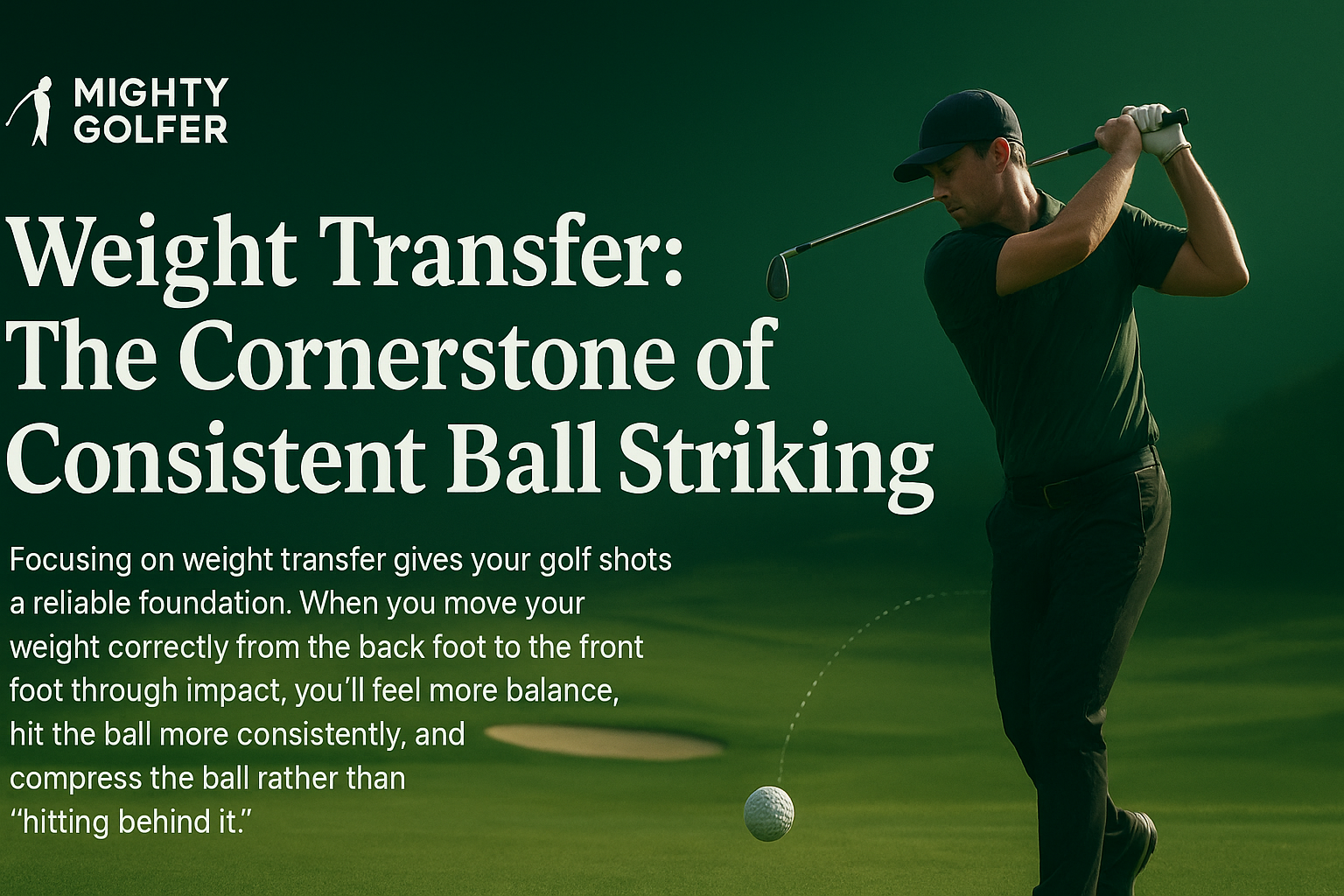
Weight Transfer: The Cornerstone of Consistent Ball Striking
Focusing on weight transfer gives your golf shots a reliable foundation. When you move your weight correctly from the back foot to the front foot through impact, you’ll feel more balance, hit the ball more consistently, and compress the ball rather than “hitting behind it.” This post zeroes in on weight transfer as a single, repeatable concept you can practice right away.
What the concept is
- Weight transfer is the deliberate movement of your body weight from the trail (back) foot toward the lead (front) foot as you swing.
- It begins in the backswing and continues through the downswing into impact, with the hips rotating and the upper body over the front side.
- Proper transfer helps you maintain spine angle, stay centered over the ball, and deliver the clubface to the ball with the correct path and compression.
Why it matters to the golf swing
- Solid contact: Moving weight forward helps the low point of your swing arc rise to meet the ball, reducing fat or thin shots.
- Consistent ball flight: A controlled weight shift promotes a more repeatable low point and swing path, leading to straighter shots more often.
- Control under pressure: As you swing faster, proper weight transfer keeps you balanced and reduces compensations that worsen contact.
What the golfer should feel when doing it correctly
- During the downswing and into impact, you should feel the pressure move from the back foot toward the lead foot.
- Your lead leg becomes grounded and stable at impact; you don’t “hang back” on the trail foot.
- Your center of mass stays over the front half of your stance at impact, with your torso gradually facing the target as your hips rotate.
- Balance is maintained through the shot, and your finish shows weight comfortably on the lead foot with the chest toward the target.
2–3 common mistakes golfers make with weight transfer
- Staying too much on the back foot through impact.
This leads to fat shots, loss of forward shaft lean, and inconsistent divots. - Over-shifting too quickly to the front foot (early weight transfer).
Loses spine angle, early extend, and a loss of power as the body “collapses” toward the ball. - Excessive lateral sway (sliding sideways) instead of turning.
Body moves forward, but the hips don’t rotate enough, causing open/blocked paths and inconsistent contact.
Simple, actionable fixes for each mistake
- Mistake: Staying on the back foot
- Fix: At setup, feel a balanced pressure across the entire foot. During the downswing, imagine your weight sliding forward along the inside of your lead foot as your hips rotate toward the target.
- Fix: Practice with small, controlled sways only—no big shift—until you can feel the trail knee unloading and the lead knee loading to support impact.
- Mistake: Early/rapid weight transfer
- Fix: Maintain your spine angle and let the transfer happen naturally as the hips drive the downswing. Think “rotate then settle” rather than “lean forward.”
- Fix: Use a 3-count rhythm (backswing, downswing, impact) to tempo your transfer and avoid rushing the move.
- Mistake: Excess sway instead of rotation
- Fix: Practice with a wall drill: stand a few inches from a wall with your trail hip lightly touching it at setup. As you swing, keep that contact and rotate, not slide.
- Fix: Focus on turning the hips toward the target while keeping your head relatively still and centered over the ball.
One easy practice drill you can do at home or on the range
Slow-Motion Weight Shift Drill
- Stand with feet at shoulder width, knees flexed, and weight evenly distributed across both feet.
- Without a ball, take a half backswing and pause at the top. Feel the weight still planted toward the trail foot, then slowly shift the weight to the lead foot as you rotate the hips toward the target.
- Continue to a slow, controlled downswing and hold the finish with most of the weight on the lead foot. Repeat 10–15 times, keeping your spine angle intact.
- Progress to short, then full swings at a very easy tempo, paying attention to the transition of weight through impact.
Mastering weight transfer won’t overhaul your entire swing overnight, but it will create a reliable anchor for your ball striking. Practice with intention, stay patient with the rhythm, and you’ll start seeing more solid contact and consistent flight on the range and the course.
Weight Transfer: The Cornerstone of Consistent Ball Striking
Weight Transfer: The Cornerstone of Consistent Ball Striking
What is weight transfer?
Weight transfer refers to the intentional repositioning of body weight from the trail (back) side to the lead (front) side during the
moment of impact or contact with the ball. It is not a mere step or shift; it is a coordinated sequence within the kinetic chain that unleashes stored energy from the ground up. In most striking sports, a well-timed weight transfer adds speed, control, and consistency to every shot.
Core ideas:
- Initiation from the ground: Ground reaction forces kick off the transfer.
- Sequenced hips, torso, and arms: The hips lead in most efficient patterns, followed by the torso and finally the arms/club or racquet.
- Forward transition: The weight moves toward the target line as contact is made for a stable,compact impact.
How weight transfer affects ball speed, accuracy, and control
A properly executed weight transfer optimizes energy transfer from the ground through the kinetic chain to the ball. The result is not only greater velocity but also more precise ball contact and consistent spin.
- Power with control: Transferring weight efficiently adds club or bat speed without forcing the body to overextend.
- improved strike zone reliability: A stable lead side reduces off-center hits and produces more centered contact.
- Spin and trajectory management: Weight shift helps manage trajectory by aligning the center of mass with the line of attack at impact.
- Injury risk reduction: Balanced weight transfer reduces compensations that ofen lead to overuse injuries.
Key biomechanics behind weight transfer
Understanding the mechanical components helps turn theory into practical enhancement.
- Ground reaction forces (GRFs): The force the ground exerts on your foot changes as you push off. A deliberate push from the back foot toward the front drives the transfer.
- Center of pressure (CoP) path: The CoP should move smoothly from the back foot toward the front foot, signaling a clean weight shift.
- Hip rotation and pelvis timing: Pelvic rotation opens the hips, creating space for the torso to rotate and extend into impact.
- Spine and core alignment: A stable spine angle protects posture and promotes true sequencing rather than compensations.
- Sequence and tempo: A well-timed sequence-hips first, torso second, arms third-maximizes club/ball interaction at impact.
Weight transfer across sports
Although the mechanics share principles,each sport has it’s own ideal timing and cues.
Golf
- Back foot pressure builds into the forward bend, and weight moves to the lead foot as you strike the ball.
- Proper sequence minimizes early extension and maintains spine angle for solid contact.
Tennis
- Forehand and backhand rely on shifting weight through the hitting shoulder toward the target.
- Early weight transfer can cause out-in shots; a controlled, late transfer increases depth and pace.
Baseball/softball
- Weight transfer powers bat speed and helps with rotational acceleration through contact.
- Sequential hip-shoulder-wrist action is key for maximizing exit velocity.
Soccer/kicking sports
- For powerful kicks, the support leg plants, weight shifts toward the striking leg, and hips rotate through impact.
- Balanced weight transfer improves precision and reduces stress on the plant leg.
Benefits of proper weight transfer
- Consistency: Reproducible contact on every attempt.
- Increased club/ball speed: Ground-up energy conversion amplifies impact velocity.
- Improved accuracy and direction control: Lead-side stabilization aligns the impact path with target geometry.
- Better timing: Clear sequencing reduces guesswork and late adjustments.
- Injury resilience: Efficient force transfer lowers compensatory movements that strain joints.
Practical tips and drills to improve weight transfer
Use a mix of metrics, feeling cues, and deliberate practice to ingrain the transfer pattern. Start slow, then progress to full speed.
- Cue-based focus: “Push off the back foot, rotate hips, and land on the lead foot.”
- Foot-tracking drill: Stand with feet shoulder-width apart, perform a slow, controlled push-off from the back foot to the front foot while keeping the torso quiet and shoulders square.
- Step-through drill: Take a small step toward the target during your swing or strike, emphasizing weight transfer through impact.
- Medicine-ball transfer: Stand tall, rotate the hips and torso while passing a medicine ball from back to front side to build sequencing.
- Wall contact drill: Hit a light ball or shadow swing with a wall on your front side; focus on finishing with weight over the lead foot.
Tip: Use a mirror or video feedback to verify that your weight moves progressively toward the target line rather than staying on your back foot.
Drills and case studies
Below are practical drills and short case observations from athletes who improved their ball striking through focused weight transfer.
Drill: Front-Foot Finish (Golf/club Swing)
- Set up as you would for a normal shot.
- Take your backswing, then, without over-rotating, finish with your weight onto the lead foot while keeping the trailing heel light.
- Return to setup and repeat with slow tempo, then increase speed as transfer becomes fluid.
Case Study: Tennis Forehand Power
- A junior player reduced mishits by 28% after focusing on initiating weight transfer from the back foot and finishing with the front foot expanded toward the court edge.
- Coaches noted better ball contact and more predictable cross-court depth after 6 weeks of targeted drills.
Case Study: Baseball Exit Velocity
- Hitter improved exit velocity by aligning hip rotation with shoulder rotation, enabling a clean transfer of weight through contact.
- Knob-to-ball connection felt more stable, reducing inconsistent upper-body timing errors during fast pitches.
First-hand experience: athlete voices
Coaches and players often report that once weight transfer is internalized, shot quality follows quickly.
- Player A (golf): “I used to stall my hips in the backswing. Now I feel the bench of energy from the ground pushing me forward, which makes impact cleaner.”
- Player B (tennis): “I used to throw my racquet head toward the ball. With a better weight shift, I drive through contact and keep my strings in the sweet spot longer.”
- Player C (baseball): “Weight transfer helped me square the barrel earlier, resulting in more consistent line drives.”
Common mistakes and how to fix them
- Mistake: Staying back on the trail foot at impact. Fix: Integrate a deliberate load-to-forward-shift cue in your swings, ensuring the front foot lands with a stable base.
- Mistake: Early extension of the spine. Fix: Maintain a slight spine angle and rotate the hips rather than sliding the torso forward.
- Mistake: Over-rotation without weight transfer. Fix: Synchronize hip turn with a forward weight shift to avoid over-tilt or loss of balance.
- Mistake: Lifting the head or eyes early. Fix: Keep the gaze focused on the ball until contact is made, using your core to stabilize.
Tools and measurement for better feedback
- Video analysis: Record at 60-120 fps to review the CoP path, hip rotation, and weight shift timing.
- Pressure mats: Monitor the shift from back foot to front foot during impact to quantify transfer.
- Motion capture or wearables: Use simple wearables to track pelvic tilt, knee flexion, and trunk rotation for qualitative feedback.
- Mirror checks: Visual feedback helps you feel the correct transition and polish the sprint-to-impact sequence.
Speedy reference cues table
Use these cues as a daily mental checklist during drills and rounds. Short, actionable prompts help reinforce correct weight transfer under pressure.
| Phase | Back Foot Action | Front Foot Action | Key Cue |
|---|---|---|---|
| Readiness | Rooted, slight knee bend | Light on ball of foot | “Set and sequence” |
| Load | Pressure builds on the trail heel | Coil and prepare for forward shift | “feel the coil” |
| Transition | Push toward lead, hips start turning | Weight begins to settle on the lead foot | “Drive off the ground” |
| Impact | Majority of weight on lead foot | Firm, contact-ready stance | “Land solid, stay level” |
| Follow-through | Finish with balance on lead leg | Full extension toward target | “Finish tall and balanced” |
SEO-friendly practices for coaches and readers
- Use clear headers (H1, H2, H3) to organize content around weight transfer concepts and sport-specific guidance.
- Incorporate keywords naturally: weight transfer, ball striking, transfer of weight, weight shift, kinetic chain, impact position, sequencing, and sport-specific terms.
- Provide structured lists and bullet points for quick readability and mobile accessibility.
- Use descriptive alt text for any images or video thumbnails that illustrate weight transfer progressions.