
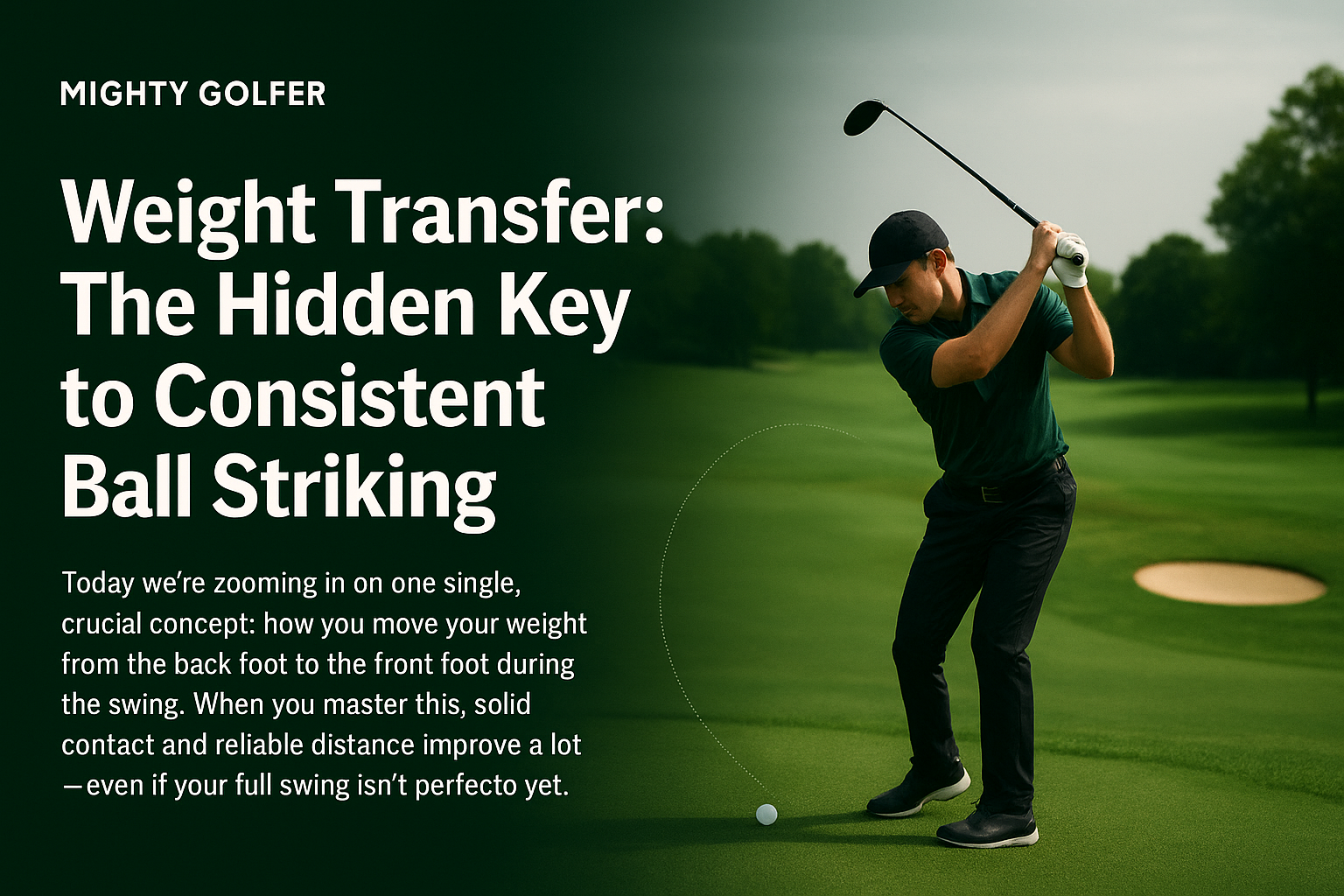
Weight Transfer: The Hidden Key to Consistent Ball Striking
Today we’re zooming in on one single, crucial concept: how you move your weight from the back foot to the front foot during the swing. When you master this, solid contact and reliable distance improve a lot—even if your full swing isn’t perfecto yet.
What the concept is
- Weight transfer is the smooth shift of your body’s center of gravity from your trail foot (the right foot for right-handed players) to your lead foot (the left foot) from backswing through impact and into follow-through.
- It’s not a big jump or a jump-cut; it’s a gradual, controlled shift that keeps your spine angle and balance intact while you swing.
Why it matters to the golf swing
- Solid contact: Proper transfer helps you hit down on the ball with the right angle of attack and avoid fat or thin shots.
- Direction and flight: Moving into your lead foot stabilizes your lower body, helping you square the clubface and control the ball flight.
- Consistency: When weight moves smoothly, you maintain balance through the shot, so you don’t “swim” or sway off the ball.
What you should feel when doing it correctly
- Momentum moves from your back foot to your front foot as you start the downswing, like a gentle shift rather than a snap.
- You feel your lead foot beginning to bear more weight just before impact, while your trail leg releases energy into rotation.
- Balance stays centered. Your spine angle remains steady, and you don’t slide your feet apart or collapse your knees excessively.
- You hear a clean, solid sound at impact, not a thud or a scrape—the ball leaves with a crisp feel.
2–3 common mistakes and simple fixes
- Mistake 1: Stalling weight on the back foot into impact, then dumping it forward too late. Fix: Feel a deliberate, gradual shift into the lead side during the downswing. Pause your hips slightly toward the target just before impact to encourage the transfer (but don’t pause so long you lose tempo).
- Mistake 2: Reverse weight transfer—too much weight onto the lead foot early, or pushing off the back foot too soon. Fix: Think “trail-to-lead” transfer through the entire downswing. Practice without a ball focusing on moving weight from back to front before you hit the ball.
- Mistake 3: Excessive sway or slide, which makes you lose balance and mis-hit. Fix: Keep your feet rooted lightly to the ground and rotate your hips instead of sliding. A small, controlled weight shift is key; big moves spoil the sequence.
One simple drill you can do at home or on the range
Drill: Slow-Motion Weight Shift with a Step
- Take your normal stance with a short club or just a swing coach stick to feel the motion.
- Make 6–8 slow, half-swings. Focus on the sensation of weight moving from the trail foot to the lead foot during the downswing and into impact.
- On the last 3 reps, add a small, natural step with your lead foot toward the target as you finish. The step should be light and balanced, not forced.
- Finish with your weight clearly on the lead foot, a stable spine angle, and a quiet finish position.
Tip: perform this drill with no ball at first. Once the feeling is consistent, add a half to three-quarter swing and then—only if you’re comfortable—progress to hitting easy shots on grass or a range mat.
By focusing on weight transfer, you’ll create a solid foundation for the rest of your swing. It’s not flashy, but it’s highly effective for beginner to intermediate players who want more consistent contact and control. Practice this regularly, and you’ll notice steadier strikes and more reliable distances over time.
Weight transfer: The Hidden Key to Consistent Ball Striking
When you watch a ball strike look effortless yet powerful, you’re often seeing a well-tuned sequence of weight movement rather than pure arm strength. Weight transfer-the purposeful loading and unloading of your body’s mass from back to front foot during the swing or shot-is the silent engine behind clean contact, consistent contact point, and added power. In this guide, we’ll unpack what weight transfer really means, how it effectively works across different ball sports, and how you can train it with practical drills and feedback to elevate your game.
Why weight transfer matters
- Consistency: A controlled shift of weight helps reproduce the same contact point, reducing mishits and off-center strikes.
- Power transfer: By loading the hips and torso before the strike, you store elastic energy which is released through the kinetic chain into the ball.
- Balance and control: Proper weight transfer improves your base stability, allowing you to swing or kick with controlled tempo even under fatigue or pressure.
- Injury prevention: A coordinated transfer reduces overload on the arms and shoulders, dispersing force more evenly through the legs and core.
Biomechanics of weight transfer: how the body builds momentum
Understanding the science behind weight transfer helps you translate feeling into repeatable action. The core idea is sequencing: load,store,and release energy in a controlled order so the body acts as a synchronized system rather than a collection of parts.
Center of gravity and ground reaction forces
The center of gravity (CoG) shifts as you move, while the ground reacts with force in the opposite direction. In a successful strike, you intentionally drop weight onto the back leg to load the hips, then push off the front leg to release energy into the ball. This process involves both linear movement (forward progression) and rotational movement (torque generated by hips and torso).
Sequential loading and unloading
Think of weight transfer as a relay race inside your body. The back foot and hip initiate the load, the torso and core control rotation, and the front foot becomes the engine that drives the release. For most sports, the sequence looks like this:
- Load: Weight shifts to the trail/back leg, hips load in readiness for rotation.
- Coiling: Torso and hips rotate, storing elastic energy in the core and posterior chain.
- Unloading: Weight moves over the lead/front leg as the strike occurs, releasing energy into the ball.
Core stability and hip rotation
A strong, stable core provides a solid platform for the hips to rotate freely without losing balance. Efficient weight transfer relies on coordinated hip drive,spinal posture,and a responsive ankle-foot mechanism that keeps you grounded during the rotation.
Sports-specific applications: how weight transfer shows up in different ball sports
Golf
In golf, weight transfer is often described as loading the right heel on the backswing of a right-handed golfer, then transferring through the lead foot during impact.the goal is a shallow, repeatable path with solid contact near the center of the clubface.
- backswing loading: Keep a slight knee flex and hinge through the hips to feel the weight settle into the right side (for right-handed players).
- Transition: Initiate the downswing with the hips, maintaining spine angle while the arms briefly lag to allow the torso to unwind.
- Impact: Lead with your left side, transferring weight onto the lead foot as the clubface squares to the ball.
Tennis
In tennis, weight transfer helps you generate power on groundstrokes and serves while maintaining balance for quick recovery. The leg drive and trunk rotation create a stable base to accelerate the racket head through contact.
- Groundstrokes: Push off the back foot into the front foot,while maintaining a stable base and a relaxed grip.
- Serve: Heavy leg drive from the ground-up translates into racket speed; weight moves from the back foot to the front foot at contact.
- Footwork: Quick steps help maintain contact on the sweet spot and allow for consistent rhythm.
Baseball/Softball
Hitters rely on precise weight transfer to maximize bat speed and contact quality. The back leg loads, the hips rotate, and the front leg drives forward into the swing plane to deliver the bat through the hitting zone.
- Load and stride: A small stride lets your weight shift smoothly without breaking rhythm.
- Hip-driven rotation: The hip turn leads the hands, delivering faster bat speed at impact.
- contact point: Shift weight toward the front foot as the barrel meets the ball to maximize energy transfer.
Soccer/kicking
In soccer,weight transfer influences shot power and accuracy. The non-kicking foot provides a stable base, while the kicking leg loads backward before delivering a forward, linear drive through the ball.
- Plant foot positioning: The plant foot stabilizes the body and points toward the target.
- Backswing to strike: Shift weight to the trailing leg, then move through the ball with a strong front-side drive.
- Follow-through: A balanced finish prevents over-striding and maintains control for follow-up plays.
Practical drills and progressions to master weight transfer
Strong fundamentals come from progressive, practical training. Start with awareness drills and simple static shifts, then evolve to dynamic, full-swing scenarios with feedback. Focus on tempo, balance, and feel-rather than just “power.”
Foundational drills (beginner to intermediate)
- Stand with feet shoulder-width apart.Shift weight from the back foot to the front foot over 3-4 seconds,hold for 2 seconds,return. Do 2-3 sets of 6-8 reps per side.
- use a short swing or half-swing with a club or broomstick. Emphasize backing up weight to the trail leg and sliding into the lead foot at impact.
- Lie on your back,bridge hips,then push through the heels as you “release” weight to the front foot. Adds hip drive without overloading the arms.
Dynamic drills (intermediate)
- Take a step toward the target while shifting weight from back to front foot in a controlled manner; progress to swinging a light club as you step.
- Stand in a narrow stance, rotate hips to create a slight T across the body, then shift weight forward through the lead foot while keeping contact points stable.
- From a setback stance, rotate hips and trunk to toss a light medicine ball ahead of you, reinforcing weight movement through rotation and forward transfer.
Table of drills: progressive practise plan
| Drill | Focus | How to Perform | Reps / Duration |
|---|---|---|---|
| Weight Shift Hold | Back-to-front loading | Stand tall, shift weight to back foot then front foot over 3-4 seconds; hold 2 seconds. | 2-3 sets of 6-8 reps per side |
| Mini-Swing with Load | Sequencing and tempo | Perform a half-swing with a light club; focus on weight moving first, hands following. | 2-3 sets of 8-10 reps |
| Step-Through Drill | Dynamic transfer and balance | Take a step toward target while transferring weight; progress to full swing with light club. | 2-3 sets of 5 reps per side |
Benefits of proper weight transfer
- Higher accuracy: A repeatable transfer pattern helps you strike the ball consistently on the sweet spot.
- increased power without extra effort: stored energy is released at impact, boosting ball speed without requiring heavier swings.
- Better timing: Proper sequencing makes timing more forgiving during fast-paced exchanges (think tennis rally or soccer buildup).
- Reduced fatigue and injury risk: Distributed loading lowers peak stresses on the arms and shoulders and improves overall efficiency.
Common mistakes and how to fix them
- Mismatched weight shift: Shifting too late or too early disrupts timing. Fix: practice slow, deliberate transfers with a metronome or a wall-tacing drill to cue rhythm.
- Over-rotation without ground support: If the torso twists while the feet lag, balance suffers. Fix: keep a grounded stance; initiate rotation from the hips while the feet remain solid on the ground.
- Early extension: Pushing the knee forward too soon can throw off contact. Fix: maintain knee flex and hinge through the hips until the strike window.
- Lead foot pounce: Lunging onto the lead foot can cause off-center hits. Fix: transfer weight smoothly, keeping pressure on the lead foot while maintaining a light, balanced base.
First-hand experience: a real-world exmaple
Sam, a recreational golfer and weekend tennis player, struggled with inconsistent contact. He noticed his shots would often start offline as the ball left the face. We worked on a simple progression: begin with weight shift holds, then add half-swings, and finally integrate into full swings with light clubs. Over eight weeks, Sam reported fewer mis-hits, improved ball speed, and a more stable finish. The key? He learned to feel the weight shift first, then translate that feeling into the swing path. In tennis, the same approach helped him stabilize his groundstrokes on the forehand, translating to more confident rallying without trailing foot fatigue.
Measurement, feedback, and progress tracking
To ensure you’re moving in the right direction, incorporate objective feedback alongside your practice. Here are practical options:
- Record slow-motion footage from perpendicular angles to observe how your weight shifts during each phase of the swing or kick.
- Balance and force sensors: use a balance board,smart insoles,or timing gadgets to quantify weight distribution and transfer speed.
- feeling cues: Pair each drill with a cue like “load, then explode” to remind you of the sequence.
- Perceived effort: Rate your effort and balance on a 1-10 scale after each rep to monitor fatigue-related changes.
Case studies and practical tips
Real-world athletes often fine-tune weight transfer through trial, error, and keen self-awareness. Here are two short anecdotes and practical tips to emulate their success:
Case study: the bow-arm baseball hitter
A player found his power declined when his weight stayed too centered and his hips didn’t engage early enough. He integrated a sequence of back-foot loading, hip rotation, and front-foot drive, with emphasis on maintaining spine angle. After several weeks of drill work and live batting practice focusing on weight transfer,he regained bat speed and consistency at the plate.
Practical tips you can apply today
- Focus on the trail-to-lead transition during the first 0.5-0.8 seconds of contact.
- Use a slow tempo at first; as you gain confidence, increase speed while maintaining control.
- Keep the upper body relaxed; tension in the arms will hinder quick, precise weight transfer.
- Always practice with a stable base-feet shoulder-width apart and knees slightly bent to allow smooth weight flow.
Advanced tips: refining your transfer for peak performance
- Integrate a slight difference in stance width depending on the sport to optimize leverage and balance during weight transfer.
- Coordinate breath with the transfer sequence; exhale as you release energy into the ball to promote a smoother, controlled swing.
- Progress from static to dynamic movements: begin with shift holds, advance to half-swings, then full swings with cadence control.
- Tailor your drills to your dominant sport’s demands (golf and baseball emphasize rotational sequencing, tennis emphasizes racket acceleration and footwork, soccer emphasizes knee and ankle stability for vector control).
Incorporating weight transfer into your routine: a sample weekly plan
- 2-3 days of foundational drills (weight shift holds, mini-swings) for 15-20 minutes
- 1-2 days of dynamic drills (step-through, T-position, medicine ball work) for 20-30 minutes
- 1 day for field-based practice (golf range, tennis court, batting cage, or soccer field), focusing on transfer timing for 30-45 minutes
Conclusion-free wrap-up: key takeaways
Weight transfer is the hidden key to consistent ball striking because it aligns your body’s weight with the ball’s contact point, creating a reliable, repeatable path. By understanding the biomechanics,applying sport-specific transfer patterns,and following a progressive drill plan,you’ll improve timing,power,and accuracy. Remember: start with awareness and control, then build to speed and authenticity in your shots or swings.