
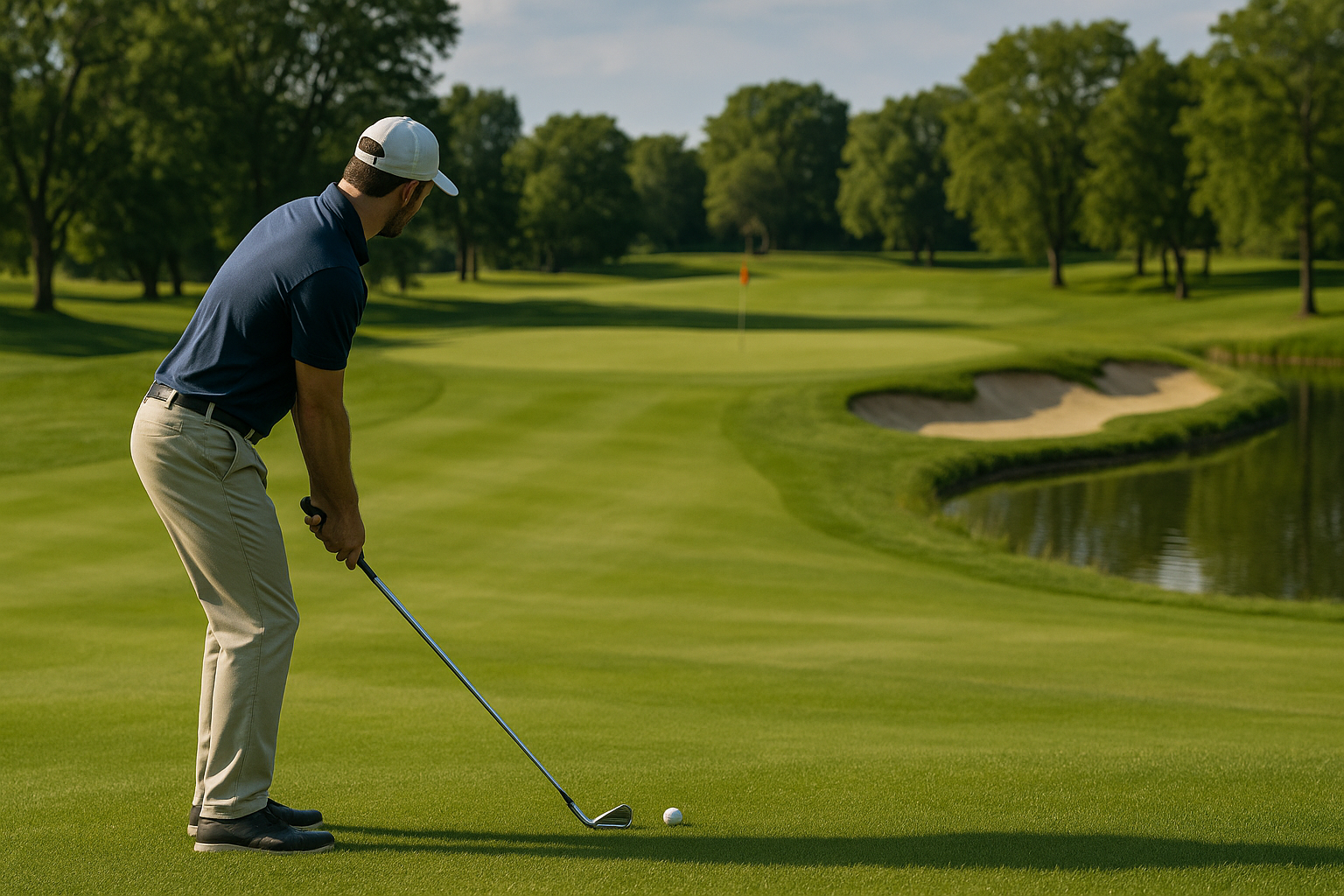
Why the Best Approach Shot Is Sometimes Away From the Hole
You hit a solid drive, find the fairway, and leave yourself a comfortable approach. Then you notice the flag is tucked beside a bunker, near a pond, or only a few paces from the edge of the green.
Your first thought is probably, “I need to hit it close.” But that mindset can turn a straightforward approach into a big number. For many golfers, the smartest target is not the flag. It is the safest part of the green.
The Flag Is Not Always the Best Target
Golfers often choose a club based on the distance to the hole and then aim directly at the flag. That works when the pin is near the center of the green and trouble is not nearby. It becomes risky when the flag is positioned close to danger.
A shot that finishes 25 feet from the hole is usually a good result. A shot that misses by 10 feet into a bunker, penalty area, or deep rough can lead to bogey or worse.
The goal of an approach shot is not simply to get close. It is to leave yourself the best chance of finishing the hole with a reasonable score.
Use the “Safe Side” of the Green
Before choosing your target, identify the side of the green where a miss would be least damaging. This is sometimes called the fat side—the part of the green with the most room around it.
For example:
- If the flag is on the left beside a bunker, aim toward the middle or right side of the green.
- If the flag is on the right with water beyond it, choose a target left of the hole.
- If the flag is at the front, favor the middle rather than risking a short shot into trouble.
- If the flag is at the back, use enough club to reach the center but avoid chasing the pin.
You may end up farther from the hole, but you will usually have a simpler next shot and more room for a small mistake.
Pick the Club for the Target, Not the Flag
Suppose the flag is 150 yards away, but the center of the green is 160 yards away. If the pin is protected by trouble short, selecting a club for 150 yards may not be the best choice. You might choose the club that comfortably reaches the middle instead.
This does not mean automatically hitting more club. It means deciding exactly what distance and location you want before pulling a club from the bag.
Ask yourself:
- Where is the safest area of the green?
- What is the carry distance to that area?
- What happens if I miss left, right, short, or long?
- Which miss gives me the easiest recovery?
Choose a club that makes your intended target realistic, not one that requires a perfect strike to avoid danger.
Account for Your Normal Miss
Your normal miss matters more than your best possible shot. If you commonly miss to the right, aiming at the right edge of the green near a bunker is a poor decision—even if the flag is positioned there.
Instead, aim farther left and give your usual miss some room. You are not trying to eliminate every bad shot. You are making sure your ordinary mistake does not become a disaster.
This is one of the easiest ways to lower scores without changing your swing.
Try This on Your Next Round
For one round, ignore the flag on every approach shot until you have answered three questions:
- Where is the trouble?
- Where is the largest safe section of the green?
- Which club and target protect me from my usual miss?
Keep track of how many greens you reach and how many approach shots leave you with a straightforward putt or chip. You may discover that conservative targets produce fewer penalty shots and easier pars, even when your putts are longer.
Common Mistakes to Avoid
- Aiming at the flag automatically: The pin is a reference point, not always your target.
- Ignoring short-side trouble: Missing on the side with less green often creates a difficult chip or bunker shot.
- Choosing a club for your perfect strike: Plan for a normal swing, not your best-ever contact.
- Changing targets after addressing the ball: Make the decision behind the ball, then commit to it.
One Thing to Remember
On approach shots, aim for the safest part of the green—not automatically at the flag. A longer putt is usually easier to handle than a short-sided recovery shot, and smart targets can save more strokes than a heroic swing can create.