
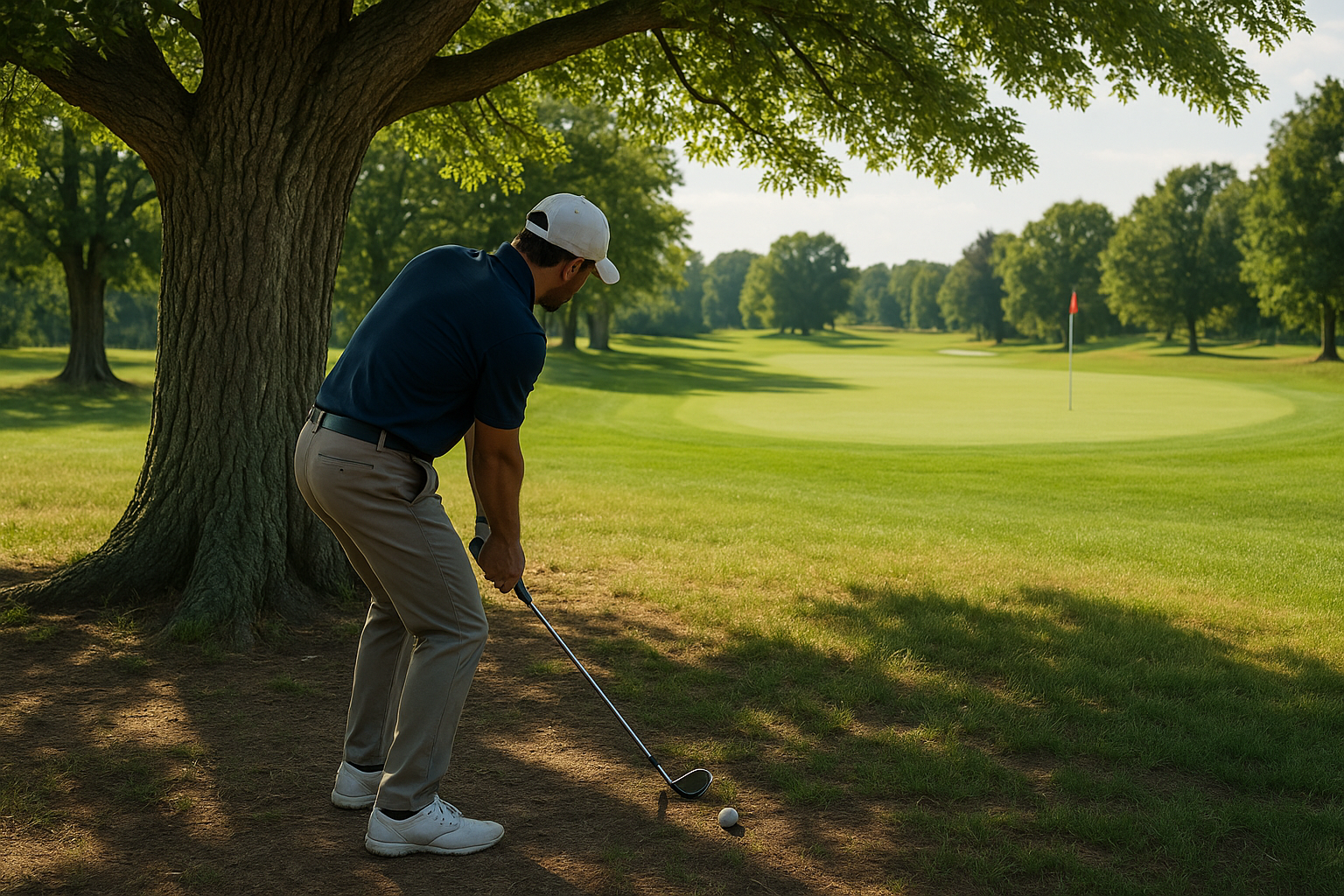
You’re Behind a Tree: The Three Questions That Prevent a Double Bogey
Your ball has found the trees. You have a narrow gap, the green is somewhere beyond it, and your first thought is probably, “I can get this through.” Sometimes you can. More often, the ball clips a branch, hits a trunk, or comes out sideways and turns one bad shot into a big number.
Recovery shots are not about showing off. They are about giving yourself the best chance to finish the hole with a manageable score. Before choosing a club, ask three simple questions.
1. What Is the Safest Way Out?
Start by forgetting the flag for a moment. Your first job is to return the ball to a place where you can make a normal golf shot.
Look for:
- The widest opening between trees
- The lowest-risk direction, even if it is backward or sideways
- A landing area with grass rather than rough, sand, or hazards
- Enough room for the ball to roll after it exits the trees
Many golfers make the mistake of choosing the smallest gap that points toward the green. That gap may require a perfect shot, and even a small mistake can leave you in worse trouble.
If the open side is 30 yards away from the hole but gives you a clean next shot, it is often the better choice. A simple sideways punch can save a bogey. A risky attempt at the green can quickly produce a double bogey or worse.
2. What Ball Flight Can You Actually Hit?
Do not choose a recovery shot based on what you wish you could hit. Choose it based on the shot you can reasonably control.
Ask yourself:
- Can I keep the ball low enough to miss the branches?
- Can I start the ball far enough to the left or right?
- Will the ball curve in the direction I expect?
- Do I have enough room to make a comfortable swing?
A low punch is usually easier with a lower-lofted club such as a 5-iron, 6-iron, or hybrid. Play the ball slightly farther back in your stance, make a shorter swing, and finish low. The goal is not maximum distance. The goal is to get the ball safely back into play.
However, lower loft is not automatically better. If the ground is soft, the ball is sitting down, or you need to carry an obstacle, a higher-lofted club may be more reliable. The best club is the one that produces the ball flight and direction you can control.
3. What Happens If the Shot Is Slightly Wrong?
This is the most important question. Every recovery shot has a miss, so decide where you can afford to miss before you swing.
For example, suppose you have a gap between trees with a pond on the right. A shot that starts slightly right could find the water. A shot that starts slightly left might leave you in the fairway. That makes the left side your target, even if the hole is located to the right.
Pick a target that gives your common miss room to survive. Do not aim at the exact center of the opening if your ball often starts or curves to one side. Aim away from danger and give yourself a margin.
Try This: The Recovery Decision Drill
During your next practice round, deliberately place a ball near a tree or in a difficult position. Before touching a club, say your decision out loud:
- “My safest exit is…”
- “The ball flight I can control is…”
- “My safe miss is…”
Then choose a club and commit to the shot. You are practicing decision-making, not just technique. Repeat this exercise from several awkward locations, including behind trees, beside hazards, and under branches.
Common Recovery Mistakes
- Trying to reach the green at all costs: The green is not always the correct target.
- Ignoring branches: A shot that clears the gap may still hit overhanging limbs.
- Using too much club: Extra distance is useless if the ball cannot stay under control.
- Changing your mind during the swing: Make the decision first, then commit.
- Forgetting the next shot: Leave yourself a reasonable angle and distance whenever possible.
One Thing to Remember
When you are behind a tree, your best shot is usually the one that gives you the most room for error—not the one that points closest to the flag.