
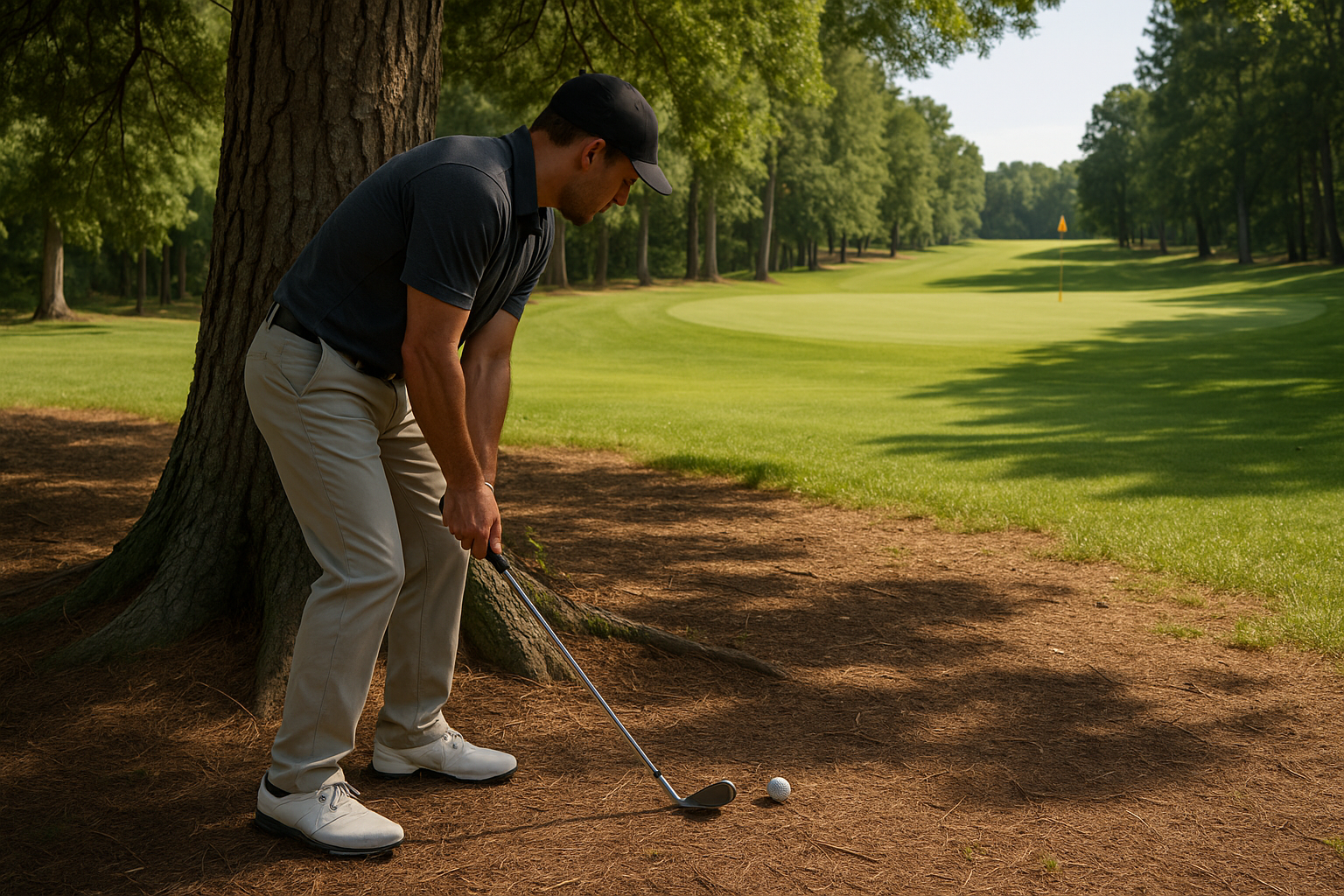
Your Ball Is Behind a Tree: Choose the Exit, Not the Hero Shot
You hit a poor drive, and now your ball is sitting behind a tree. The green is visible, but only through a narrow gap. You can probably curve the ball around the trunk—or at least you think you can.
This is where many golfers turn one bad shot into a much bigger number. The problem is not usually a lack of skill. It is choosing a shot that has almost no margin for error.
When you are in trouble, your first goal should not be to reach the green. Your first goal should be to get back into a position where golf becomes easy again.
Start by Finding the Safe Exit
Before choosing a club, walk around the ball if you can. Look in every direction and ask one simple question:
Where is the largest opening that gets me back toward the fairway?
That opening might be behind you, to the side, or through a gap between branches. It does not have to point directly at the hole. A shot that travels 40 yards sideways and leaves you a clear approach is often much better than a risky shot that travels 140 yards toward the green.
Think of the recovery shot as an escape route, not a scoring opportunity.
Separate the Shot You Want From the Shot You Can Hit
Many golfers look at the green first and then try to invent a shot that gets there. Instead, look at the obstacles first:
- How wide is the opening?
- How high does the ball need to travel?
- Are there branches that force a low shot?
- What happens if you miss the opening?
- Where will the ball finish if the shot works?
A narrow gap may look tempting, but the real question is whether your normal shot pattern fits through it. If your ball can start several yards left or right of your intended line, a gap that looks generous may not be generous at all.
Also consider the consequences. If missing the gap means hitting another tree, going out of bounds, or finding a hazard, the shot is probably too aggressive.
When a Punch-Out Is the Smart Play
A punch-out is a low shot played mainly to escape trouble. You usually use less club, make a shorter swing, and accept that the ball may not travel very far.
It is often the best choice when:
- The opening is wide enough for a straight shot.
- You cannot see the entire route to the green.
- Branches block a normal-height shot.
- The risky option could lead to a penalty or another recovery shot.
- You are already in a difficult position and need to stop the damage.
Choose a club that keeps the ball below the lowest branches. For many golfers, that may be a hybrid, long iron, or middle iron. The correct club is not necessarily the one that sends the ball the farthest. It is the one that gives you the most predictable launch and direction.
Play the ball slightly farther back than normal, keep your finish controlled, and focus on sending the ball through the opening. You do not need to hit the shot hard. A smooth, centered strike is more valuable than extra speed.
Do Not Assume You Must Hit Toward the Hole
Suppose you are 150 yards from the green, but the only safe escape leaves you 110 yards away in the fairway. That may feel like giving up, but it is usually a chance to save bogey—or sometimes make par.
Trying the miracle shot can create:
- A penalty stroke
- A blocked or awkward next shot
- A lost ball
- A second recovery shot
- Extra frustration that affects the rest of the hole
Golfers often underestimate how valuable a clean next shot is. From the fairway, you can use your normal routine, choose a familiar club, and aim at a sensible target. From behind another tree, you are still solving problems.
Try This on Your Next Round
Whenever you are behind a tree or blocked by trouble, pause for ten seconds before touching your club. Identify three possible exits, then rank them:
- The safest route back to a playable position
- A moderate option that advances the ball without much risk
- The aggressive shot toward the hole
Then choose the highest option on the list that you can execute confidently. This small decision-making routine prevents your emotions from choosing the shot for you.
One Thing to Remember
When you are in trouble, aim for the biggest opening—not the closest flag.