
Introduction
At the range, you will spend a lot of time with your irons — the clubs with flat, angled faces numbered from 5-iron to 9-iron, plus a pitching wedge. Irons are for shots from the fairway, rough, and tee on shorter holes. They can feel tricky because the ball sits on the ground, not teed up high. With simple setup keys and the contact ideas from Lesson 8, you can start hitting iron shots that feel solid and predictable.
What You're Going to Learn
- What irons are designed to do
- How iron setup differs from driver setup
- Where to position the ball for iron shots
- How to make a simple, effective iron swing
- Common beginner iron mistakes and fixes
Understanding Your Irons
Lower-numbered irons (like a 5-iron) have less loft and hit farther. Higher-numbered irons (like a 9-iron) have more loft and send the ball higher with less distance. As a beginner, start with a mid-iron like a 7-iron or 9-iron — forgiving clubs that build confidence.
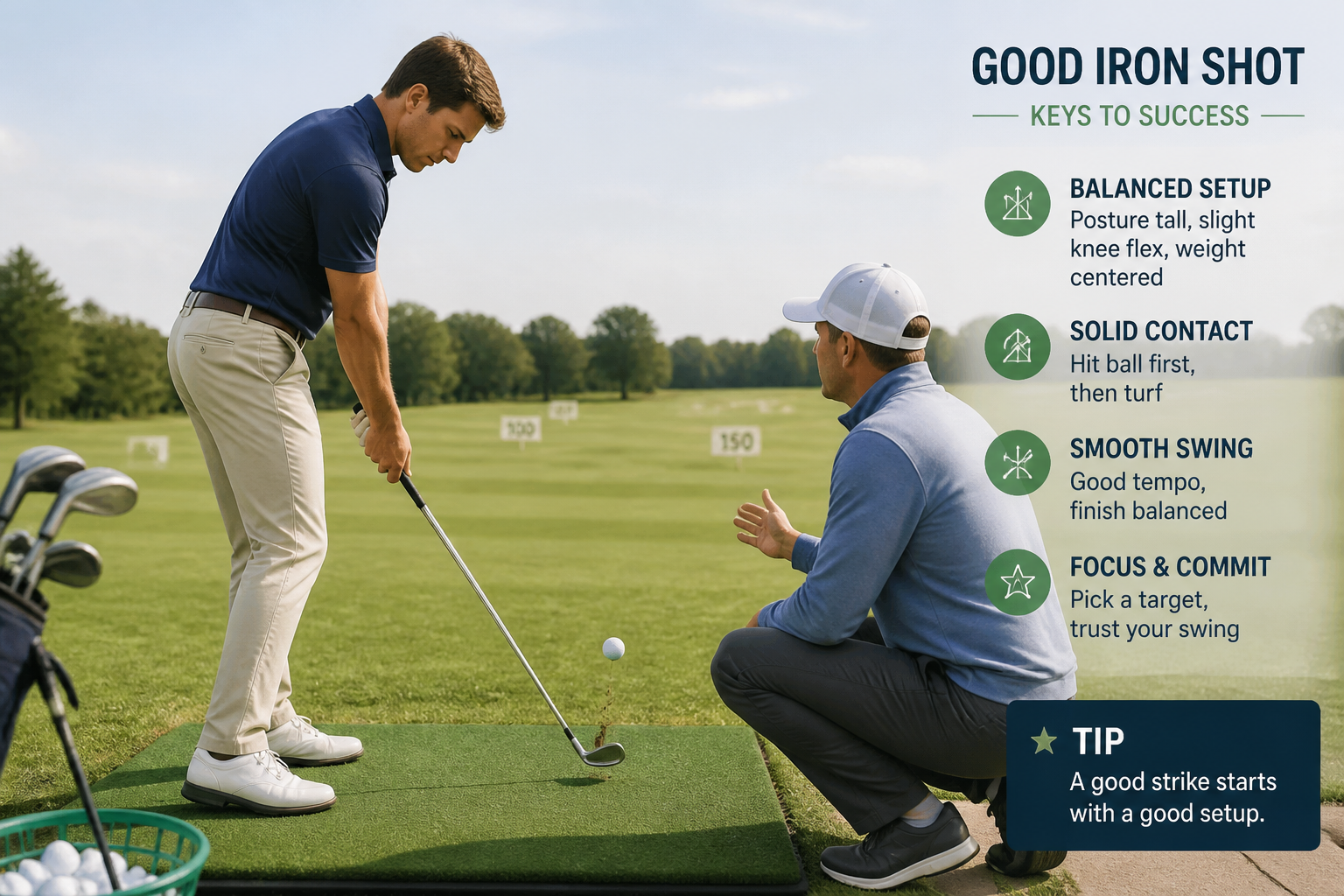
Irons are designed for a slightly descending blow: the club moving downward at impact. Solid iron contact means hitting the ball first, then the turf.
Simple Iron Setup
Your iron setup builds on earlier lessons:
- Ball position: For a mid-iron, place the ball in the center of your stance or slightly forward. Shorter irons stay nearer center; longer irons move slightly forward.
- Stance: Feet about shoulder-width apart — slightly narrower than your driver stance.
- Posture: Bend from your hips, arms hanging naturally, balanced over the middle of your feet.
- Weight: Fairly even between both feet, maybe slightly favoring your front foot.
When aimed and set up correctly, make a smooth swing and let the club's loft do the work.
Why It Matters
Irons are the clubs you use most during a round — fairway shots, approaches to the green, and recoveries from the rough. Learning to hit them consistently means you can actually play holes, not just hit drivers at the range. Good iron play builds the confidence that makes golf fun.
What Should It Feel Like?
A solid iron shot feels crisp at impact. The ball launches with a reasonable trajectory — not a line drive or sky-high pop-up. Feel your weight finish on your front foot with your body turned toward the target. Think of compressing the ball against the ground, not scooping it. A small divot after the ball is a good sign. Distance will come later; contact comes first.
Common Beginner Mistakes
Mistake 1: Ball too far forward
The Mistake: You set up with the ball off your front toe, like a driver.
What You Might Notice: Thin shots, topped shots, or a slice from reaching for the ball.
Simple Fix: Move the ball to center or slightly forward of center for mid-irons.
Mistake 2: Swinging too hard
The Mistake: You swing maximum effort with long irons for more distance.
What You Might Notice: Poor contact and shots that go shorter than smooth swings.
Simple Fix: Use smooth, controlled tempo. Solid contact goes farther than a hard swing with poor contact.
Mistake 3: Not committing to the shot
The Mistake: You decelerate through the ball from fear of hitting it wrong.
What You Might Notice: Fat shots, weak contact, and shots that fall short.
Simple Fix: Make a committed, smooth swing to a full finish. Trust your setup and aim.
Try This Simple Drill
What You Need
A 7-iron or 9-iron and access to a driving range.
How to Do It
- Pick a target on the range.
- Set up with the ball slightly forward of center, feet shoulder-width apart.
- Take three practice swings focusing on tempo and balance.
- Hit 5 balls at 50 percent effort, then 5 at 70 percent — contact over distance.
What to Feel
The best shots feel like the ball jumps off the clubface with minimal effort. Finish balanced with your chest toward the target.
How Much to Practice
Spend one range session hitting only your 7-iron or 9-iron — 30 to 40 balls before switching clubs.
One Thing to Remember
Ball first, turf second.