
Introduction
Before you worry about swing speed or follow-through, get your grip right. The way you hold the club affects every shot. A good grip gives you control. A bad grip makes everything else harder.
What You're Going to Learn
- Why the grip matters more than most beginners realize
- How to place your lead hand on the club
- How to add your trail hand for a secure hold
- The difference between a strong, neutral, and weak grip
- How to check your grip before every shot
Why the Grip Comes First
Your hands control the clubface — the part that hits the ball. If your grip is wrong, the clubface twists at impact no matter how good your swing path is.
Step 1: Place Your Lead Hand
For a right-handed golfer, the lead hand is the left hand. (Left-handed golfers, reverse everything.)
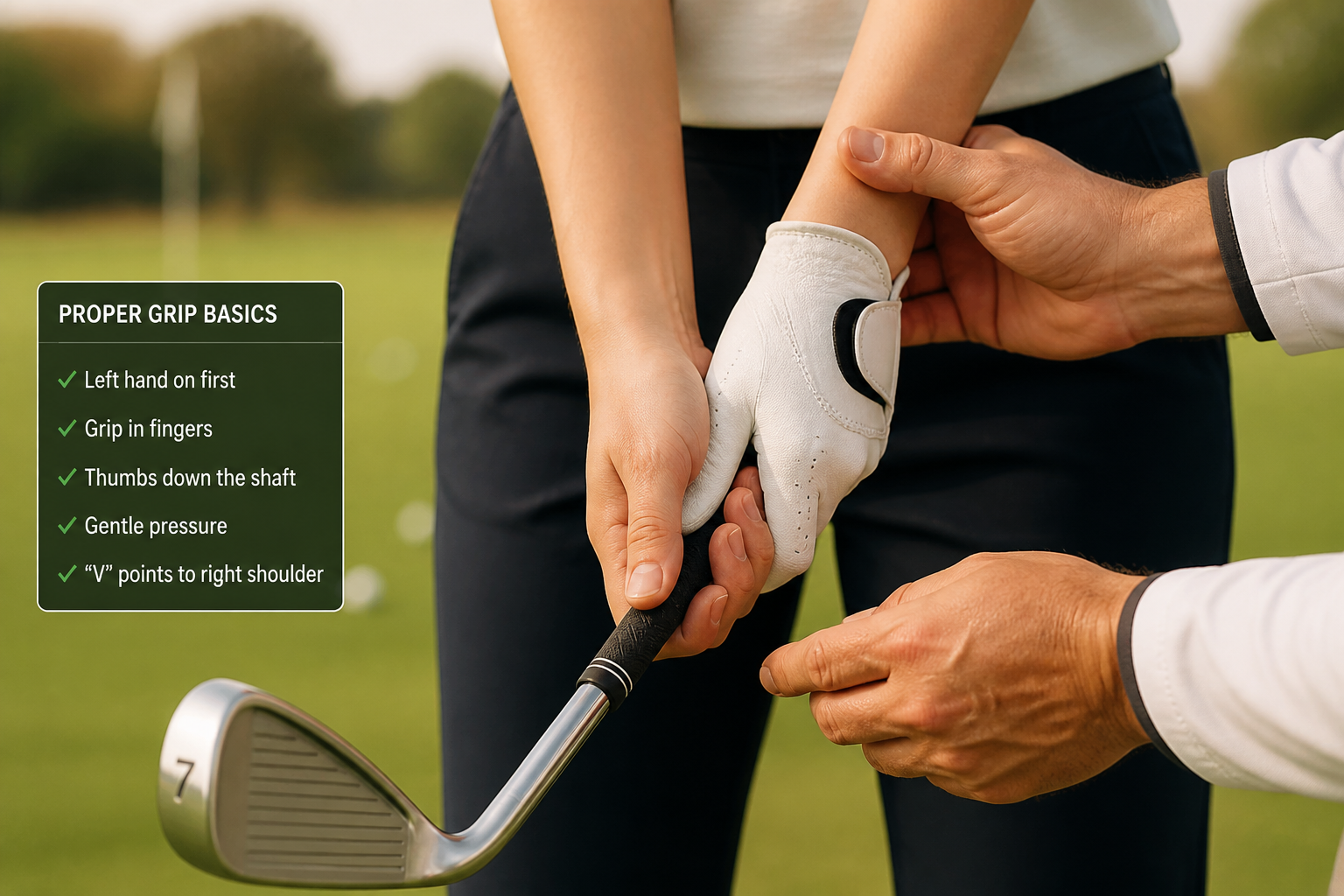
Start by holding the club at a 45-degree angle. Let it rest on the fingers of your lead hand, not deep in the palm. You should see two to three knuckles on the back of your lead hand.
Wrap your fingers around the grip and place your thumb on top, slightly to the right of center.
Step 2: Add Your Trail Hand
Now bring in your trail hand (the right hand for right-handed golfers). There are two common ways to connect the hands:
- Overlap grip (Vardon grip): The pinky finger of your trail hand rests on top of the gap between the index and middle fingers of your lead hand. This is the most popular grip on tour and a great choice for beginners.
- Interlock grip: The pinky finger of your trail hand interlocks with the index finger of your lead hand. Some golfers with smaller hands prefer this option.
Place the lifeline of your trail hand over your lead thumb. Both thumbs should point down the shaft without squeezing.
Step 3: Check Your Grip Pressure
One of the most common grip errors is holding the club too tightly. Tension in your hands travels up your arms and restricts your swing. Aim for a pressure level of about 4 or 5 out of 10 — firm enough to control the club, loose enough to let your wrists move freely.
A helpful image: imagine holding a tube of toothpaste without squeezing any paste out.
Strong, Neutral, and Weak Grips
Where your hands sit determines whether your grip is strong, neutral, or weak — this is about rotation, not force.
- Neutral grip: Two knuckles visible on your lead hand. Start here.
- Strong grip: Three or more knuckles. Tends to close the clubface.
- Weak grip: One knuckle. Tends to open the clubface.
Start neutral. Adjust only after working on other fundamentals.
Why It Matters
A consistent grip is the foundation of a consistent game. Getting it right now saves you from relearning later.
What Should It Feel Like?
Your grip should feel secure but relaxed. You should not see white knuckles or feel strain in your forearms. The club should feel balanced in your fingers, almost like an extension of your arms.
When you waggle the club, it should move freely without slipping. If you feel like you are strangling the club, loosen up.
Common Beginner Mistakes
Gripping in the Palms Instead of the Fingers
When the club sits in your palm, your wrists cannot hinge properly. This reduces power and makes it hard to square the clubface. Shift the handle down into your fingers until you can see knuckles on the back of your lead hand.
Gripping Too Tight
Under pressure, every beginner squeezes harder. Tight hands lead to stiff arms, a shortened backswing, and weak contact. Before each shot, take a breath and consciously soften your grip. You will hit the ball better with less effort.
Changing the Grip Every Round
Some beginners adjust their grip after every bad shot. Pick one style, commit to it for several weeks, and trust the process.
Try This Simple Drill
At home, take your club and set up your grip without hitting a ball. Hold the club in front of you and check: two knuckles visible, thumbs pointing down the shaft, pressure at 4 out of 10. Now close your eyes and regrip the club five times. Open your eyes and check your hand placement each time.
Repeat this for two minutes daily until the grip feels automatic. When you arrive at the range, your hands will know exactly where to go.
One Thing to Remember
Your grip is not glamorous, but it is essential. Spend time on it now, check it before every shot, and resist the urge to tinker. A simple, neutral grip held with light pressure will serve you well for your entire golf journey.