
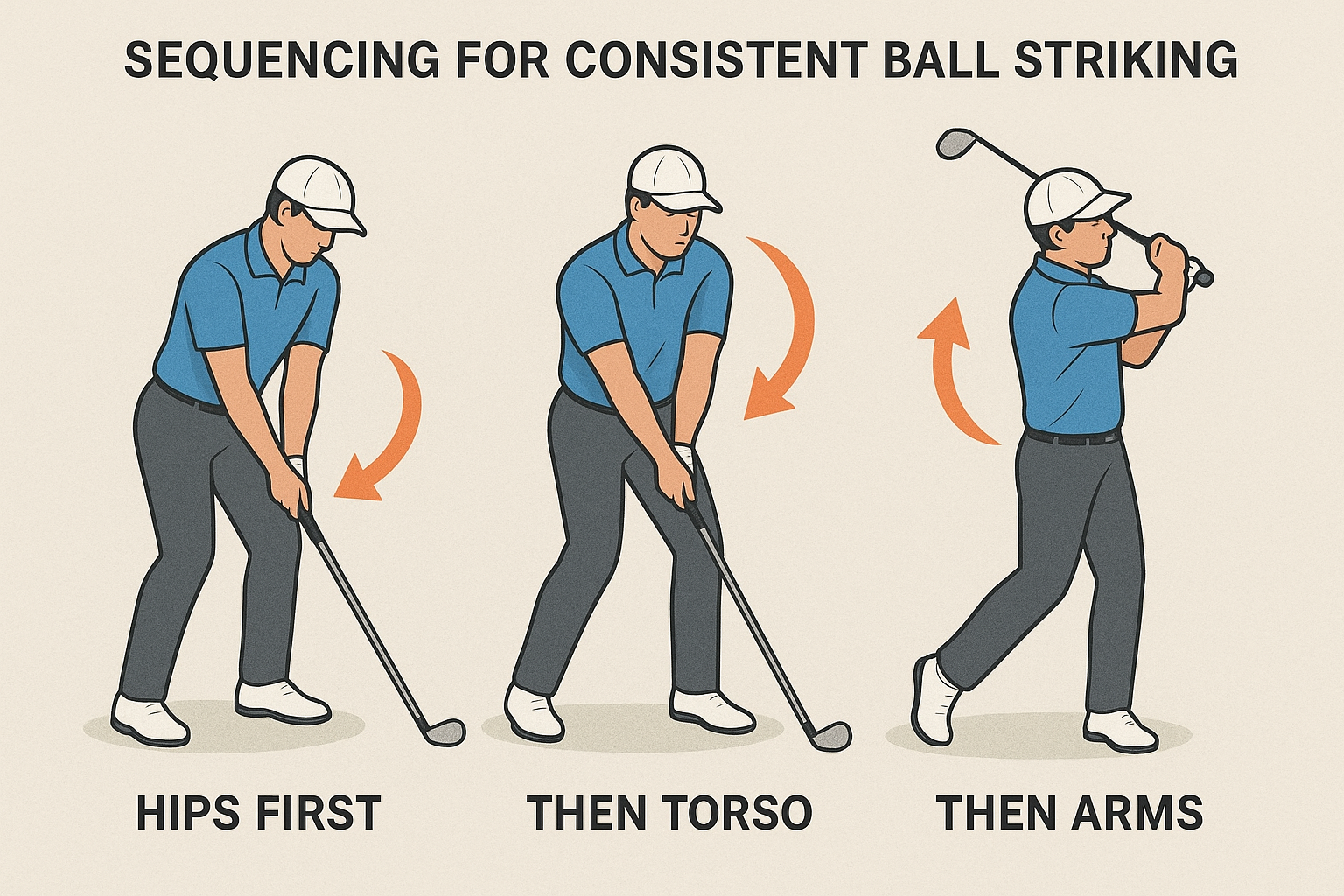
Sequencing for Consistent Ball Striking: Hips, Torso, Arms
When you swing, speed in the clubhead comes from the way your body parts work together in order. That order is called the downswing sequence or kinetic sequencing. The best players start the move with the hips, then the torso, and finally the arms and hands. Getting this order right helps you strike the ball more solidly, with better direction and more speed, shot after shot.
What the concept is
Kinematic sequencing means you pressurize and release energy in a clean, timed chain: rotate the hips toward the target, allow the torso to unwind, and let the arms and hands follow. This keeps your spine angle, reduces excess tension, and delivers the clubhead to the ball in a stable, square position. Think of it as a smooth, three-part relay rather than three parts fighting each other at once.
Why it matters to the golf swing
- More consistent contact. When the hips lead, the club travels on a natural path, helping you compress the ball more reliably.
- Better speed with control. Proper sequencing reduces energy leaks and keeps the clubface more square at impact.
- Less strain and fewer misses. A smooth chain lowers the chances of early release, over-rotating, or excessive sway.
What the golfer should feel when doing it correctly
- Feel the hips turn toward the target first, initiating the downswing.
- Feel the chest and torso unwind after the hips start, as the upper body follows the turning hips.
- Feel the arms and hands drop into place naturally, so the clubhead reaches the ball with the face square to the target.
- Keep a steady spine angle and avoid creeping forward or backward as you rotate.
- Weight shifts gradually from the back foot to the front foot as you deliver the club through the ball.
2–3 common mistakes and simple fixes
- Mistake 1: Arms and hands start the downswing before the hips.
- Fix: Use the cue “hips first.” Practice with no ball or a very light swing, focusing on turning the hips toward the target to begin the downswing, then let the torso and arms follow.
- Mistake 2: Sway or slide instead of rotate, so the sequence gets out of order.
- Fix: Stand tall and stay centered. Practice turning the hips in place (without moving the head or lower body excessively) and feel the weight shifting to the front foot as the arms come through. A towel under the armpits can help you stay connected and reduce lateral movement.
- Mistake 3: Early release or losing the lag with the wrists, so the clubface isn’t square at impact.
- Fix: Maintain a light wrist hinge and delay the release a beat longer than you think. Pause briefly at the moment the hips finish their job and the torso begins to unwind, then let the arms release naturally through the ball.
One easy practice drill you can do at home or on the range
- Drill name: 3-2-1 Sequencing Drill
- Set up with a mid-iron or a short iron. No ball is required for the initial reps.
- Count 3-2-1 as you move through the downswing:
- 3: Initiate the downswing with a noticeable hip rotation toward the target.
- 2: Allow the torso to unwind after the hips start moving.
- 1: Let the arms and hands drop into place and complete the strike.
- Do 2–3 sets of 8–12 slow, controlled repetitions at a comfortable tempo (60–70% effort). Keep your spine angle and balance steady.
- Progress to a light half-swing with a ball, still emphasizing the same order. If you feel the arms taking over, restart with no-ball drills to rebuild the sequence.
Sequencing for Consistent ball Striking: Hips First, Then Torso, Then Arms
Understanding the Sequence: Hips, Torso, arms
In any rotational athletic movement, the way you sequence your body parts can dramatically impact power, speed, accuracy, and repeatability. The phrase “hips first, then torso, then arms” describes a practical hierarchy that aligns with how forces are generated, stored, and released through the kinetic chain. When you initiate with the hips, you create a powerful ground reaction force, which is then transferred through the torso and finally released by the arms and hands.The result is a smoother, more consistent ball strike with reduced mis-hits and lower risk of overloading any single joint.
Why the order Matters: The Physics Behind Hips-Torso-Arms Sequencing
The human body functions like a linked system of levers and joints. Initiating from the hips accomplishes several things:
- Ground reaction forces: The hips drive weight transfer and leg drive, turning ground force into rotational torque.
- Core sequencing: The torso acts as a hinge that decouples the pelvis from the arms, allowing coiling and uncoiling that add angular velocity without creating jammed, rushed arms.
- Release timing: The arms release the stored energy at the optimal moment, producing club, bat, or racket speed with better control.
When the hips are late or the torso doesn’t properly coil, the sequence can regress to the arms dominating the motion, which often leads to off-center contact, reduced power, and inconsistent ball flight. By practicing a hips-torsos-arms progression, players create a repeatable rhythm that translates into more solid contact time after time.
Building the Hips-First Principle: Drills and Cues
To train the hips-first pattern, focus on initiating movement from the pelvis, then allowing the trunk to rotate, and finally letting the arms follow. Use these cues and drills to ingrain the sequence:
Key Drills
- : Stand with feet shoulder-width apart. Begin with a slight hip hinge, then rotate the hips toward the target while keeping the chest square. The goal is a small, controlled hip turn that starts the motion.
- : Place a resistance band around your hips or use a cable machine. Step back to create tension, then drive the hips forward and rotate, allowing the torso to follow naturally.
- : Stand with your back to a wall, hips slightly back.Initiate contact by rotating the hips first so that the torso faces slightly away from the wall, then rotate toward the target while keeping the lower body engaged.
Common Hips-First Cues
- “Start with the hips, then the chest, then the hands.”
- “Scratch the ground with your back foot, then twist.”
- “Lead with your pelvis; your torso will follow.”
Torso Sequencing: The Middle Link of the Chain
If the hips initiate the motion, the torso acts as the engine that stores and releases energy through spinal rotation and rib-hinge mechanics. Proper torso sequencing ensures the energy generated by the hips is transformed into angular velocity rather than dissipated prematurely.
Cues to Promote Torso Sequencing
- : As the hips turn, imagine the torso coiling like a spring. The chest should remain connected but slightly closed to the swing path.
- : Allow a small amount of torso rotation before the arms come into play, maintaining tension through the core without over-rotating.
- : Keep shoulder movement in sync with the torso to avoid braking the rotation with excessive shoulder motion.
Arms and release: Timing for Solid Contact
The arms and hands are the final link in the sequence. They translate the rotational energy into a precise impact by aligning the hands with the club, bat, or racquet through a coordinated release. The goal isn’t to swing the arms wildly but to allow a controlled, timed extension after the torso has rotated and energy has built.
Arm-Release Cues
- : Maintain a slight bend in the elbows as you approach impact, then extend through the ball with minimal manipulation of the wrists.
- “Delay the Arms”: Don’t rush the hands; give the hips and torso a moment to transfer energy before the hands accelerate.
- “Wrist Release”: A subtle, natural release of the wrists at impact can help maximize speed without sacrificing control.
Step-by-Step Workflow: Sequencing the Movement
Use this practical workflow on the practice ground or field to internalize hips-first sequencing:
- Begin with a quiet stance and a pleasant wind-up that begins at the hips.
- Initiate rotation from the pelvis, allowing the torso to follow smoothly.
- Track the rotation with the torso, ensuring the chest faces the target through impact.
- Unfold the arms toward the ball with a controlled,timed extension,maintaining the connection to the rotating torso.
- Finish in balance, with eyes on the target and weight evenly distributed.
Drills to compound the Sequence: From Practice to Performance
Practice blocks that emphasize the transitions between hips, torso, and arms help transfer the concept into live performance. Try these structured blocks during sessions:
- – Practice hip rotation while keeping the torso and arms passive, then gradually add torso work in the next block.
- – Add the torso rotation after the hips have initiated,focusing on the timing between pelvis and chest.
- – Add arm extension and release once the hips and torso are in a confident, synchronized sequence.
Benefits of Proper Sequencing: Performance and Health
Adopting hips-first, then torso, then arms sequencing provides several tangible benefits:
- Consistency: A repeatable chain reduces timing errors and off-center hits.
- Power and Speed: Efficient energy transfer increases clubhead or racket speed without over-swinging.
- Injury Prevention: Distributing load across the hips, spine, and shoulders lowers the risk of overloading the elbow, shoulder, or wrist.
- Versatility: Works across sports and various ball sizes because it’s founded on worldwide kinetic-chain principles.
Practical Tips for Training the Sequence
Implement these actionable tips to accelerate the learning curve and keep the sequence sharp during practice and competition:
- : Record slow-motion clips to observe hip initiation, torso follow-through, and arm extension. Look for a visible chain from pelvis to hands.
- Feel-Based Cues: Use tactile cues like placing a hand on the lower abdomen to feel hip drive, then on the chest to sense torso rotation.
- Tempo Control: Practice with a metronome or a counting rhythm to maintain a consistent tempo across reps.
- Load Management: Start with light resistance or no weight to focus on sequencing before adding load or speed.
- Rotation Drills: Include gentle trunk-rotation exercises to improve thoracic mobility, which supports better torso sequencing.
Case Studies: Real-World Examples
Here are anonymized, practical examples to illustrate how the hips-torso-arms sequence translates into different sports contexts:
Case Study A: Golf Swing
A mid-handicap golfer focused on initiating the downswing from the hips.After three weeks, the player reported fewer late-heel-out drives and more consistent ball striking on both short and long irons. The torso follow-through became smoother, and a measurable increase in swing speed occurred without added effort.
Case Study B: Tennis Forehand
A recreational player had inconsistent forehands with late string contact. By emphasizing hip drive first, the player noticed cleaner contact points and improved topspin control. The torso’s rotation lined up with the desired racket path, reducing mis-hits on wide balls.
case Study C: Baseball Batting
A high-school batter used the hips-first approach to improve bat speed and contact timing. The coaching team observed a more compact swing plane, better energy transfer from legs to torso, and a steadier arc through the ball.
First-Hand Experiance: Insights from Players and Coaches
Coaches and players often describe the hips-first sequence as the “engine that powers the chain.” One elite golfer shared that focusing on the pelvis as the primary initiator transformed her entire swing, making it easier to stay balanced and deliver consistent contact even under pressure. An amateur tennis player noted that learning to feel the torso as a coil rather than a stiff connector reduced shoulder fatigue during long rallies. These experiences reinforce that concept-driven practice translates into tangible performance gains.
Common Mistakes and How to Fix Them
Even with the right idea, common errors can derail sequencing. Here are frequent issues and practical fixes:
- Early arm movement disrupts timing.Fix: Pause the hands until the hips and torso have begun their rotation; focus on a smooth transfer of energy.
- Mistake: Torso over-rotates before hips initiate.Fix: Recenter by initiating from the hips and watching for a delayed chest turn until the pelvis has moved enough.
- Mistake: Excessive spine extension leads to over-rotation. Fix: Maintain a compact spine angle and avoid excessive counter-rotation; practice with soft, controlled reps.
- Mistake: Rushing the release.Fix: Practice with a slower tempo to ensure the arms release after energy transfer rather than during the backswing.
Speedy Reference: Drills and Cues Table
| Drill | Main Cue | Target Outcome |
|---|---|---|
| Pelvic Initiation Drill | Initiate with hips first | Clear hip drive, improved sequencing |
| Ground-to-Torque Drill | Engage ground reaction forces | Stronger torsional energy transfer |
| Wall-Behind Drill | Torso follows pelvis, chest toward target | Better torso sequencing and control |
| Coil-and-Uncoil Drill | Coil with torso rotation after hips | Enhanced angular velocity without rushing arms |
SEO-Friendly Notes: Keywords in Practice
Throughout this article, several keywords and phrases naturally appear to boost search visibility without compromising readability. Key terms include:
- sequencing for consistent ball striking
- hips first
- torso sequencing
- arms sequencing
- kinematic sequence
- rotational power transfer
- drills for hip initiation
- impact timing and release
Frequently Asked Questions
What sports benefit most from hips-first sequencing?
All rotational ball sports—golf, baseball, tennis, cricket, and even bowling—benefit from efficient energy transfer through a hips-first, torso-second, arms-third sequencing.the principle is universal across sports that require rotational power and precise timing.
Can I learn this sequence as a beginner?
Yes.Start with low-load, slow-motion practice to establish the motor pattern. Focus on hip initiation first, then gradually add torso rotation and arm follow-through as you gain confidence and control.
How long does it take to see improvement?
Improvements can appear within a few weeks of dedicated practice, particularly in consistency and contact quality.More noticeable gains in swing speed or bat speed may take longer,depending on your sport and current skill level.
Are there risks in training this sequence?
When performed with proper form and progressive loading,the hips-torso-arms sequencing is safe and beneficial. Overloading or forcing the sequence without adequate mobility and strength can lead to strain. Always start with lighter loads and proper technique before increasing intensity.
Final Thoughts for Long-Term Practice
The hips-first, then torso, then arms sequencing is not just a coaching slogan; it’s a practical framework grounded in biomechanics that helps athletes generate power efficiently while maintaining control. By integrating pelvic initiation, mindful torso rotation, and timely arm extension, you create a robust kinetic chain that translates into consistent ball striking across practice and competition. Use the drills, cues, and drills table provided here to implement the sequence in a structured, trackable way, and watch your performance rise with repeatable, reliable contact.