
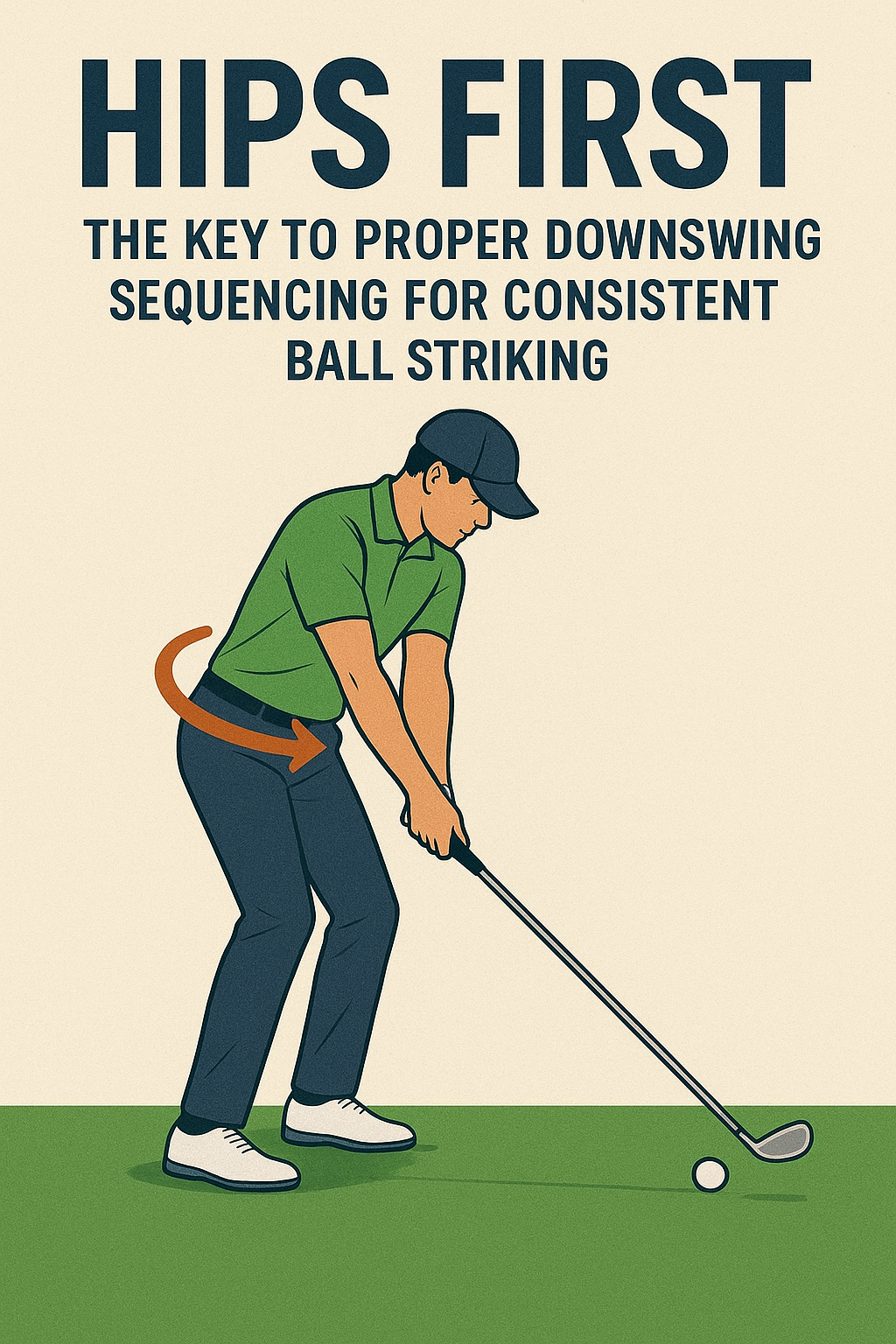
Sequencing in the Golf Swing: Start the Downswing with the Hips
This post focuses on a single, critical concept for consistent ball striking: the sequencing of the downswing. In practical terms, Sequencing means the order in which your hips, torso, arms, and hands contribute to the downswing. The goal is to start the move with the hips turning toward the target, then let the torso and arms follow in a smooth, connected flow.
What the concept is
The downswing should unfold in a tidy, ground-up sequence:
- Hips initiate the move and rotate toward the target
- Torso follows, rotating to face the target
- Arms and wrists release through the ball with minimal early hand action
Keeping this order helps you maintain your spine angle, create dynamic lag, and deliver the clubface to the ball with solid and consistent contact.
Why it matters to the golf swing
Proper sequencing matters because:
- It maximizes speed from the ground up, not from the hands
- It helps you stay on plane and avoid over-the-top or scooping motions
- It reduces fat shots (thin contact) and thin shots (fat contact) by promoting solid, centered impact
When sequencing is off, you’re more prone to early arm release, loss of lag, and inconsistent ball flight.
What you should feel when doing it correctly
- You feel your belt buckle/hips rotate first toward the target
- Your weight shifts naturally onto your lead foot as you rotate
- Your chest and shoulders follow, but your wrists stay moderately cocked and your hands stay calm until just after impact
- The clubhead increases speed from the ground up, not from your arms only
A simple cue: think “hips first, then torso, then arms.” If the arms are leading, you’re likely breaking the sequence.
2–3 common mistakes and easy fixes
-
Mistake: Arms and hands fire first; the hips are late.
Fix: Practice slowly and feel the hips initiate the downswing. Use a mirror or video to verify that the hips move before the hands. A helpful cue is “hips first, hands last.” -
Mistake: Excessive sway or losing spine angle, which disrupts sequencing.
Fix: Keep a neutral spine angle and rotate around it. A towel under the arms can help you stay connected and prevent excessive side-to-side movement. Practice half-speed swings emphasizing rotation rather than lateral slide. -
Mistake: Early release or casting (wrists straighten too soon).
Fix: Maintain a light wrist hinge longer into the downswing. A simple drill is to pause the downswing briefly after initiating with the hips, keeping the wrists passive so the release happens closer to impact.
One easy drill to try
Drill: Hip-Start Slow-Motion Downswings
- Take your normal address position with a mid-iron or use a 7-iron.
- Perform the swing at about 50% speed. At the top, begin the downswing by rotating the hips toward the target while keeping the upper body quiet.
- Pause for a brief moment (0.5–1 second) with the hips rotated and your torso quiet, then continue through impact with a smooth, connected follow-through.
- Repeat 8–12 repetitions, paying attention to the order: hips → torso → arms.
Tip: Use a mirror or record yourself to confirm that the hips lead the move. The goal is a clean, coordinated sequence that produces solid contact without rushing or over-rotating.
Focusing on sequencing gives you a reliable framework for more consistent ball striking. Practice the drill, keep the cues simple, and let the body’s natural swing flow do the work.
Hips First: the Key to Proper Downswing Sequencing for Consistent Ball Striking
Why Hips First Matters
In golf, the quality of your ball striking hinges on how smoothly the clubhead travels through the
impact zone. A downswing that starts with the hips—often described as “hips first”—sets up
the proper sequence of body parts working in harmony: hips, torso, arms, adn finally the hands
delivering the clubhead to the ball. When the hips initiate the downswing, you can maintain lag,
generate power from ground forces, and produce more consistent contact.
- Improved contact: a clean, centered strike becomes more repeatable when the lower body leads the swing.
- Enhanced speed with control: initiating from the hips fosters efficient energy transfer up the kinetic chain.
- Reduced inconsistency: timing becomes less reactive and more repeatable when you follow a hip-first sequence.
Note: “hips first” does not mean you fling your hips wildly toward the target. It means a deliberate,organized
sequencing where pelvic rotation initiates the downswing,coordinating with the torso and arms as you approach impact.
How Downswing Sequencing Works: A Speedy biomechanics Review
The golf swing is a dynamic kinetic chain. Proper sequencing translates to how efficiently forces are
transmitted from the ground up through the hips to the club. When you start the downswing with the hips, you
create a forward transfer of energy that helps preserve the angle between the lead arm and the club—a
phenomenon golfers call lag. If the arms start the downswing first, a few negative outcomes can occur:
- Early extension or slide of the pelvis, reducing the potential for power.
- Lack of lag, causing early release and distance penalties.
- Inconsistent contact and direction due to timing conflicts among body segments.
The Kinetic Chain and Sequencing
Think of the body as a whip: the energy starts from the ground, travels through the legs and hips, up the spine,
and finally into the arms and hands to deliver the clubhead. A hips-first downswing reinforces this chain by
effectively using ground reaction forces and pelvic rotation to generate leverage.
Ground reaction forces and Pelvic Rotation
ground reaction forces drive through the feet into the legs,then into the hips.When the hips rotate toward the target
first, you help the torso stay in a stacked, stable position, allowing the spine to maintain posture while the arms
are guided into the correct angle. This helps you hit down on the ball with more predictability and control.
Practical Drills to Teach Hips-first Downswing
Below are drills designed to ingrain hips-first sequencing without overthinking the mechanics. Practice them slowly,
then gradually build tempo as you feel the sequence settle.
The Pelvic Turn drill
Stand with your feet shoulder-width apart. Take your grip and address the ball as you normally would. Focus on
initiating the downswing with a subtle rotation of the pelvis toward the target while keeping your upper body quiet.
Stop before you reach impact, then repeat. The goal is to feel the hips “turning” first, followed by the torso.
Hip Bump with Wall Drill
Place a small cushion or rolled towel between your hips and a wall. From the top of the backswing, bump the lead hip
toward the target while maintaining posture. The wall serves as a cue to prevent excessive lateral movement and to
emphasize a clean hip lead into the downswing.
Step-Through Drill
Start with a short backswing, then step forward with the lead foot into the left side (for right-handed golfers) as you
rotate the hips.This drill trains the timing of hip initiation with leg movement, creating a natural transition into a
powerful, on-plane downswing.
Stop-At-Impact Drill
Take slow practice swings, stopping at the moment of impact. Check if the hips have led the sequence and if the torso and arms
are reacting in the correct order. Repeat, gradually increasing speed while preserving the hip-first feel.
Medicine Ball Rotation Drill
hold a light medicine ball at chest height. From the top of the backswing, rotate the hips aggressively toward the target while
keeping the ball near the chest until impact. This drill reinforces continuous hip drive and sequencing without rushing the arms.
Benefits of Hips-First Downswing
- Consistent strike pattern across multiple clubs and trajectory settings.
- Enhanced clubhead speed through efficient sequencing and lag preservation.
- improved balance and posture during the swing, reducing compensations with the upper body.
- Better contact on the sweet spot, leading to more predictable ball flight and dispersion.
- Reduced tendency to flip or cast the club due to better timing and energy transfer.
Case Studies: Pro vs Amateur
Case studies illustrate how hip-first sequencing translates into real-world improvements. The core idea is that a
small, repeatable hip initiation cue can transform a swing that frequently misses the center of the face into one that
consistently finds the sweet spot.
Professional Player: Smooth, on-Plane Transitions
A touring pro who previously struggled with a late hip action realized that a deliberate hip-first cue allowed the torso to
stay stacked while the arms remained relaxed. In a short period, their dispersion tightened by 25% and driving distance
increased marginally due to more consistent contact. The key takeaway was that hip initiation didn’t reduce power; it
improved timing and repeatability.
Amateur Golfer: From Swing Chaos to Consistency
An amateur member of a club struggled with a slice and inconsistent contact. After adopting hip-first downswing drills and
a few coaching sessions focusing on pelvic rotation before the torso, they gained a more repeatable pattern. Their ball flight
became straighter, and their greens-in-regulation improved as they stopped compensating with excessive hand action.
First-Hand Experience: A Practitioner’s View
In coaching sessions, many players report fewer guided misfires when the hips lead. One student described the sensation as
feeling “the barrel of a cannon” unloading through impact: the hips initiate the motion, the torso follows, and the hands
stay connected to the club. This mental cue helps align practice with the physics of the swing, rather than chasing
rapid arm speed that often leads to inconsistent contact.
Practical takeaway: start with a hip-led feel in the set-up, practice with slow tempo, then weave in tempo, always
verifying that the hips are first to move in the downswing. With time, the body learns the sequencing and gains effortless
ball-striking consistency.
Common Mistakes and How to Fix Them
Understanding frequent missteps helps reinforce hip-first sequencing. Here is a concise guide to address them in practice sessions.
| Mistake | Correct Cue | Impact |
|---|---|---|
| Arms outrun the hips on the downswing | Feel the hips rotate first; keep the arms passive until hips lead | Improved lag, better contact, more consistent distance |
| Early extension or jump of the pelvis | Maintain spine angle; rotate hips toward target without lifting the chest | Better sequencing and balance through impact |
| Weight stay on the back foot during transition | Shift weight to lead side as the hips rotate | Stable base; more efficient energy transfer |
| Too much lateral hip movement (sway) | Controlled pelvic rotation with minimal side-to-side sway | Cleaner path and less compensatory hand action |
Further Reading and Resources
If you want to dive deeper into the biomechanics of the downswing and hip-first sequencing, consider consulting the latest evidence-based coaching articles,
biomechanics papers, and video tutorials that demonstrate hips-first cues in slow-motion. Practicing with a measurable plan—such as tracking
contact quality, dispersion patterns, and clubhead speed—helps translate theory into tangible improvements on the course.
Cues at a Glance: Hip-First Downswing
| Cue | What to Feel | When to Use |
|---|---|---|
| Lead with the hips | Feel the pelvis rotate toward the target first | Transition from backswing to downswing |
| Keep the torso stacked | Maintain spine angle as hips lead | Through impact to maintain lag |
| Weight toward the lead foot | Shift weight as the hips rotate | During the downswing sequence |
| Relax the arms | Arms stay connected, don’t “pull” with the hands | All the way to impact |