
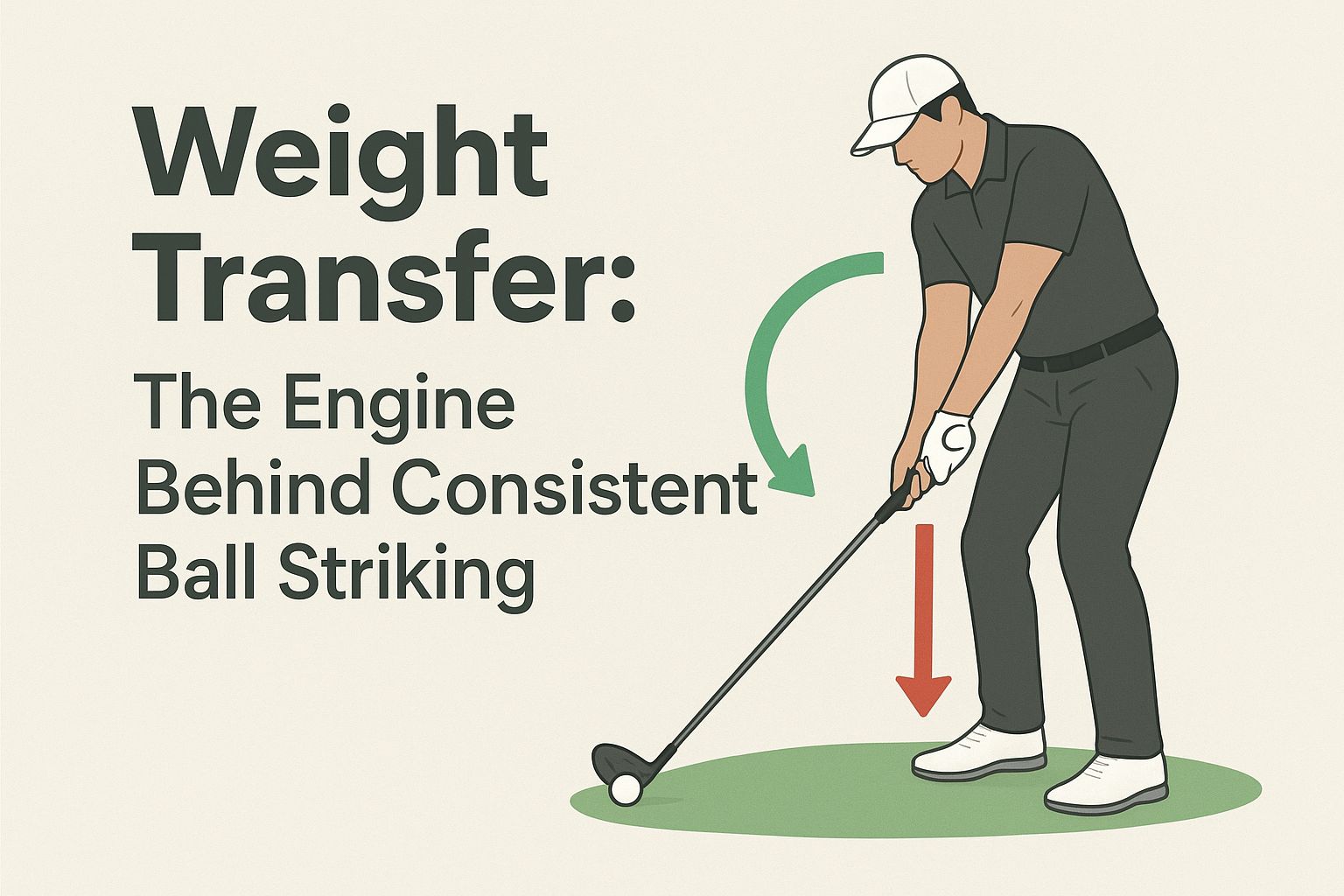
Weight Transfer: The Engine Behind Consistent Ball Striking
Today we’re zooming in on one core concept that quietly drives accuracy and distance: weight transfer. For most amateur players, how the body moves its weight from the back foot to the front foot defines how cleanly the club meets the ball.
What the concept is
Weight transfer is the deliberate shifting of your center of mass from your trail (back) foot toward your lead (front) foot during the downswing and into the follow-through. It isn’t about rushing or swaying; it’s a controlled transfer that keeps your balance, preserves spine angle, and helps the club strike the ball with solid impact.
Why it matters to the golf swing
- Improved contact: a forward shift helps the club meet the ball when the clubface is square to the target.
- Better compression and distance: transferring weight into the ball without hanging back boosts speed and stability.
- More consistent ball flight: energy is released through the bottom of the swing arc, reducing thin or top-heavy shots.
What the golfer should feel when doing it correctly
- Pressure building in the lead foot as you approach impact.
- A slight rise of the trail heel as your hips rotate toward the target.
- Chest staying over the lead leg; your hips rotating and your spine angle staying fairly constant.
- Finish with most of your weight on the lead foot and a balanced, controlled finish line.
2–3 common mistakes and fixes
- Mistake 1: Not transferring enough weight forward (too “backward” through impact).
Fix: feel the pressure shift into the lead foot during the downswing. Practice with slow tempo and a slight pause at impact to confirm weight is moving forward rather than staying on the back foot. - Mistake 2: Excessive lateral movement or sway (hips slide instead of rotate).
Fix: focus on rotating the hips toward the target rather than sliding your pelvis. A simple cue is to imagine your belt buckle pointing at the target as you rotate, not swinging your hips side to side. - Mistake 3: Weight shift happening too early or too late.
Fix: train a deliberate “load–turn–forward” sequence. Start with a slower backswing, then feel the weight begin moving forward as you transition from the top, not before the takeaway or after impact.
One easy practice drill you can do at home or at the range
Step-Through Weight Transfer Drill
- Stand with feet shoulder-width apart and hands resting on the hips or holding a club lightly across the shoulders.
- Take a small backswing (about a quarter swing) and pause at the top.
- Shift your weight toward the lead foot and step your trail foot forward into a shallow, controlled swing. As you swing through, finish with your weight solidly on the lead foot.
- Repeat 8–12 reps, focusing on feeling the load into the front side and a balanced finish. Do not rush the step or the turn—tempo matters.
Final notes
Weight transfer is a foundational element of consistent ball striking. When you can feel and control this shift, you’ll notice crisper contact, more solid feel at impact, and more repeatable results across clubs. Practice with patience, and use the drill above to ingrain the sensation of moving efficiently from back to front through the swing.
Weight Transfer: The Engine Behind Consistent ball Striking
What is Weight Transfer and Why It Matters
Weight transfer is the intentional movement of your body’s mass from one area to another during a ball strike. In practice, it means loading your weight on the back foot during the backswing and then shifting smoothly toward the front foot as you make contact with the ball.This sequencing is the key to harnessing momentum,maintaining balance,and maximizing both power and precision.
The core idea is simple, but the execution is highly nuanced. when you transfer weight efficiently, you engage a continuous kinetic chain—from the ground up: feet, ankles, knees, hips, torso, shoulders, arms, and finally the club or racket. if the chain is interrupted or mistimed, you lose energy, misalign your body, and your contact quality suffers.
Practical takeaway: weight transfer is less about “how hard you hit” and more about “how well you move your body through the hit.”
Key Biomechanical Concepts Behind Weight Transfer
Understanding the biomechanics helps you train more effectively and fix faults at the source rather than just chasing symptoms.
- Kinetic Chain: A continuous transfer of energy from the ground through the legs, hips, torso, and arms to the ball.
- Ground reaction Forces (GRF): The force your feet exert on the ground, which pushes back through your body to generate momentum.
- Center of Gravity and Balance: Maintaining a stable center of gravity while shifting weight avoids excess sway and preserves swing plane.
- Sequencing and Timing: The order and speed of hip, torso, and arm rotation determine how cleanly the club meets the ball.
- Posture and Spine Angle: A consistent spine angle provides a reliable platform for a repeatable weight shift.
How Weight Transfer Drives Consistency Across Sports
Golf: From Ground to Green with a Smooth Forward Shift
In golf,the weight transfer journey begins at address. A stable stance with slight knee flex allows you to load the back leg without losing posture. As you start the downswing,the hips begin the uncoiling,and weight moves toward the front foot just as the arms release the club toward the ball. The result is solid contact and a consistent ball flight.
Common golf cues include “keep your head steady,” “feel the load into the back foot,” and “drive through the belt buckle toward the target.” When weight transfer is dialed in, players report less dispersion of shots and improved launch angles.
Tennis: Ground Contact to Racket Through efficient Hips-to-Shoulders Sequencing
For a powerful tennis stroke, weight transfer helps you generate racket head speed without excessive arm effort.The back foot presses into the court during the backswing, the hips rotate, and the weight shifts forward during the forward swing. The torso then unwinds toward the ball, converting lower body motion into racket speed while preserving shoulder stability.
Tennis players benefit from drills that emphasize footwork, early knee bend on the backing phase, and a deliberate transfer into the front foot at contact. Proper weight transfer reduces mishits and improves depth of shot.
Baseball: From Stance to Swing Path with Forward-Shifted Force
In baseball, the weight transfer concept is closely tied to the timing of stride and swing path. The hitter loads the back leg, rotates the hips, and then shifts weight forward as the front foot lands. The momentum from the lower body drives the upper body and the bat through the zone. A well-timed transfer helps produce explosive bat speed and clean contact.
Breakdown cues include “load, coiling the hips,” ”land and shift forward,” and “stay over the plate with balance.” When executed consistently, hitters can reduce mis-timing and improve exit velocity.
Essential Sequence: From Feet to Hands
Visualize weight transfer as a five-phase process that you can rehearse in slow motion to build consistency:
- Establish a stable base with balanced weight, a slight knee bend, and a neutral spine.
- Shift weight to the back foot, allowing the hips to load and the torso to coil. Maintain posture and avoid early extension.
- Initiate the torso and hip unwinding while the front foot remains grounded. The center of gravity should begin moving toward the midfoot.
- The hips and torso accelerate toward the target, transferring weight onto the front foot as the arms swing through.
- Achieve a balanced finish with weight over the front foot and a stable athletic posture, ready for the next rep.
Drills and Practice Cues for Mastery
These drills help you feel the correct weight transfer without overthinking. Use slow, controlled reps before increasing speed.
- Stand tall,take a small step back with the trailing foot,and then shift weight forward as you strike. Focus on keeping the spine angle and balance.
- Place two helmets or cones as a gate.Start behind the gate,load onto the back foot,and step through the gate while transferring weight to the front foot at contact.
- Sit or stand with light resistance; rotate hips and torso to throw a light medicine ball forward. This trains hip initiation and forward weight transfer in a controlled way.
- Use a mirror to monitor knee flex, spine angle, and how weight shifts from back to front during the swing.
Table: Speedy Comparison of Weight Transfer Across Sports
| Phase | Key Principles | Common Faults | Drills/Notes |
|---|---|---|---|
| Setup | Stable base, neutral spine, relaxed shoulders | Over-tilt, excessive tension, uneven weight | Posture checks, mirror view |
| Load (Backswing) | Load into back foot, coil hips | Back foot dominance fades, early extension | Back foot lead drill, slow-motion swing |
| Transition | Uncoil hips toward the target; midfoot balance | Premature release, sway | Tempo-focused drills, band resistance |
| Impact | Weight over mid-to-front foot; solid contact | Heel-heavy contact, mis-timing | Impact tape or foot-tracking cues |
| Finish | Balanced, ready for next rep | Head dips, loss of posture | Hold finish pose, video check |
Benefits and Practical Tips for Improving Weight Transfer
- Increased ball speed with control: Efficient weight transfer converts lower-body energy into faster club/racket speed without over-rotating the upper body.
- Better contact and consistency: A stable, repeatable transfer reduces off-center hits and enhances accuracy.
- Injury prevention: Proper sequencing reduces overload on the spine and shoulders by distributing force through the hips and legs.
- Adaptability across sports: The same principles apply whether you’re swinging a golf club, a tennis racket, or a baseball bat.
- Simple cues to reinforce: “Load, then shift,” “drive with the belt buckle,” and “stay balanced over the front foot at contact.”
Case Studies and Firsthand Experience
Case Study 1: Golf—From Inconsistency to Fairway Confidence
A recreational golfer with a high handicap struggled with off-center contact and inconsistent draw/fades. Working with a focus on weight transfer, the player began using a step-drill and mirror feedback to ensure a deliberate weight shift from back foot to front foot during the downswing. Over eight weeks,the golfer reported more consistent contact,a tighter dispersion pattern,and a modest increase in average driving distance. The key change was not forcing more power but improving sequencing and balance through the swing.
Case Study 2: Tennis—Forehand Power with Less Arm Strain
A club-level player faced elbow and shoulder strain due to aggressive arm-driven forehands. By emphasizing ground contact and a deliberate weight transfer through the hips, the player learned to generate racket head speed with leg and hip action rather than pure arm effort. Drills included a slow-motion forehand with a focus on loading the back foot, then shifting weight forward through the shot. After a season, timing improved, and the coach noted more consistent depth and pace with reduced arm tension.
case Study 3: Baseball—Explosive Swing Consistency
A young hitter trained with a focus on hip-initiated weight transfer and a controlled stride. The new sequence allowed the hitter to arrive at the ball with more forward-shifted weight, improving exit velocity and plate discipline. The training included a simplified drill: step, load, rotate, and strike with a stable front-foot finish. The result was steadier swing paths and fewer late hits on the hands.
common Faults and How to Fix Them
- Early weight shift onto the front foot leading to toss-out of pelvic stability.
- Fix: Pause slightly at transition, feel the hips initiating the move before the torso and arms follow.
- Fault: Remaining to rigid in the legs, causing a mechanical, linear swing.
- Fix: Allow a small knee bend to absorb ground reaction forces and enable a smoother transfer.
- Fault: Over-rotation of the torso without corresponding foot and hip position.
- Fix: Synchronize hip rotation with a controlled weight shift; maintain a stable spine angle for balance.
- Fault: Swaying or stepping off the line during the swing.
- fix: Use wall or line drills to keep the body centered while transferring weight.
Practical Takeaways for Everyday Training
- Start with a stable setup and gradual loading of the back foot before initiating forward weight transfer.
- Use slow-motion practice to feel the exact moment when weight shifts toward the front foot at impact.
- Incorporate drills that emphasize the seamless connection between hip rotation and forward weight transfer.
- Use video feedback to analyze knee flex,spine angle,and how weight shifts relative to the target line.
- Progress from stationary drills to controlled swings, then to full-speed rounds to build consistency under pressure.
Pro tip: Consistency comes from predictable, repeatable sequencing. Treat weight transfer as a rhythm you practice, not a binary push or pull.