
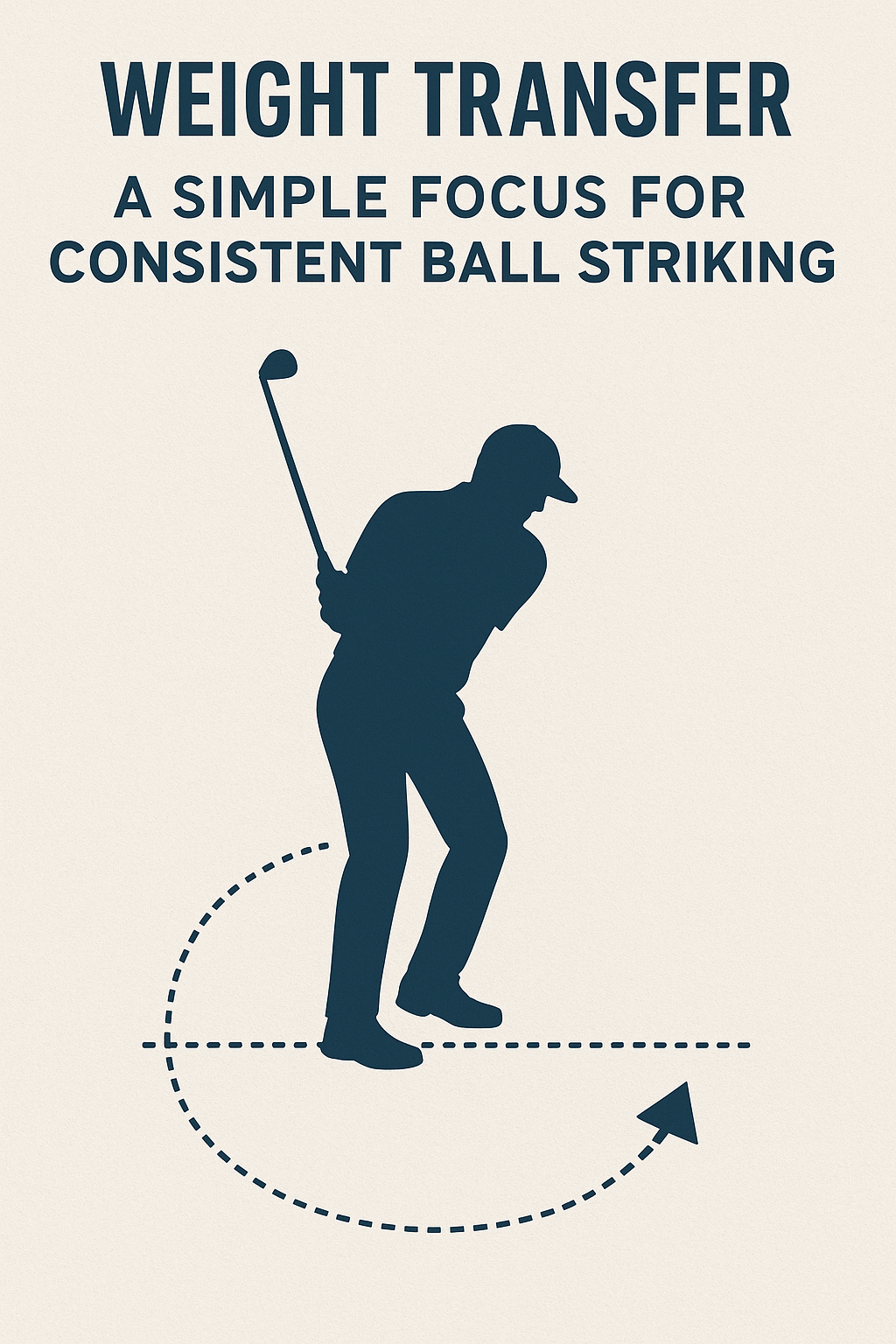
Weight Transfer: A Simple Focus for Consistent Ball Striking
What the concept is
Weight transfer is the movement of your body’s weight from your back foot (trail foot) toward your front foot (lead foot) during the swing. For most golfers, the critical moment is through impact when the weight should feel like it’s shifting forward rather than staying planted on the back foot. Think of it as a controlled, athletic move that helps the club face meet the ball with solid contact.
Why it matters to the golf swing
Proper weight transfer keeps your balance, supports a consistent swing path, and helps you strike the ball with the center of the clubface. If the weight stays too much on the back foot, you’re more likely to hit fat shots or thin shots and you’ll often lose power. If you crash too far onto the front foot too early, you can reach for the ball or lose lag and control. A smooth, intentional transfer through the shot leads to crisper contact and better distance control.
What the golfer should feel when doing it correctly
- In the backswing, you feel loading into the back foot without collapsing your posture.
- As you start the downswing, you sense your weight gradually moving toward the lead foot.
- At impact, the majority of your weight is on the front foot, with a stable base and a quiet head.
- Through the finish, your chest faces the target and you’re balanced comfortably on the lead foot.
2–3 common mistakes golfers make with this concept
- Mistake 1: Staying back too long and not transferring weight through impact.
- Mistake 2: Losing balance or falling backward after impact because the weight never fully shifts forward.
- Mistake 3: Moving weight too early or too abruptly, causing timing issues and loss of connection with the arms.
Simple, actionable fixes for each mistake
- Fix for Mistake 1: Practice a slow, deliberate shift. During half-swings, focus on feeling the right hip rotation and a gradual transfer of pressure to the lead foot as you approach impact. Don’t rush the transfer—smoothness wins.
- Fix for Mistake 2: Build a solid base. Maintain a slight knee flex and keep your spine over the center of your feet. Finish with your chest toward the target and your weight settled on the lead foot.
- Fix for Mistake 3: Sync weight shift with your swing tempo. Use a 2-count backswing and a 2-count downswing. If you feel timing slipping, pause briefly at the top of the backswing and then begin the transfer deliberately.
One easy practice drill you can do at home or on the range
Drill name: The Weight-Shift Slow-Motion Drill
- Stand with feet comfortable apart and distribute your weight evenly.
- Take a half-swing and keep most of your weight on your back foot as you load up.
- Begin the downswing and slowly shift your weight toward the lead foot, finishing with your chest facing the target and most weight on the front foot.
- Repeat 10–15 half-swings, focusing on a smooth, continuous transfer rather than a quick jump of weight.
- Progress to a full swing once you feel the transfer clearly in slow motion.
Tip: use a mirror or video to verify you’re finishing balanced with your weight forward. A steady, controlled transfer beats a fast, abrupt shift every time.
Weight Transfer: A Simple focus for consistent Ball Striking
Why weight transfer matters for consistent ball striking
In any sport where you strike a ball—golf, tennis, baseball, or even field hockey—success hinges on how well you move energy from the ground through your body and into the ball. Weight transfer, the deliberate shift of your body’s weight from one side to the other during the swing, is a simple yet powerful focus that raises the reliability of contact and the quality of the shot. When done correctly, weight transfer helps you:
- Initiate the strike with a solid foundation, reducing early head movement and miss hits.
- Improve timing by coordinating lower-body actions with upper-body rotation.
- Increase power without sacrificing control, thanks to better sequencing and ground reaction forces.
- Maintain balance through impact, which translates to more consistent ball speed and trajectory.
- Reduce stress on joints by sharing load between legs, hips, and core during the swing.
How weight transfer works in the swing
Weight transfer is a dynamic process, not a single move. It involves a controlled loading, shifting, and unloading of weight that travels from the back foot to the front foot (or from the dominant side to the non-dominant side, depending on your sport and stance). the goal is to align the body’s center of gravity with the path of the swing so that your limbs can deliver energy efficiently and consistently.
The stance and initial weight distribution
Before you swing, your weight should be evenly distributed along the base of support, with a slight bias toward the mid-foot to enable quick adjustments. In many sports, a small pre-load into the back leg sets you up for a smooth transition. key cues include:
- Keep the knees softly bent to maintain shock absorption and reactive force.
- Feel grounded through the balls of the feet, ready to push from the ground.
- Maintain a centered head position to preserve balance through the swing.
Shifting weight during the swing
During the swing,weight transfer unfolds in a sequence that helps your body generate power efficiently while maintaining control.A typical, sport-balanced sequence includes loading the back leg, rotating the hips and torso, then unloading weight toward the target side as you strike. Key aspects to focus on:
- Controlled loading of the trail leg (the leg opposite your striking side) during the backswing or backswing-like phase.
- Even trunk rotation with hips leading the lower body to create a clean chain of energy transfer.
- progressive weight shift to the lead foot at impact to maximize contact quality and power transfer.
- Minimal lateral slide that would reduce precision; aim for a directional, purposeful transfer rather than a slipping motion.
Ground reaction forces and sequencing
Ground reaction forces (GRFs) are the bedrock of effective weight transfer. The intention is to push against the ground with the legs in a way that channels energy upward and forward through the kinetic chain. Quality sequencing means your feet, ankles, knees, hips, and torso coordinate as a unit.practical cues to improve sequencing include:
- Focus on a smooth takeaway of weight from the back foot into the plantar surface of the back leg.
- Allow the hips to rotate before the shoulders to create a natural whip-like action that drives the hands through the ball.
- Keep the upper body tall and relaxed; tension makes timing harder and can disrupt the transfer.
- finish with a stable balance on the lead foot, indicating a successful transfer and controlled deceleration.
Practical tips to train weight transfer for consistent ball striking
Developing a reliable weight transfer requires deliberate practice, cues that work for you, and drills that reinforce the correct sequencing without overloading your joints. Here are practical steps you can incorporate into your routine:
- Start with mirror feedback or a video recording to see where your weight sits at setup, during the backswing, and at impact.
- Use a simple cue: “hips first, hands second” or “load, lift, drive” to remind your body of the sequencing.
- Practice with small, controlled reps (even without a ball) to ingrain the feeling of shifting weight smoothly from back to lead foot.
- Gradually add a ball and limit your swing to pleasant tempo until the transfer becomes automatic.
- Incorporate balance drills on one leg to improve your stability and control as you shift weight.
- Pair weight transfer practice with breath control to maintain relaxed shoulders and steady timing.
Drills and exercises to reinforce weight transfer (with concise steps)
Below are target-driven drills designed to elicit proper weight transfer. Each drill is purpose-built to be used in a warm-up or practice session before hitting balls.
1. Step-through weight shift drill
- Stand with feet shoulder-width apart and a ball in front of you.
- Take a small step forward with your lead foot as you begin the swing, allowing weight to transfer onto the lead foot at the moment of contact.
- Pause for a moment after impact, then step back to your starting position and repeat.
- Benefit: trains directional transfer and balance through impact.
2. Slow-motion top-down pause
- Perform a slow, controlled swing from setup to contact, pausing briefly at the top of the backswing and again at impact.
- focus on the feeling of pressure loading into the back leg, then shifting forward through the hips to the lead foot.
- Benefit: reinforces sequencing and control under reduced speed, cutting down momentum errors.
3. Ladder footwork for rhythm and transfer
- Place a mini ladder or a line of cones on the ground.
- Move through the ladder with small, quick steps while maintaining a stable spine and a slight knee bend, then perform a light strike at the end of the pattern.
- Progression: increase tempo gradually as you maintain balance and proper weight transfer.
- Benefit: improves footwork timing, which directly affects how well you transfer weight during the strike.
4. Static to dynamic transfer progression
- Begin in a static stance with equal weight distribution. Then, slowly transfer weight to the back foot and hold for a count of two before driving forward to the lead foot.
- Repeat with increasing speed, ensuring every transfer is deliberate and under control.
- Benefit: builds the confidence and control needed for consistent contact under pressure.
Common mistakes and how to fix them
A few recurring issues derail weight transfer and hurt ball striking quality. Here are the most common mistakes along with practical fixes:
- Early weight shift toward the lead foot before contact.
- Fix: Pause the hips slightly on the trail leg to ensure loading happens first,then transition forward as you strike.
- Mistake: Over-rotation without lateral weight transfer, causing an uphill strike path.
- fix: Emphasize a linear transfer from back foot to lead foot; let hips rotate in a coordinated manner with the lower body progressing forward.
- Mistake: Losing balance at impact due to excessive spinal tilt or poor posture.
- fix: Practice with a slightly taller posture and relaxed shoulders, focusing on foot-to-ground connection and a stable base.
- Mistake: Slipping or sliding the trail foot during the swing, reducing control.
- Fix: Build awareness of the trail foot’s role during loading and ensure the lead foot remains firm on the ground through impact.
Case studies and first-hand experiences
real-world examples can illustrate how focusing on weight transfer translates into tangible improvements in ball striking. Here are two anonymized scenarios based on common practice observations:
Case Study A: Amateur golfer’s betterment in consistency
A weekend golfer struggled with inconsistent contact and varying shot direction. After a four-week focus on weight transfer—coupled with video feedback and the step-through drill—the golfer began reporting tighter shot dispersion and more predictable ball speed.The key change was a deliberate shift of weight from the back foot to the lead foot that occurred slightly earlier in the backswing, allowing the hips to lead and the hands to follow through with better alignment. By the end of the program, the golfer noticed a 12–18 yard improvement in carry distance and fewer miss hits on both left and right sides.
Case Study B: Tennis player refining the forehand stroke
A recreational tennis player found that forehand shots felt labored and ofen flew long or short with inconsistent depth. A focus on weight transfer—loading into the back leg, rotating the hips, and unloading through the lead side—led to a smoother, more repeatable swing. The player reported improved net play, more depth on baseline shots, and less shoulder fatigue. The approach emphasized light grip pressure, a stable core, and timing the transfer with the forward swing rather than letting the arms do too much of the work.
Benefits of consistent weight transfer over time
Committing to weight transfer as a central focus yields lasting benefits that go beyond a single shot. Expect improvements such as:
- Sharper ball contact and more predictable ball trajectories across different shot types.
- Greater power without increasing swing effort, thanks to efficient energy transfer from the ground up.
- Enhanced balance and stability during the swing, reducing the likelihood of mis-hits and injuries.
- Better endurance and reduced fatigue, as energy is coursed through the body more efficiently rather than being absorbed by the upper body alone.
- A versatile skill set that transfers across sports, making training more time-efficient and transferable to multiple disciplines.
Progress tracking: simple metrics to measure weight transfer progress
Tracking progress helps you stay motivated and confirms that the focus is improving your performance. Here are practical metrics you can monitor:
- Rate ball contact on a scale of 1–5 in terms of solidness and consistency during practice sessions.
- Ball speed consistency: Measure average ball speed with a radar gun or app,noting reductions in dispersion.
- Balance stability: Record 5–10 seconds of static balance on each leg after impact; lower sway equals better transfer control.
- Foot pressure split: If you have access to pressure mats, monitor the shift from back foot to lead foot during the swing to ensure a smooth transition.
- Video review: Weekly 30-second swing clips can reveal progressive improvements in weight transfer timing and sequencing.
Lightweight, practical table: weight transfer cues and drills
| Phase | Cue / Focus | Drill | Expected Outcome |
|---|---|---|---|
| Setup | Balanced, slight mid-foot weight | Neutral stance with soft knees; hold for 5 seconds | Stable foundation for efficient transfer |
| Load | Back leg loading | step-through weight shift drill | Back leg energy stored, hips ready to rotate |
| Transition | Hips lead the movement | Slow-motion top-down pause | Clear sequencing from hips to hands |
| Unloading/Impact | Lead foot connection | Step-through to impact with hold | Consistent contact and forward energy transfer |
Note: tables like this are helpful anchors in WordPress posts, especially when you’re organizing drills and cues for readers. use the wp-block-table class to keep styling consistent with Gutenberg blocks.
Frequently asked questions
is weight transfer only crucial in golf?
no—weight transfer is a universal principle across ball-striking sports. The same concept applies to tennis, baseball, softball, field hockey, and even cricket.The specifics of how weight shifts may vary, but the underlying idea remains the same: move energy efficiently from the ground through the body to the ball.
How soon can I expect improvements?
Several athletes notice noticeable changes within 2–4 weeks of deliberate practice, particularly if drills are integrated into regular training and supported by video feedback. For others, it may take 4–8 weeks to develop strong, automatic sequencing depending on prior movement patterns and frequency of practice.
What if I have balance issues?
Start with balance-enhancing exercises such as single-leg stands, wobble board drills, and controlled slow-motion swings without a ball. Strengthening the core and lower body will support more reliable weight transfer and help prevent wobble during impact.
Bottom line: a simple,repeatable focus for consistent ball striking
Weight transfer is a simple,repeatable focus that can unlock significant gains in consistency and power across ball-striking sports. By establishing a solid setup,practicing deliberate loading and unloading sequences,and integrating drills that reinforce timing and balance,you can transform how you connect with the ball. The key is to keep the cues clear, the tempo smooth, and the transfer deliberate. Over time, your body will learn a more efficient energy path—from the ground up—that translates into cleaner contact, better control, and more confident performances on the field, court, or course.