
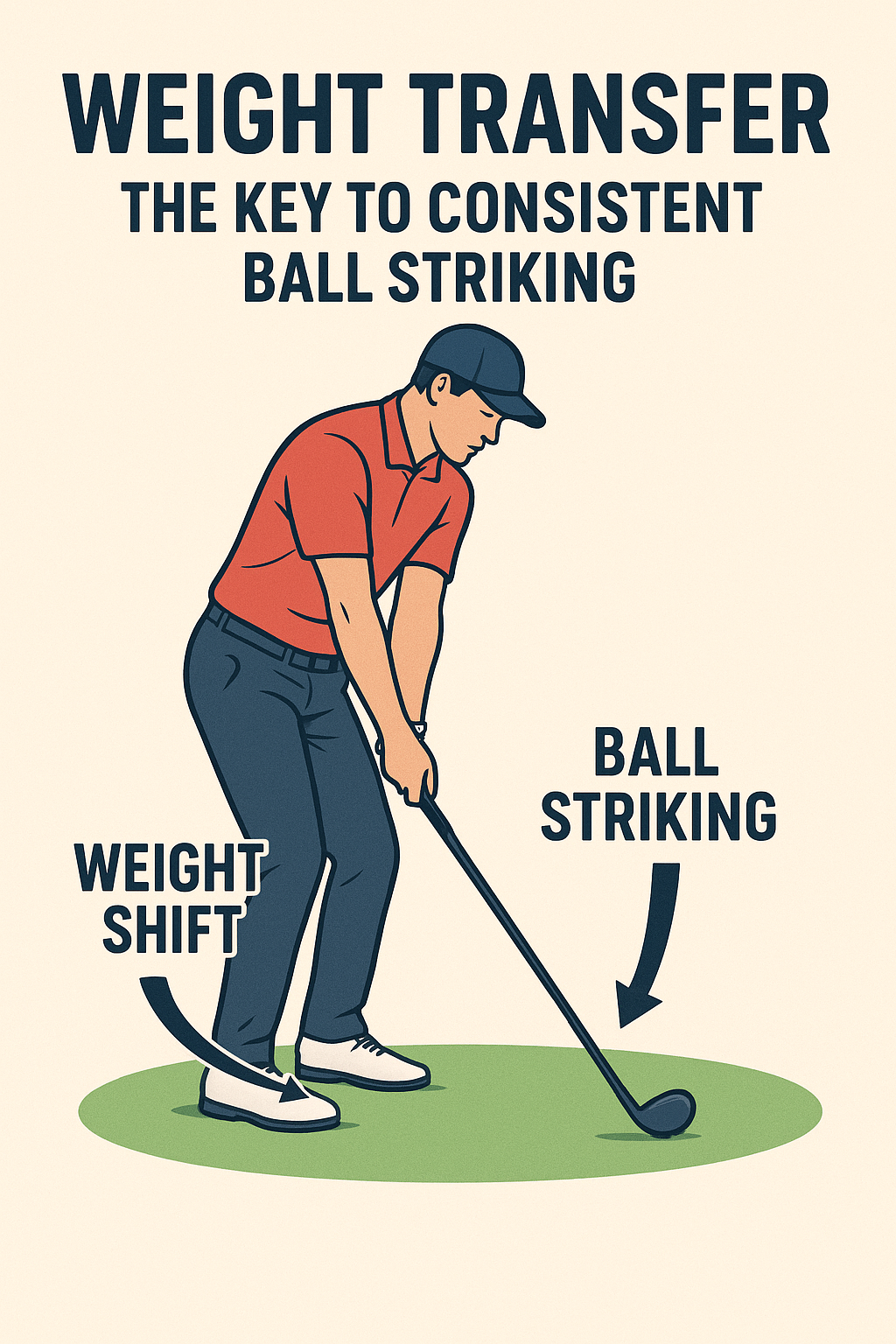
Weight Transfer: The Key to Consistent Ball Striking
When it comes to solid contact, many golfers focus on the hands or arms. The truth is simpler—and more powerful: moving your weight correctly from your trail foot to your lead foot through impact. This single concept, done well, unlocks better distance, straighter shots, and more consistent ball striking.
What the concept is
- Weight transfer is the controlled shift of your body mass from the back (trail) side toward the front (lead) side as you swing.
- At setup you should feel balanced. As you swing, your weight should move toward the lead foot and stay there through impact, with a smooth transition into the finish.
- Think of it as the body “loading” toward the target and then unloading into impact to compress the ball cleanly.
Why it matters to the golf swing
- Improves contact: proper weight transfer helps you strike the ball with a centered path and consistent low point.
- Boosts power: loading into the lead side stores energy that releases through impact, giving you more distance with less effort.
- Stabilizes the swing: a deliberate transfer reduces excessive lateral sway and helps your clubface stay square to the target.
What the golfer should feel when doing it correctly
- At impact, most of your weight is on the lead foot (roughly 60–75% of your body weight).
- Your trail knee flexes and your hips rotate toward the target, allowing the torso to rotate and the hands to release naturally.
- Balanced finish with your chest facing the target and your weight comfortably centered over the lead foot.
2–3 common mistakes and fixes
- Mistake 1: Not transferring weight at all
- Why it happens: the upper body pulls you through, but the legs/glutes don’t load or release properly.
- Fix: consciously feel the weight shift to the lead foot during the downswing. Use a slight knee bend in the lead leg and let the hips rotate toward the target.
- Mistake 2: Weight moves too early or too late
- Why it happens: shoulders and arms start the motion before the lower body is loaded, or the body shifts after impact.
- Fix: maintain spine angle and let the lower body lead the downswing. A simple cue: “load, then rotate,” and pause briefly at impact to feel the weight on the lead foot.
- Mistake 3: Excessive lateral sway or sliding off the ball
- Why it happens: a big shift to the side without turning the hips and core keeps you off balance.
- Fix: keep your center over a stable base. Practice without a ball, rotating your hips to the target while your upper body stays connected over your feet. A wall or step drill can help you feel your spine staying tall rather than collapsing sideways.
Simple, actionable fixes for each mistake
- To avoid staying on the back foot: practice half-swings focusing on loading the lead side. Pause at impact and feel 60–75% of your weight on the lead foot, then finish softly.
- To control timing: use the cue “load, then rotate.” With a towel under your lead foot, practice shifting weight onto the towel as you rotate into impact, then press into a full finish.
- To curb excess sway: keep your head fairly steady and turn your hips toward the target. A mirror or video check helps you confirm you’re rotating, not simply gliding sideways.
One easy practice drill you can do at home or on the range
- Pause-Impact Drill: Take your normal stance and swing to the point of impact. Pause for 2 seconds with most of your weight on the lead foot, then complete the swing to a comfortable finish. Repeat 8–12 times. This trains the feel of loading and unloading through impact and reinforces proper sequencing. If you’re unsure, use a mirror or record a quick swing to verify your weight is on the lead foot at impact.
Tip: keep sessions short and focused on this single concept. Once weight transfer feels more natural, you’ll notice crisper contact and more consistent ball flight without trying to “muscle” the swing.
Weight Transfer: The Key to Consistent Ball Striking
What is Weight transfer?
Weight transfer describes how a player moves their body’s weight from one foot to the othre through the stance during a swing or shot.In any ball-striking sport,the ability to shift pressure smoothly from the back foot to the front foot helps create solid contact,increased power,and better control over ball flight. Proper weight transfer is not about “lifting off” or “driving through” without sequence; it’s about a coordinated kinetic chain where ground reaction forces feed into the hips,torso,and upper body,culminating in a precise impact position.
In practical terms, weight transfer is the deliberate management of pressure across the feet as the body rotates and the arms and club (or racket/stick) move. When done correctly, the center of gravity stays within a dynamically balanced range, allowing faster clubhead or racket speed at impact without losing balance or timing.
Why Weight Transfer Matters for Consistency
- Contact location: Accurate weight transfer helps you strike the ball with the sweet spot or the center of percussion, reducing mishits and inconsistent ball flight.
- Power generation: Ground forces move up the body in a deliberate sequence, contributing to transfer of energy from legs through hips and torso to the upper body and finally to the implement.
- Tempo and timing: A well-timed weight shift aligns your swing arc with the ball, improving timing and repeatability across shots and practice sessions.
- Balance under pressure: In fast-paced rallies or high-pressure situations,proper transfer helps maintain balance,enabling controlled,solid contact even when under duress.
The Kinetic Chain: From Ground to Ball
A practical mental model for weight transfer is the kinetic chain: feet grip the ground,legs push,hips rotate,torso stabilizes,and limbs deliver the final impact impulse. Each link in the chain must fire in the correct order for maximum efficiency.
- Start by establishing a stable base. Plant the back foot with a slight knee flex and balance the weight toward the heel (golf) or the sole (tennis/baseball) depending on the stroke.
- As you begin the backswing or backswing-like motion, the majority of your weight should gradually move toward the back foot. This creates stored energy for the forward transition.
- The weight shifts from back to front as you rotate your hips and torso toward the ball. This is the critical “hit moment” where most power is released.
- At impact, pressure should be balanced, enabling a stable platform to release the club, racket, or bat smoothly toward the target.
Mastering Weight Transfer: Step-by-Step Plan
1) Setup and Stance
- Adopt a balanced athletic stance with feet shoulder-width apart for golf, or the appropriate distance for tennis/baseball. Knees slightly bent and athletic posture.
- Distribute weight evenly or slightly toward the middle of the feet to maintain stability at address.
- Keep the spine angle and posture tall enough to allow a smooth hip turn without losing balance.
2) Back Foot Load
- during the initial phase, allow the weight to settle toward the back foot (inside edge of the back foot can feel engaged).
- Feel the back-leg muscles starting to “brace” as you prepare to move into the forward swing.
- Avoid swaying; focus on a controlled weight shift instead of a lateral slide.
3) Transition and Hips Lead
- Initiate the transfer with a hip turn that generates torque. The hips should begin rotating toward the target before the arms accelerate.
- Keep the shoulders passive enough to allow the hips to lead the sequence, maintaining connection to the lower body.
- Pressure should shift from the back foot through the midfoot and forefoot as you rotate into impact.
4) Front-Foot Release
- As you approach impact, the front foot should feel loaded and ready to accept pressure without collapsing the knee.
- push slightly with the front foot into the ground to help release energy through the handle end of the tool (club/racket/bat).
- Maintain spine angle and a stable head position to keep contact consistent.
5) Through-Impact Coordination
- Finish with a balanced, athletic finish and a solid post-impact position that mirrors the setup stance.
- Avoid early release or “over-rotation” that decouples the hands from the lower body.
- Use grooves in your swing plane or stroke to keep the weight transfer linear and repeatable.
6) Feedback and Refinement
- Record your swing or stroke on video to verify weight shift sequence and balance.
- Use mirrors or a buddy to observe whether you’re maintaining posture and transferring weight evenly.
- Implement small, progressive changes to avoid breaking timing.
Drills and Practice Routines
Incorporate these drills into your practice week. Each drill focuses on reinforcing the weight transfer sequence and reducing common faults like excessive sway, early extension, or abrupt energy leaks.
- place a small towel under the back foot and practice keeping it in contact with the ground during the backswing, emphasizing load without lifting the heel. This enhances back-foot engagement and early weight transfer.
- After address, take a step with the back foot toward the target after impact, simulating a smooth transition and finish that preserves balance.
- Stand close to a wall and perform shadow swings, focusing on keeping a stable head and maintaining weight over the midfoot through impact.
- Record 5–6 swings per session and analyze ground contact, hip turn, and torso rotation timings. Compare to a known good swing and adjust.
- Use a light-weight position to practice transferring weight in a controlled arc, then apply to full-speed shots as form stabilizes.
quick-Reference Drills Table
| Drill | Focus | Common Mistakes | Tip |
|---|---|---|---|
| tied-Back Foot Drill | Back-foot engagement | Heel lift, sway | Keep towel contact; feel stable load |
| Step-Through Drill | Backward-to-forward transfer | Over-rotation, early extension | Drive steps toward target after impact |
| Wall-Shadow Drill | Head stability | Head moves off line | Keep head fixed; swing in a compact arc |
| Video Feedback Drill | Timing and sequence | Mis-timed transfer | Review and compare frames; adjust |
common Mistakes and How to Fix Them
- This can cause a late or rushed transfer. Fix by pausing at the top of the backswing and focus on a smooth, deliberate shift to the front foot.
- Replace lateral movement with controlled rotation. Keep a light knee bend and allow hips to rotate rather than slide sideways.
- Stand taller and maintain spine angle; work on pelvis movement to maintain a stable center of gravity during impact.
- Keep eyes level and head steady; use drills that emphasize balance and vertical control of the upper body.
Sports-Specific Tips for Weight Transfer
Golf
- Feel the weight shift from the back foot’s heel toward the front foot’s ball of the foot through impact.
- Maintain a slight knee flex and keep the spine angle steady to preserve swing plane.
Tennis
- Transfer happens quickly during a groundstroke; push off the back foot and rotate through the shot to contact the ball in front of the body.
- balance is key; keep the non-dominant arm extended to help with timing and mass distribution.
Baseball
- During batting, load weight to the back leg, then rotate hips toward the pitcher while transferring weight forward toward contact.
- keep the head steady and the eyes on the ball; aim for a balanced finish with weight over the front foot.
Othercautions
- Adjust weight transfer to different shot shapes or swing paths as needed; not every shot uses the exact same transfer pattern.
- In endurance sessions, gradually increase transfer speed while maintaining form to avoid injury and performance dips.
First-Hand Experience: Real-World Insights
A seasoned coaching client onc improved consistency by focusing on a simple cue: “feel the burn in the front foot.” After a few weeks of controlled transfers—back foot to front foot with deliberate rotation—the player reported fewer mishits and a more reproducible ball flight. the milestone wasn’t a dramatic power spike but a reliable, repeatable contact position. In another case, a tennis player used slow-motion video to calibrate weight transfer across the backhand and forehand, discovering they were tipping their weight too far onto the front foot before contact, which caused late timing. A corrected sequence led to cleaner contact and more consistent depth control.
Metrics and Feedback for Better Weight Transfer
- Ground reaction force measurements: Check how your feet push off the ground during the swing or stroke.
- Video analysis: Compare balance, head position, hip rotation, and the moment of weight transfer to ideal reference swings.
- Launch monitors and ball flight data (golf): Observe ball speed, carry, and spin to infer transfer efficiency.
- Feel-based cues: Use “back foot to front foot” or “hips lead” as a mental anchor to improve timing.
Benefits of Proper Weight Transfer
- Increased consistency in contact and ball flight across shots.
- Higher transfer efficiency leading to more power without sacrificing control.
- Improved balance and posture under fatigue.
- Better injury prevention due to a controlled, sequential motion rather than abrupt momentum shifts.
Practical tips for Everyday Athletes
- Practice with slow tempo first, then gradually increase speed while maintaining the transfer sequence.
- Use a mirror or partner feedback to confirm weight distribution changes through the swing or stroke.
- Integrate breathing cues to help relax the upper body and maintain rhythm during the transfer.
- Keep a neutral jaw and relaxed shoulders to avoid tension that can disrupt rotation and transfer timing.
Frequently Asked Questions
- Is weight transfer the same in golf, tennis, and baseball?
- While the underlying principle—efficient transfer of energy from the ground up—remains the same, the exact sequence and timing vary by sport due to different grips, stances, swing planes, and ball locations.Adapting the general concept to the sport-specific mechanics yields the best results.
- How long does it take to improve weight transfer?
- It varies by player, but with consistent practice (2–3 focused sessions per week for 6–8 weeks), most athletes notice clearer contact and more repeatable timing. The key is deliberate, low-stress training that reinforces the correct sequence without forcing speed.
- can weight transfer fix all swing faults?
- weight transfer is a foundational element. It helps with contact and power, but true consistency also depends on grip, tempo, swing path, and overall body mechanics. Combine weight-transfer work with targeted technique drills for best results.
Note on Structure