
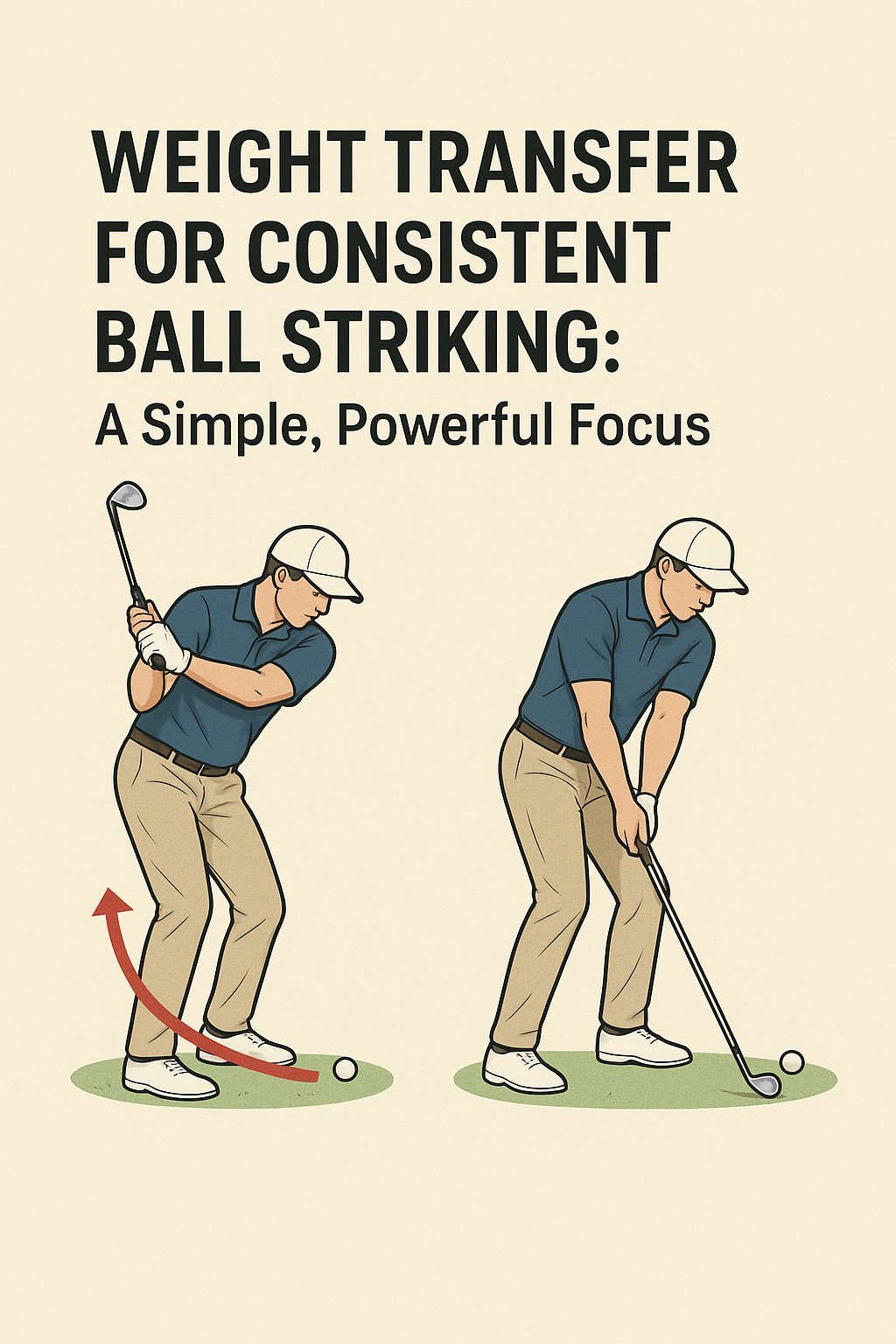
Weight Transfer for Consistent Ball Striking: A Simple, Powerful Focus
Today we’ll zoom in on one essential idea that governs how the club meets the ball: weight transfer. In plain terms, it’s the steady shifting of your body’s weight from the trail foot toward the lead foot as you swing and, most importantly, through impact. Done well, this transfer helps you hit the ball first, then the turf, with solid contact and solid direction.
What the concept is
- Weight transfer is a controlled move, starting in the backswing and continuing through the downswing and into the follow‑through. It’s not a quick stumble forward; it’s a rotation‑driven shift of pressure from the back foot to the front foot.
- Key ingredients are hip rotation, steady spine angle, and grounded feet. The goal is to let the body’s lower half lead the arms, delivering the clubhead to the ball with speed and control.
- For right-handed players, you’re moving weight from your right (trail) foot to your left (lead) foot; for left-handed players, the opposite.
Why it matters to the golf swing
- Improves contact: a proper transfer helps you strike the ball first and keep the clubface on plane, reducing fat and thin shots.
- Increases consistency: when weight shifts through impact, your path and timing become more repeatable, yielding straighter targets more often.
- Enhances power without overpowering: using the legs and hips to drive weight forward adds speed naturally, without overusing the arms.
What you should feel when done correctly
- You feel pressure build and move from the trail foot into the lead foot as you approach impact.
- Your hips rotate toward the target, and your spine angle is maintained (you don’t “stand up” or leak height).
- At impact, most of your weight sits over the lead foot, with the trail leg gradually relaxing in preparation for the follow‑through.
- Balance remains solid: you finish tall, with the chest facing the target and the weight mostly on the lead foot.
2–3 common mistakes with fixes
- Mistake 1: Swaying or sliding laterally instead of turning
Fix: Practice with a wall drill. Stand with your back, hips, and head lightly touching a wall. Make half→three‑quarter swings while rotating the hips and keeping contact with the wall. This trains rotation over lateral movement. Also try a towel under the trail foot to limit sliding. - Mistake 2: Hanging back and not transferring through impact
Fix: Use a step‑through cue. After contact, step your lead foot toward the target to finish your swing. This forces the weight to move forward and helps you feel the transfer through impact rather than staying on the back foot. - Mistake 3: Weight transfer timing off (too early or too late)
Fix: Slow‑motion tempo drill: rehearse a 1‑2‑3 pattern—1) backswing, 2) transition with a deliberate weight shift to the lead side, 3) impact/finish. Keep the lower body leading and the arms following. You can practice with a pillow or alignment stick behind you to remind you not to dip or rise during the move.
One easy practice drill you can do at home or on the range
The Step‑Through Weight Transfer Drill
- Set up normally with a comfortable stance.
- Take a half‑swing and pause at impact, then step the lead foot toward the target, allowing your weight to finish on the lead foot.
- Repeat with a few more half‑swings, focusing on feeling the trail foot unload and the lead foot take over as you complete the motion.
- Progress to a full swing only after you consistently finish with your weight on the lead foot and good balance.
Short on space? Do the same drill with a chair behind you: rotate into impact while the chair gently supports your back, then step through to finish. The goal is a smooth, coordinated shift of weight that stays connected to your spine angle and rotation, not a punchy lunge or a slide off balance.
Focusing on weight transfer won’t overhaul your entire swing overnight, but it will anchor your ball striking. Practice these cues, stay patient with the feel, and you’ll notice cleaner contact, more distance control, and better targets lined up week after week.
Weight Transfer for Consistent Ball Striking: A Simple, Powerful Focus
Weight Transfer for Consistent Ball Striking: A Simple, Powerful Focus
At the heart of every clean, repeatable strike across sports is a well-timed and balanced transfer of weight. When you move your weight efficiently from your back side toward your front side during impact, you create a stable base, improve contact, and unlock more consistent ball flight. this section covers the core idea, the mechanics behind it, and why this focus matters whether you’re swinging a club, racket, or bat.
Core idea: how weight transfer drives consistency
- Ground connection: Your feet, ankles, and legs are the primary force producers. A deliberate weight shift keeps your center of gravity over a solid base.
- Sequenced movement: The transfer usually follows a sequence: hips initiate the shift, followed by the torso and finally the arms, leading to a solid, centered impact.
- Angle and spine stability: Maintain spine angle as you transfer weight so that your torso can stay over the ball and avoid tipping forward or backward.
- Timing over force: speed and power come from well-timed weight flow, not from jerky or abrupt effort through impact.
Tip: think of weight transfer as a controlled glide from back foot to front foot, not a jump or sudden lunge. Great contact often follows a quiet upper body and a fast, efficient lower-body sequence.
Why weight transfer matters across sports
Weight transfer is a global mechanic that translates to several measurable benefits, no matter the ball sport.By understanding and practicing this focus, you can improve:
- Consistency of contact: Reduced fat-footing and fewer mishits.
- Shot trajectory control: More predictable ball flight with less variability.
- Power generation: Greater impulse through the contact zone without increasing swing effort.
- balance and endurance: Fewer early losses of balance, allowing longer practice sessions with better form.
In golf, tennis, and baseball, athletes who master weight transfer frequently enough report steadier offsets from windup to impact, less compensatory upper-body movement, and smoother follow-throughs.
How to Train Weight Transfer: practical Drills
Below are practical drills you can perform on the range, court, or field. They emphasize a smooth,deliberate shift of weight,while maintaining posture and balance.Adapt the drills to your sport and level.
1) Back-heel to front-heel transfer (static drill)
Purpose: Feel the transition of weight while staying grounded and balanced.
- Stand with feet shoulder-width apart, weight evenly distributed.
- Shift weight to the back foot as you raise the front foot slightly (or keep both feet flat if you’re a beginner).
- Slowly transfer weight to the front foot while keeping knees flexed and spine angled forward slightly.
- Hold for a count of two, then return to center. Repeat 12–16 reps.
2) Step-through drill (dynamic)
Purpose: Build momentum transfer in a natural stance and rhythm.
- Take a small step toward your target with the front foot as you shift weight forward.
- Lead with the hips, allowing the torso to rotate after the weight moves.
- Return to the starting position and repeat in the opposite direction.
- Perform 2–3 sets of 8–12 reps per side.
3) Medicine ball rotational throws (power transfer)
Purpose: Train the kinetic chain from ground to impact without relying on arm strength alone.
- Stand with feet shoulder-width apart, knees slightly bent. Hold a lightweight medicine ball at chest height.
- Rotate your hips and torso toward the target, transferring weight from the back foot to the front foot as you throw the ball sideways or forward (depending on space).
- Control the movement, avoid flipping through the ball, and focus on hip-to-shoulder sequencing.
- Do 6–8 throws, then switch sides if space allows.
4) Sport-specific integration: golf, tennis, baseball
- Golf: Practice half-swings with a deliberate weight tilt, keeping the spine angle constant through impact before finishing the swing.
- Tennis: Use a light racquet during drills to emphasize transfer, not raw arm speed. Maintain a stable core during contact on both forehand and backhand.
- Baseball: Batting practice with a tee or soft toss, focusing on shifting weight smoothly from the back foot into the front foot through the zone of contact.
Key principles and common mistakes to avoid
- Avoid early forward weight transfer: Shifting too soon can pull you off balance and ruin contact.
- Don’t lock the back knee: A rigid leg reduces energy transfer and robs you of torque from the hips.
- keep head and eyes steady: Excessive head movement disrupts timing and balance.
- focus on the sequence: Hip drive first, then torso, then arms for optimal transfer.
- Control, not force: Power comes from controlled sequencing; forceful shoves create inconsistency.
Benefits of emphasizing weight transfer
- Enhanced contact consistency across swings and strokes
- Improved ball/objet contact quality and trajectory predictability
- better balance under dynamic conditions (moving targets, changing wind, crowding pressure)
- Reduced risk of overuse injuries by distributing load more evenly through the kinetic chain
case studies and first-hand experiences
These short vignettes illustrate how a focus on weight transfer translates into real-world improvements.
Case Study A: Amateur golfer improves greenside consistency
A recreational golfer struggled with short-game consistency,frequently enough hitting fat or thin shots. By slowing the swing and emphasizing a deliberate transfer of weight from the back foot to the front foot through impact, the golfer reported tighter dispersion and more predictable distance control within two weeks of practice. The key adjustment was maintaining spine angle and letting the hips lead the transfer rather than forcing the hands through contact.
Case Study B: Tennis player lowers erratic baseline shots
A club-level player noticed wide variability in groundstrokes, particularly under pressure. Integrating a step-through drill and back-heel to front-heel transfer during practice sessions led to steadier contact,improved return depth,and fewer off-center hits. The player emphasized keeping the core engaged and letting the legs do the work during rallying.
Case Study C: Baseball hitter gains consistent contact in crowded innings
A hitter who repeatedly fouled off pitches due to timing issues started to focus on a small, controlled weight shift during the swing. Over a month, the hitter reported fewer late swings, improved line drive contact, and more consistent power because the weight transfer aligned with the bat speed and hip rotation.
Quick Reference: Drills in Action
Use this quick reference table to pick drills for warm-ups or specific problem areas. Short,simple,and actionable.
| Drill | Focus Area | How to Do | Common Mistakes | Reps / Time |
|---|---|---|---|---|
| Back-heel to front-heel transfer | Weight shift, spine angle | Shift weight from back foot to front foot with controlled knee bend | rushing, popping up | 12–16 reps |
| Step-through drill | Sequencing, balance | Take a small step while shifting weight forward; rotate hips first | Too much upper-body movement | 2 sets x 8–12 reps per side |
| Medicine ball rotational throws | Kinetic chain, power transfer | Rotate hips/torso, transfer weight, and throw with controlled follow-through | Arm-dominant throws | 6–8 throws per side |
| Tee work (baseball/golf) | Impact position | Slow, deliberate swings focusing on weight transfer through contact | Over-swinging | 5–10 minutes |
First-hand experience: personal practice notes
During my own coaching sessions, focusing on weight transfer changed the feel of the swing more than any single cue. Early on, students tended to “pull” through contact, losing balance. By guiding them to connect the transfer with a slight but steady hip drive and a quiet upper body, we saw more consistent impact lines and fewer twisting motions. The practice takeaway was simple: if the transfer feels smooth at the start, it will feel smooth all the way through contact.
Frequently Asked Questions
- Can weight transfer be overdone? Yes. Excessive backward lean or rushing the front foot can disrupt balance. The goal is a controlled, forward transfer that maintains spine angle and balance throughout the swing or stroke.
- Does weight transfer apply to all grips and stances? Most athletic swings benefit from some form of weight transfer. Adjustments may be sport-specific (e.g., wider base for tennis slices, slightly staggered stance for golf irons) but the underlying principle remains consistent.
- How long does it take to see results? Beginners might notice improvements within a couple of weeks with deliberate practice; seasoned athletes may experience faster gains when integrating the concept with timing and rhythm.
- Should I wear special shoes for weight-transfer drills? Stable footwear with a good grip helps, but the key is maintaining balance and correct sequencing. Start with flat, supportive shoes, then adapt as needed.
Putting it all together: a simple weekly plan
- 15 minutes of weight-transfer drills (back-heel to front-heel, step-through) + 15 minutes of sport-specific practice focusing on contact.
- 20 minutes of medicine ball work and rotational throws, followed by 10 minutes of slow-motion swing analysis or video review.
- On-court or on-field practice with emphasis on sequencing and balance; integrate light rallying or tee work.
- Rest or light mobility work; mental rehearsal of the weight transfer sequence.
- 4–6 weeks: Increase drill duration modestly and add a sport-specific pressure test (short game, tight rally, or hitting to target) to measure consistency gains.
Key takeaways
- Weight transfer is the backbone of consistent ball striking across sports.
- A smooth, sequenced shift from back foot to front foot improves contact, balance, and power.
- Combine low-composure drills (static) with dynamic, sport-specific practice for best results.
- Observe your own patterns, use video feedback if possible, and adapt drills to your comfort level.