
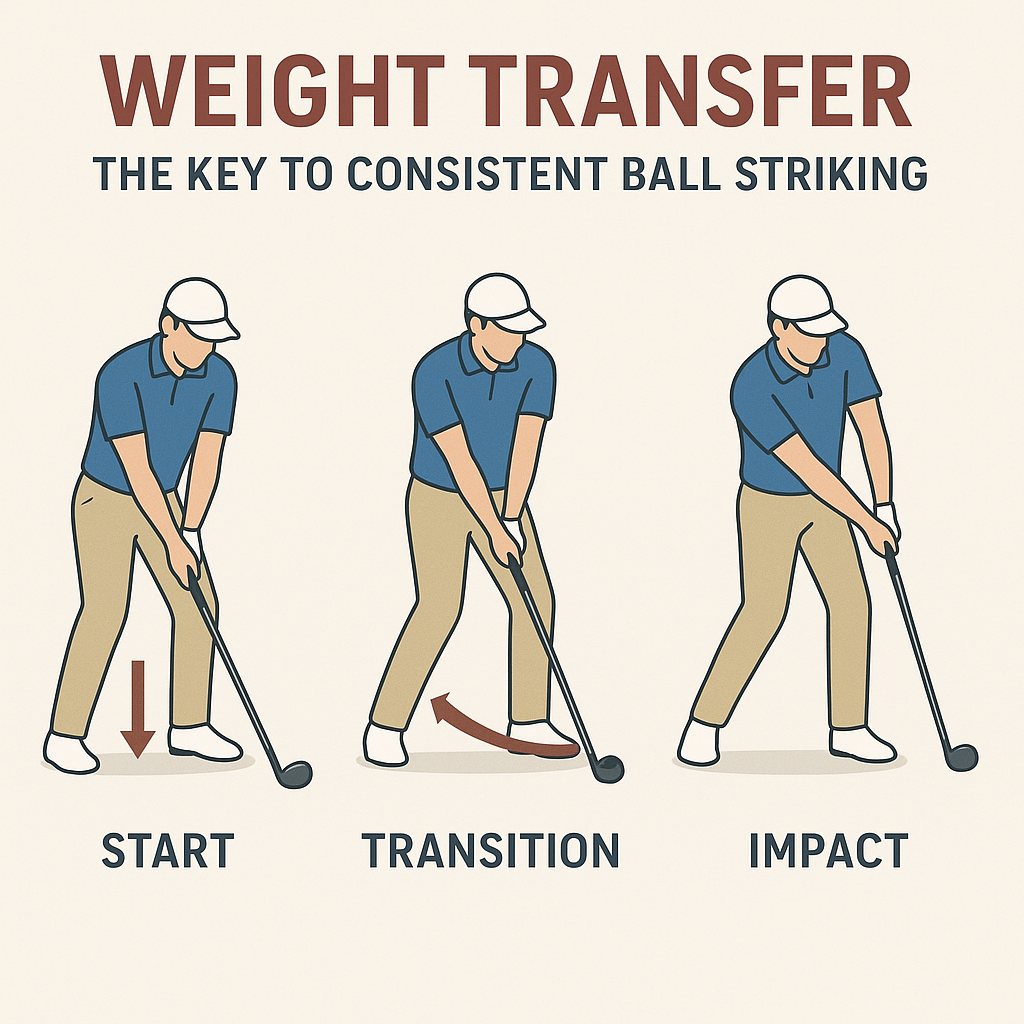
Weight Transfer: The Key to Consistent Ball Striking
For many golfers, the secret to solid contact isn’t just rotation or wrists. It’s how you move your weight through the swing. Focusing on weight transfer means you’re actively loading onto the trail foot, shifting toward the lead foot, and finishing with your weight forward. This single concept, practiced well, helps you strike the ball more consistently and control ball flight.
What the concept is
Weight transfer is the gradual movement of your body’s center of gravity from the back foot to the front foot as you swing. At address you’ll feel your weight balanced toward both feet. In the backswing, your weight stays mostly over the mid-foot or slightly toward the trail foot. In the transition and downswing, you progressively shift into the lead foot. At impact and through the finish, most of your weight rests on the lead foot, with your spine tilted slightly toward the target and your balance centered over that front side.
Why it matters to the golf swing
- It helps you compress the ball and make clean contact by keeping your hands in the correct relationship to the ball as you strike down.
- It supports a steady spine angle through impact, reducing fat or thin shots caused by weight being too far back or out of position.
- It promotes a more consistent strike pattern, because timing is tied to when your weight moves forward, not to an arbitrary arm motion alone.
What you should feel when doing it correctly
- At setup: a balanced feel, with slight contact pressure under the arches of both feet.
- During the backswing: the weight stays mostly over the middle of your feet; you’re prepared to shift, not already over the lead foot.
- During transition and downswing: you feel a deliberate press into the lead foot while the trail leg unwinds. Your hips rotate and your chest slowly faces the target while your balance remains centered.
- At impact and finish: your lead knee flexes slightly, the weight is shared forward onto the lead foot, and you finish tall with good posture and a stable finish line.
2–3 common mistakes and simple fixes
-
Mistake: Weight stays on the back foot too long and you “slide” laterally toward the target.
Fix: Think of your weight as moving along a vertical line from heel toward the lead foot, not sliding sideways. Initiate the downswing with an athletic hip rotation and chest turn while keeping your spine angle constant. Practice by feeling the center of gravity move from the back foot to the middle, then to the lead foot. -
Mistake: Weight shifts too early or too abruptly, causing loss of lag and crisper contact.
Fix: Delay the forward weight transfer until you’re down into the downswing and your hips start to clear. Focus on keeping your hands and wrists passive until the lower body is ready to lead. A simple cue is “drive with the hips, not the arms.” -
Mistake: Finishing with most weight back or out of balance after impact.
Fix: Finish with your weight over the lead foot and your chest facing the target. If you’re tempted to bail out early, slow down the finish and practice holding the finish position for a beat or two to reinforce the forward weight transfer.
A simple drill you can do at home or on the range
Slow‑Motion Weight Transfer Drill
- Take your normal address position and stand relaxed with light, balanced pressure on both feet.
- Slowly take the club back to a short backswing while keeping most of your weight near the middle of your stance.
- At the top, pause for a moment and feel the weight start to move toward the lead foot as you prepare to descend.
- In slow motion, begin the downswing by rotating the hips and chest toward the target, allowing the weight to progressively shift onto the lead foot. Do not rush; think of your weight “driving” forward as your arms unwind.
- Finish with the majority of your weight on the lead foot, spine tilted toward the target, and a calm, balanced finish. Repeat 8–12 half-swings, focusing on smooth transfers rather than power.
Tip: keep your head steady and your posture tall throughout the drill. If you can, club a mirror or use video to verify that your weight shifts forward rather than tilting excessively or sliding sideways.
By treating weight transfer as a deliberate, athletic move rather than a byproduct of the swing, you’ll notice more solid contact, improved consistency, and more predictable ball flight. Practice this focus next time you’re on the range, and bring the feeling to full-speed swings as you gain confidence.
Weight Transfer: The Key to Consistent Ball Striking
What Weight Transfer Really Is in a Golf Swing
Weight transfer refers to the purposeful shift of your body’s weight from the trail side (the back foot for right-handed players) through the center of gravity toward the lead side (the front foot) during the swing. This transfer is not a random happenstance; it’s a timed, repeatable sequence that unlocks power, accuracy, and solid contact. When done correctly, it aligns your center of mass with the path of the clubhead at impact, maximizing energy transfer from the ground up and helping you strike the ball consistently.
In a typical golf swing, the body stores energy in the ankles, knees, hips, and spine during the backswing, then releases that energy during the downswing.A well-timed weight transfer ensures the body’s segments move in harmony—feet,ankles,knees,hips,core,shoulders,and arms—so the clubface meets the ball squarely at the moment of impact.Without proper weight transfer, you risk thin or fat shots, off-center hits, reduced clubhead speed, and directional inconsistencies.
Why Weight Transfer Impacts Ball Striking
- Contact quality: Shifting weight toward the lead side at impact stabilizes your center of mass and keeps the clubface square to the target, improving solid contact.
- Distance and speed: A controlled weight transfer generates faster clubhead speed by effectively using ground reaction forces (GRF) from the legs and hips, feeding energy up the kinetic chain to the shaft and clubface.
- Direction and dispersion: Proper sequencing minimizes compensations that cause hooks, slices, or fading paths. Consistent weight transfer helps produce a repeatable swing arc and tighter shot dispersion.
- Ball position compatibility: The way you transfer weight interacts with your ball position and spine angle, reinforcing a stable path through impact.
- Tempo and rhythm: When weight shift is well-timed, your swing tempo becomes more predictable, which reinforces consistency across shots and course conditions.
The Biomechanics of Weight Transfer
Ground Reaction Forces and the Kinetic Chain
Every golf swing starts with the ground.Ground reaction forces push back against your feet as you load into the trail leg during the backswing. As you begin the downswing, you unweight and push off the ground, transferring energy up through the leg, into the hips, torso, arms, and ultimately into the club. This chain of energy transfer—the kinetic chain—relies on a coordinated sequence: lower body loading, hip turn, core stabilization, shoulder rotation, and finally the release of the hands and clubhead at impact. When weight transfer is synchronized with this chain, you convert more of the stored energy into ball speed rather than wasted motion or timing gaps.
The Role of Hips, Knees, and Ankles
the hips are the engine of weight transfer.A well-timed rotation and lateral weight shift initiate the downswing, allowing the lead leg to stabilize and drive the body toward the target. The knees function as dynamic shock absorbers, maintaining flex throughout the swing so you don’t dip or slide off balance. The ankles act as flexible fulcrums that allow subtle flexion and extension, maintaining posture and preventing excessive movement that can derail sequencing. Together, these joints create a stable platform that guides the clubhead on the desired path while maximizing energy transfer at impact.
Drills and Practice: Training Weight Transfer
The most effective way to ingrain proper weight transfer is a structured practice routine that blends setup, sequencing, tempo, and balance. Below are practical drills you can incorporate into your sessions. Start slow, focus on feel, then progressively increase speed and distance as your mechanics become more reliable.
Setup Essentials: Establishing a Foundation
- Feet shoulder-width apart with a slight athletic knee bend—weight evenly distributed, roughly 50/50 between the lead and trail foot.
- Maintain a stable spine angle and a quiet head position to help your centers of gravity stay aligned through the swing.
- Ball position should correspond to your club: longer clubs slightly forward of center; shorter clubs closer to the center line.
- Keep your weight ready to move, not to stall. Think of “owning” the ground under your feet before you initiate the backswing.
Sequencing Drills for Consistent Transfer
- Pump Drill: Start with a short backswing, pause for a beat at the top, and then initiate the downswing by transferring weight to the lead foot. This helps you feel the exact moment when weight shifts forward and the energy starts to drive through the ball.
- Step-Through Drill: From a square stance, take your backswing and step toward the target with the lead foot as you begin the downswing.the step acts as a physical cue for transferring weight cleanly to the front side.
- Turn-and-Release Drill: Pause at the top, rotate the hips open, and then release the hands through impact while allowing the trail heel to lift slightly. This emphasizes turning the hips from load to unload, which promotes efficient weight transfer.
Tempo and Timing Drills
- Three-Count Tempo: 1-2-3 rhythm for backswing and downswing.Think: load (1), accelerate (2), release (3). This cadence encourages a deliberate weight shift rather than a rushed, rushed swing.
- Slow-Motion to Real-Time: Practice at 50% speed focusing on the trail-to-lead weight transfer. Gradually build to full speed while maintaining control of transfer timing.
Stability and Balance Drills (Props and Tools)
- Practice half-swings on a balance board to enhance ankle stability and proprioception, reinforcing a solid base for weight transfer.
- resistance Bands: Place a loop around the hips or thighs while performing sways and light swings to reinforce controlled movement of the hips and torso during weight shift.
- Medicine Ball Toss: Standing with feet hip-width apart, twist and toss a light medicine ball to a partner. The movement trains rotational energy transfer from lower body to upper body, mirroring the swing’s weight shift.
Case Studies / Real-world Examples
These brief, illustrative cases show how improved weight transfer translates to better ball striking. The numbers are simplified for clarity and are intended to demonstrate relative improvements in performance metrics.
| Case | Before Weight Transfer | After Weight Transfer Training | Key Outcome |
|---|---|---|---|
| Player A (9 ➜ 5 Handicap) | Inconsistent contact; average clubhead speed 72 mph; dispersion wide | Consistent contact; clubhead speed 82 mph; tighter dispersion | |
| Player B (Scratch ➜ +2) | Head moves excessively to the ball; weight stalls during downswing | Balanced finish with forward weight transfer; improved carry | |
| Player C (Double- digits to single-digit) | Foot slip and late weight shift | Solid weight transfer; early release and cleaner impact |
First-hand Experience: A Coach’s Perspective
From coaching weekend golfers to competitive amateurs,I’ve seen how knowledge of weight transfer often separates good players from great players. One common scenario: a golfer who can generate power in the backswing but loses energy at impact due to late or inconsistent weight shift. By focusing on the cue of driving weight into the lead foot in the last third of the downswing and ensuring the trail heel rises at impact, the player begins to feel the clubhead accelerate through the zone where the ball is. The result is crisper contact, higher ball speed, and more predictable direction. The learning takeaway: weight transfer isn’t a single move; it’s a sequence you practice until it becomes automatic under pressure.
Benefits of consistent Weight Transfer
- Greater accuracy: A stable weight transfer reduces lateral body sway, promoting a straighter ball flight.
- Increased distance: Efficient energy transfer from the ground to the clubface yields higher ball speed without added effort.
- Enhanced consistency: Reproducible weight shift patterns lead to repeatable ball striking across different clubs and course conditions.
- Better posture and reduced injury risk: A controlled transfer supports proper spine angle and reduces compensatory movements that strain the back or hips.
- Improved mental focus: A defined sequence gives players a tangible cue system to trust under pressure.
Practical Tips for daily Practice
- Start every practice session with a 5-minute balance and footwork warm-up to prime the nervous system for weight transfer.
- Use a tee or alignment rods to ensure correct ball position as you train your transfer sequence.
- Record your swing from multiple angles.Look for a visible shift of weight from trail to lead foot around the transition and impact area.
- Keep your head steady and your eye on the ball through impact to reinforce the sensation of transferring weight toward the target.
- Gradually increase swing length and clubhead speed while maintaining a consistent transfer pattern. If you lose the transfer, reduce speed and reset the drill.
Swift Reference: checklist for on-Course Weight Transfer
- footing: athletic, balanced stance with slight knee flex
- load: noticeable weight shift into the trail leg during the backswing
- transition cue: initiate downswing with hip rotation and weight shift toward lead foot
- impact: weight is forward and centered; the lead knee stabilizes while the trail heel rises
- post-impact: maintain balance and a slight forward body tilt toward the target
- reflection: review impact posture, compare to previous shot, adjust stance or tempo as needed
Common Mistakes and How to Fix Them
- Mistake: Late weight transfer or staying posted on the trail foot through impact. Fix: Practice the pump drill to feel the forward shift just before impact and keep the lead foot firm as you strike the ball.
- Mistake: Swaying laterally rather of rotating into the shot. Fix: Focus on hip turn and core rotation,not moving the head backward or forward excessively.
- Mistake: Over-rotation causing a flip of the wrists. Fix: Maintain lag and a stable wrist set through impact; emphasize a clean, square release rather than dumping energy early.
- Mistake: Ball position and weight mismatch. Fix: Ensure ball position aligns with club length; adjust weight transfer timing to fit the club you’re using.
Not every golfer transfers weight at exactly the same rate or likewise. Factors such as height, leg strength, flexibility, age, and swing style (early vs. late pivot) influence your ideal weight transfer pattern. Here are quick personalization tips:
- If you have strong legs and excellent balance, you may be able to initiate a more aggressive weight shift with controlled hip rotation, increasing power without sacrificing control.
- If you have limited hip mobility,focus on maintaining posture with a smaller,more controlled weight transfer,prioritizing timing and clubface control over raw speed.
- For players with a late-release swing, emphasize a more pronounced weight transfer toward the lead foot to prevent early timing issues.
For those pursuing precision, consider recording swing metrics with launch monitors or video analysis. Track parameters like peak lead-side pressure, timing of center of mass shift, and correlation between weight transfer and clubhead speed. small gains in the timing of weight transfer can translate into meaningful improvements in carry distance and consistency on the course.
Weight transfer is the cornerstone of a repeatable, powerful golf swing.By understanding the biomechanics, embracing structured drills, and applying practical tips in practice and on the course, you can enhance ball striking consistency.The goal isn’t merely to move weight faster; it’s to move it with purpose—loading, transferring, and releasing energy in a controlled way that aligns with the club’s path to the ball. With deliberate practice, weight transfer becomes automatic, producing cleaner strikes, longer runs on the scorecard, and more confidence during pressure shots.