
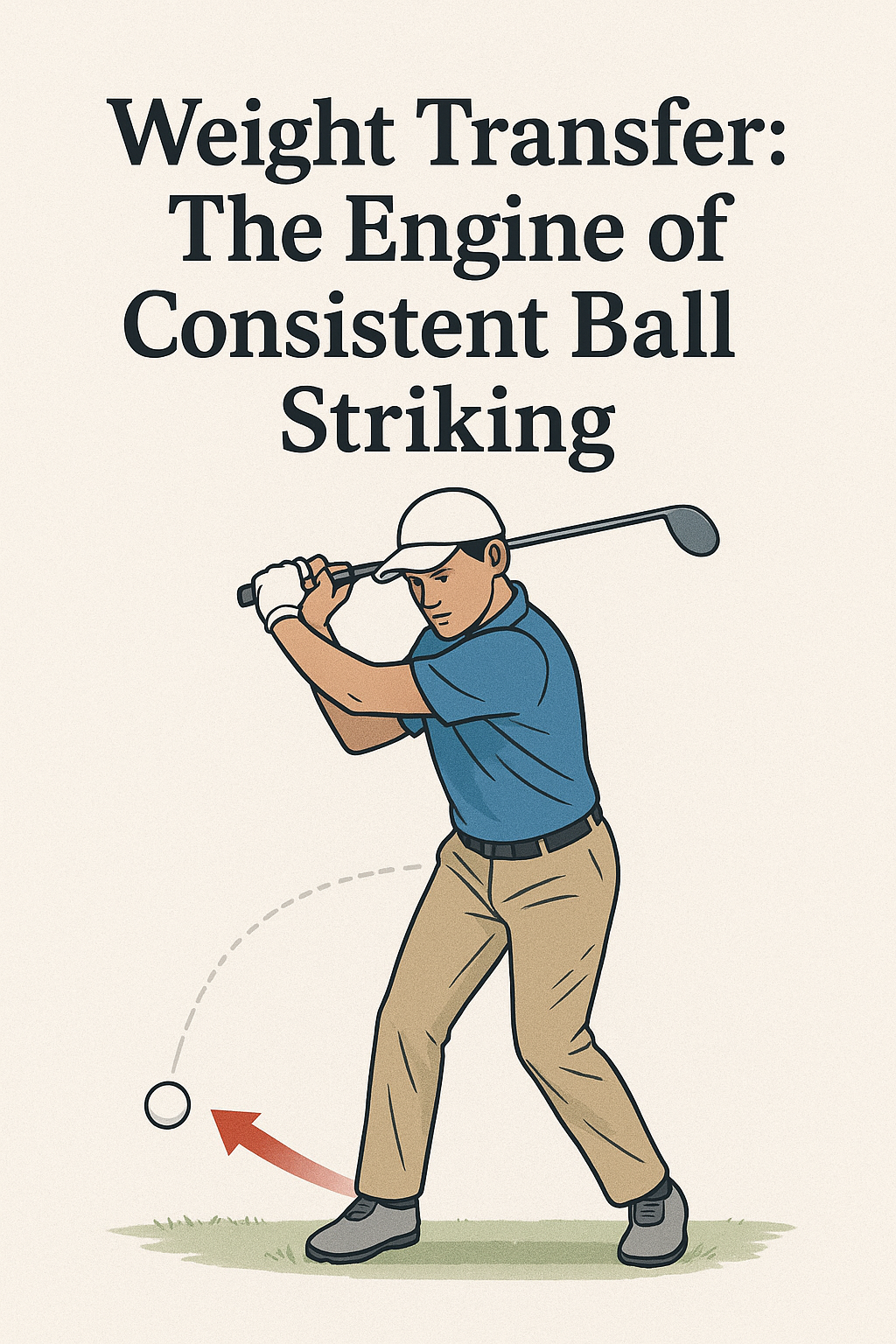
Weight Transfer: The Engine of Consistent Ball Striking
Today we’re focusing on one core concept that drives reliable contact and solid distance: weight transfer. Think of it as the deliberate move of your body’s weight from the back foot to the front foot as you swing. When done well, it supports a smooth downswing, solid contact, and consistent ball flight.
What the concept is
- Weight transfer is the controlled shift of pressure from your trail foot (the right foot for a right-hander) to your lead foot (the left foot) as you move from the backswing into the downswing and through impact.
- It involves your hips rotating, your spine staying relatively tilted and stable, and your center of gravity moving toward the target as you swing.
- Effective weight transfer helps you compress the ball, maintain spine angle, and avoid common misfires like fat shots or thin shots.
Why it matters to the golf swing
- It creates consistent contact: when weight shifts correctly, the clubface meets the ball with solid contact and the sweet spot more often.
- It improves strike quality and distance control: a clean transfer helps you retain speed and control through impact.
- It reduces swing faults like early extension, excessive slide, or “hitting behind” the ball, which can lead to pulls, fades, or slices.
What the golfer should feel when doing it correctly
- During the backswing, your weight gradually moves toward your trail foot as your hips rotate without your upper body “spilling” over your toes.
- In the downswing, you feel a deliberate shift back toward the lead foot, with your hips opening toward the target and your torso staying centered over the spine angle.
- At impact, most of your weight should be on your lead foot, with the trail foot lightly on its inside edge and your center of pressure moving toward the target.
- You should feel a steady, balanced rhythm rather than a sudden lurch forward or a hard halt.
2–3 common mistakes golfers make with this concept
- Sway or slide without turning: The body moves sideways instead of rotating, causing loss of balance and inconsistent contact.
- Staying on the back foot too long: Weight remains on the trail foot through impact, leading to thin or fat shots and a weak leftward path.
- Early weight transfer: The weight jumps to the lead foot before you’ve rotated the hips and torso, resulting in off-center hits and less power.
Simple, actionable fixes for each mistake
- : Drill your hips to rotate rather than slide. Practice with a mirror or through slow-motion swings focusing on turning the belt buckle toward the target at the top of the backswing. Maintain a slight spine tilt and keep the head centered over the ball.
- : Feel your trail foot gradually loading and your lead foot lightening on the inside edge as you approach impact. A quick checklist: hips open, weight shifting to the lead foot, and a quiet head. If you’re unsure, pause at the top of the backswing and rehearse the move by feeling your balance shift forward before you try to swing.
- : Focus on delaying the transfer slightly until you’ve completed a full hip rotation. A simple cue: “hips rotate first, feet follow.” Practicing with slow swings can help you sense the sequencing before increasing speed.
One easy practice drill you can do at home or at the range
- Step-Through Weight Transfer Drill
- Stand with your feet together and the ball at your normal address position.
- Take the club back with a normal swing, but as you start the downswing, step forward with your lead foot toward the target. Your weight should move from the trail foot to the lead foot as you step, while your hips rotate to face the target.
- Finish balanced with most of your weight on the lead foot and your chest facing the target.
- Do 2–3 sets of 8–12 swings at a comfortable speed, focusing on a smooth transfer rather than power. Progress to full speed over time.
By keeping your focus on weight transfer, you’ll build a more repeatable path to the ball and better overall contact. Remember: rotate the hips, shift the weight, and stay balanced through impact. If you practice this with intention, you’ll see clearer ball flights and more consistent distance, shot after shot.
Weight Transfer: The Engine of Consistent Ball Striking
Understanding Weight Transfer in Ball Striking
Weight transfer is the purposeful movement of your body’s weight from one part of the stance to another during the swing. It’s not about just shifting weight for power; it’s about coordinating gravity, balance, and the kinetic chain to create a stable, powerful impact. When done correctly, weight transfer helps you connect your hips, torso, arms, and club in a harmonious sequence, resulting in cleaner contact, more control, and reduced swing errors.
At the core of weight transfer is the concept of moving energy from the ground upward through your body to the club and ball. The ground reaction force acts as the foundation for everything that follows. A well-timed transfer optimizes this force, ensuring that the clubhead meets the ball with the right angle, speed, and compression. In biomechanical terms, weight transfer is the controlled rearrangement of the center of gravity (CoG) relative to the base of support, synchronized with limb and trunk rotation. Practically,this means learning how your hips rotate,how your spine tilts and tilts back to maintain posture,and how your lead foot and trail foot respond to the evolving plan of attack during the swing.
The Phases of Weight Transfer
Setup and Load
The starting position sets the stage for weight transfer. A balanced setup means your weight is distributed roughly evenly or favoring a slight load on the trail foot. The goal is to store potential energy in the lower body and core by coiling the upper body without losing posture or stability. Think of loading the spring: you load the hips and legs before the arms and club move.
Transition and Push-Off
As the backswing completes,the body transitions from loading to initiating forward movement. The hips begin to unwind,and the weight shifts toward the lead side. A smooth transfer relies on a stable pivot point in the ankles and knees, maintaining spine angle while the torso unwinds. The timing of this phase is critical: if the weight moves too early or too late,you’ll lose the lever needed to maximize speed and precision at impact.
Acceleration Through Impact
At impact, weight should feel like it’s squarely under the front foot or slightly past it, depending on the player’s style. This forward weight helps the club meet the ball with a solid low point and reduces the chance of early release or flip. A well-executed acceleration phase maintains balance, promotes linear momentum into the ball, and creates the ideal clubface path for the intended shot trajectory.
Recovery and Rebalancing
After impact, the body rebalances to prepare for the next repetition. Proper recovery involves a controlled deceleration, keeping the core engaged, and minimizing upper-body wobble as the arms swing through. This phase reinforces consistency as a repeatable post-impact position makes it easier to repeat the prior phases on the next swing.
Weight Transfer Across Sports
Golf
In golf, weight transfer is often the difference between a solid, solid contact and a miss-hit. A common cue is to “start the downswing by the hips,” ensuring the lower body leads and the arms follow with a stable spine. Proper weight transfer in golf reduces pairing errors like early extension or sway and helps you maintain a stable, athletic posture through impact.
Tennis
Tennis relies on rapid, precise weight shifts to generate pace and spin.The non-dominant foot acts as a hinge that supports approach toward the ball,while the dominant side loads,then unleashes energy through the kinetic chain. Efficient weight transfer improves shot depth, control, and the ability to recover quickly for the next ball.
Baseball and Cricket
In baseball and cricket,a clear weight transfer pattern supports powerful swings and fast bat-to-ball timing. Players often use a pronounced weight shift from the back foot to the front foot during the swing, which stores energy in the lower body and releases it through the arms. Consistency comes from training repetitions that lock in a repeatable transfer sequence despite different pitch speeds or ball trajectories.
Benefits of Proper Weight Transfer
- Improved consistency: Repeating a reliable transfer sequence reduces fluctuation in contact quality.
- Increased distance and power: Efficient energy transfer from ground to club or bat maximizes club speed at impact.
- Better accuracy and control: Proper sequencing stabilizes the club’s path and face alignment at contact.
- Enhanced balance and stability: A controlled weight shift minimizes over-rotation and sway, supporting better posture.
- Injury prevention: Balanced loading and unloading reduce excessive stress on the lower back and knees.
- Versatility across sports: The same principles of weight transfer apply to golf, tennis, baseball, and cricket, making technique transferable.
Practical Cues and Drills to Improve Weight Transfer
- Visual cue: Imagine your weight moving along a straight line from the trail heel to the lead toe during the downswing, maintaining contact with the ground until impact.
- Hip-first cue: Initiate the downswing with the hips while keeping the upper body quiet to preserve sequence and timing.
- Foot-ground cue: Feel pressure shift from the back foot to the front foot as you rotate toward the target, and maintain a steady spine angle.
- Tempo cue: Use a smooth, gradual load and a crisp, accelerated release to balance control and speed.
- Breath cue: Inhale on setup, exhale through impact to help coordinate timing and maintain posture.
Drills and practice Plans
Below are practical drills designed to reinforce weight transfer. Each drill emphasizes a repeatable transfer sequence and can be scaled for beginners to advanced players.
| Drill | What it trains | Setup | How to perform |
|---|---|---|---|
| Wall Drill | Posterior chain engagement; stability at impact | Stand close to a wall with your back approximately 6 inches away | Take a short backswing, then rotate hips and shift weight toward the lead foot while keeping contact with the wall to prevent over-rotation. |
| Step-Through Drill | Lead-limb sequencing; weight transfer to lead side | Small step with lead foot after contact | Hit from a tabletop or mat, plant lead foot, and step through with a controlled transfer of weight past impact. |
| Two-Ball Drill | Timing and sequencing; balance | Set up with two balls in a line, one just beyond the other | Hit the first ball focusing on a clean impact, then immediately shift weight into the second ball’s line with a smooth transfer. |
| Medicine Ball Turn | Core engagement; hip rotation | Light medicine ball (4–6 lbs) | Stand with feet shoulder-width apart, rotate hips to load, then explode through impact while maintaining spine angle. |
| Foot-Pressure Drills | Footwork and pressure patterns | Grip or mat to measure pressure | Perform swings while monitoring how weight shifts from back to front foot; aim for a steady, even transfer. |
case Studies and First-Hand Experiences
Case Study 1: The Golf Swing Tune-Up
A high-handicap golfer struggled with inconsistent contact and loss of distance. By focusing on a deliberate weight transfer sequence—loading the trail side, initiating the downswing with the hips, and finishing with balanced weight under the lead foot—the golfer achieved a measurable improvement in center-face hits and carry distance. After four weeks of dedicated drills (Wall Drill, Step-Through Drill, and Two-Ball Drill), ball striking improved from an average of 12 greens in regulation to 14–15 greens per round with fewer mishits.
Case Study 2: The Tennis Groundstroke Reset
A recreational tennis player found it hard to maintain pace and accuracy on backhand slices. A program focusing on weight transfer from the back foot to the front foot during each stroke, paired with hip-led rotation, restored consistency.the player reported steadier rallies and improved shot depth, especially on cross-court drives, after eight sessions combining on-court drills and the Medicine Ball Turn for core strength.
Common Mistakes and How to Fix Them
- Mistake: Early weight shift to the front foot, causing early release and loss of control.
- Fix: Emphasize hip rotation and a delayed downswing initiation; keep the trail foot connected to the ground longer during the setup.
- Mistake: Swaying or collapsing the spine during the downswing.
- Fix: Maintain spine angle by engaging the core and practicing drills that promote a stable base, such as the Wall Drill.
- Mistake: Over-rotation of the hips without the arms following correctly.
- Fix: Use sequencing cues to ensure the hips lead,followed by torso rotation,then arms and club.
- mistake: Inconsistent weight distribution in multi-planar shots (e.g., a slice or hook due to path changes).
- Fix: Practice with a fixed stance and focus on vertical weight transfer rather than lateral movement; use tempo cues to stabilize the swing arc.
Measuring Progress and Metrics
- Contact quality: percentage of center-face hits (CG contact) over a set number of swings.
- Carry distance and ball speed: track improvements with a launch monitor to quantify the impact of weight transfer changes.
- Consistency scores: rate shots by dispersion (left-right and up-down) over a fixed drill set.
- Balance and posture: monitor spine angle throughout the swing using a mirror or video analysis to ensure minimal deviation during transition and impact.
- Tempo and sequencing: measure how evenly weight shifts during the downswing and how quickly hips lead without breaking posture.
Key Takeaways for Players and Coaches
- Weight transfer is the engine of consistent ball striking.It ties together ground reactions, hip rotation, trunk stability, and arm action into a repeatable sequence.
- The phases—setup/load, transition/push-off, acceleration through impact, recovery—must flow smoothly and be practiced with targeted drills.
- Cross-sport principles apply: golfers, tennis players, and batters all rely on a clear, repeatable weight-shift pattern to maximize speed, control, and accuracy.
- Start with stance stability and hip-first sequencing, then layer in speed and ball-striking demands as proficiency improves.
- Use objective feedback (launch monitors, video analysis) and simple drills to measure progress and adjust cues accordingly.
rapid Reference Cheatsheet
| Cue | What to Focus On | Common Feel |
|---|---|---|
| Load | feel trail-side engagement | Coiling energy in the hips and legs |
| Transition | Hip initiation, spine stays angle-stable | Hips leading, torso quiet |
| Shift | Weight moves to lead foot | Solid base under lead foot |
| Impact | Ground under front foot; clean contact | Ball-first contact with crisp feedback |
| Recovery | Balanced finish; ready for next shot | Neutral posture, minimal sway |
putting It All Together: A Sample practice Session
Allocate 60 minutes for a focused session. Structure the time as follows:
- 5 minutes: Warm-up and mobility targeting hips, ankles, and thoracic spine.
- 15 minutes: Wall Drill and Step-Through Drill blocks to reinforce sequencing and stability.
- 15 minutes: Two-Ball Drill and Foot-Pressure Drills to integrate transfer with actual contact.
- 10 minutes: Medicine Ball Turn for core strength and rotational control.
- 10 minutes: on-course or on-range practice with real targets, emphasizing consistent weight transfer patterns.
Technical Considerations and Training aids
- Use a mirror or video analysis to monitor spine angle and hip rotation alignment. visual feedback accelerates the learning curve.
- Launch monitors, impact tape, or alignment sticks can quantify improvements in ball speed, launch angle, and face alignment at impact.
- Consider working with a qualified coach to tailor cues to your anatomy and sport.Small adjustments to stance width, knee flex, and shoulder tilt can have outsized effects on weight transfer.
FAQs: Weight Transfer and Ball Striking
- Q: Can I achieve consistent weight transfer with a short swing or a long swing?
A: Yes. The same sequencing applies, but the timing and feel will differ. practice both to build a versatile transfer pattern.
- Q: How long does it take to improve weight transfer?
A: It varies by individual, but consistent practice with structured drills typically shows noticeable improvements within 4–8 weeks.
- Q: Should I lock my knee on the lead side during impact?
A: No. A slight knee flex and dynamic stability help absorb pressure and maintain balance; avoid rigid, boxy stances.
- Q: Do I need to change equipment to optimize weight transfer?
A: Frequently enough not.Start with technique and drills, then adjust shaft flex, grip, or head weight if needed to match swing speed and contact quality.
Related Topics and Further Reading
- Biomechanics of the golf swing and the kinetic chain
- Torque generation and angular acceleration in athletic movements
- Injury prevention through controlled weight distribution
- Speed training and transfer of energy across sports
Author’s Note: Personal Experience with Weight Transfer
From a coaching perspective, the most transformative moment frequently enough arrives when a player notices the shift from a passive to an active weight transfer. That realization marks the transition from relying on strength alone to harnessing efficient biomechanics. In practice, weight transfer is less about force and more about timing, sequencing, and balance. when players master the sequence—load, transition, and transfer into impact—they unlock a repeatable swing that reliably translates practice into performance on competition day.