
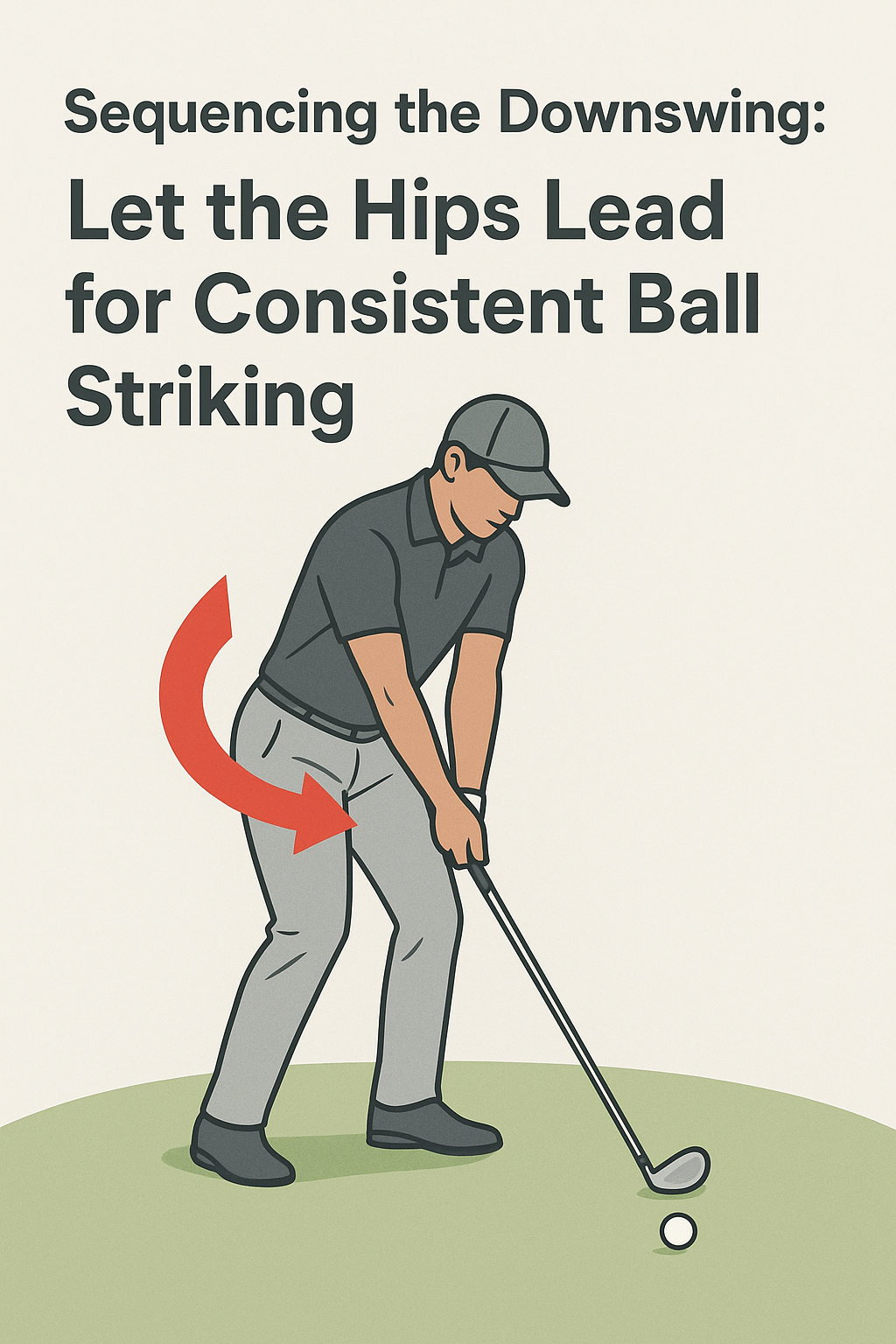
Sequencing the Downswing: Let the Hips Lead for Consistent Ball Striking
Concept — Downswing sequencing is the order in which your body parts move from the top of the backswing through impact. The core idea for most amateur players is to start the downswing with the hips, then the torso, and finally the arms and hands. When done well, energy is transferred from the ground up, the clubface stays square longer, and you’re more likely to make clean contact.
Why it matters — Good sequencing creates a smooth, powerful, and repeatable strike. When the hips lead, you:
- Maintain better spine angle and balance.
- Delegate energy from the ground up, increasing lag and clubhead speed at impact.
- Reduce common mis-hits like early release, over-the-top paths, or blocks and slices.
What you should feel when you’re doing it correctly
- Feel the hips rotate toward the target first, while the chest and shoulders stay relatively quiet for a brief moment.
- Feel your weight shift toward the lead foot as the hips turn, with a slight knee flex maintained on the trail leg.
- Feel the arms and hands “follow” the torso, so the clubface stays square through impact.
- Keep your spine angle steady so you don’t sway excessively or stand up early.
2–3 common mistakes (and quick fixes)
- Mistake: Arms take over the downswing and the hips lag.
Fix: Train hips to initiate. Practice a hip-led motion with a simple drill: pause at the top, then rotate the hips toward the target for 1–2 frames before the shoulders unwind. Concentrate on the hips turning first and the chest staying modestly quiet. - Mistake: Hips open too early or the chest faces target too soon, causing an over-the-top path.
Fix: Work on a brief “pause and point” cue: at the top, imagine your belt buckle is still pointing slightly left of the target (for a right-handed golfer). Then rotate the hips toward the target while keeping the chest and arms quiet for 1–2 beats before the arms engage. - Mistake: Weight stays on the back foot and weight transfer is poor, leading to inconsistent contact.
Fix: During practice, focus on a steady transfer of weight to the lead foot as the hips rotate. A simple check: aim to feel about 60% of your weight on the lead foot at impact. If you’re slipping, add a towel under the lead foot and practice keeping that weight pressure forward through impact.
One simple practice drill you can do at home or on the range
Hip-Lead Pump Drill
- Take your stance as if you were going to hit a shot. Place a light club or alignment stick across your hips (or simply keep your hands on your hips).
- Take the club to a comfortable, mid backswing position. Slow the motion to feel the top of the swing.
- Begin the downswing by rotating the hips toward the target while keeping the chest and shoulders more or less quiet for 1–2 frames. Let the arms follow naturally.
- Pause briefly at impact position, then complete the swing with balance. Repeat 8–12 swings, focusing on hip-first initiation each time.
Tip: keep the drill slow at first to reinforce the feeling. As you improve, increase tempo while preserving the same sequencing order.
By concentrating on sequencing—the hip-first start, the weight shift, and the arms following—you’ll build a reliable motor pattern that translates into more consistent strikes, better contact, and more controllable distance. Practice with intention, and soon this single focus will become a natural part of your swing.
Golf Swing Mechanics: Mastering the Downswing
Sequencing the downswing: Let the Hips Lead for Consistent ball Striking
Core principle: The hips initiate the downswing
The downswing begins in the lower body. Rather than pulling the club with the arms from the top, the most consistent ball strikers start the motion with a controlled rotation of the hips toward the target. This pelvic-led initiation creates the proper sequencing through the kinetic chain: hips, torso, shoulders, arms, and finally the hands and club.By letting the hips lead, you create a natural lag between the upper body and the clubhead, which helps square the face at impact and deliver solid contact.
- Initiate the downswing with a deliberate hip rotation toward the target.
- Maintain spine angle and avoid early upper-body rotation that narrows the sequence.
- Allow weight to transfer from the trail foot to the lead foot in a controlled, down-the-target path.
Why hip-led sequencing matters
- Consistency: A clear, repeatable sequence reduces over-the-top moves and pulls off-plane contact.
- Power with control: Pelvic rotation stores elastic energy and helps release it efficiently through the hands to the clubface.
- Contact quality: Proper sequencing promotes solid strike, better compression, and more center-face contact.
- Ball flight management: A hip-led downswing helps you control spin and trajectory, reducing slices or hooks for many players.
Biomechanics of a hip-led downswing
Think of the downswing as a chain of motions that starts from the ground up. The hips rotate first, creating an angular momentum that travels up through the pelvis and torso. The core stabilizes the spine angle while the shoulders rotate slightly less than the hips, allowing the arms to release naturally. This sequence helps keep the club in the correct swing plane and maintains lag—keeping the shaft lagging behind the hands until near impact.
- The hips open toward the target, initiating the path toward impact.
- A smooth shift from the trail side to the lead side under control.
- The torso unwinds after the hips start the move, keeping the upper body from outrunning the lower body.
- The arms follow, letting the hands release naturally for a square face at impact.
Cues to practice: making the hips lead
- Hips first: Visualize your hips turning toward the target before your hands begin to move.
- Stay connected: Keep the arms connected to the body through impact to preserve sequencing.
- spine angle control: Maintain your spine angle as you rotate the hips to prevent early upper-body sway.
- Lead with the ground: Press into the ground with your trail foot to drive weight into the lead side.
- Target-directed rotation: Imagine your hips pointing toward the target line as you move from top to finish.
Practical drills to feel the lead with your hips
These drills reinforce hip-first sequencing and help you train the body to move in the correct order. Practice them with a comfortable tempo and a focus on feel rather than speed.
- From address, take a partial backswing, then initiate the downswing with a small hip rotate and a forward-press into the lead leg. Repeat in 6–8 cycles, focusing on the transition cue and the feeling of the hips leading.
- Hip-First Drill (pelvic initiation): Stand tall, place a small object (like a towel roll) under your trail foot. As you swing, concentrate on the hips opening toward the target first, while the upper body remains relatively quiet until the hips have initiated the turn.
- Wall Drill (spine angle and lead hip): Stand with your back close to a wall, feet shoulder-width apart. Rotate hips toward the target while keeping your upper back and butt lightly against the wall. This enforces hip-led rotation without excessive upper-body movement.
- Step-Through Drill (weight transfer): After impact, take a small step toward the target with your lead foot while allowing the hips to drive the forward motion. This drill emphasizes forward weight transfer and helps embed hip-led sequencing in the finish.
Training plan and progression
To build durable hip-led sequencing, follow a progression that emphasizes control before speed. Start with slow, deliberate reps, then gradually add speed as you maintain the same sequencing cues.
- Week 1–2: Focus on hip initiation and spine-angle maintenance, using the Wall Drill for feedback.
- Week 3–4: Add the Pump drill and Hip-First Drill with short swings, prioritizing timing over distance.
- Week 5–6: Integrate Step-Through Drill into a full swing, monitoring weight transfer and balance.
- Ongoing: Use video analysis or a mirror to check for early shoulder turn and to ensure hips lead the motion.
Downswing sequencing checklist (swift reference)
| drill | Focus | How to Do | Benefit |
|---|---|---|---|
| pump Drill | Hip-driven transition | Partial backswing, initiate with hips, then swing through | Develops hip-first sequencing and lag |
| Wall Drill | Spine angle control | Back close to wall, rotate hips while upper body stays still | Prevents early upper-body overtake |
| Step-Through Drill | Weight transfer | Finish with a small step toward target after impact | Encourages forward shift and hip-led finish |
first-hand experience: a short case study
A 14-handicap player who struggled with a persistent slice began focusing on hip-led sequencing for six weeks. The process started with the Wall Drill to lock in spine angle and hip initiation, then moved to the pump drill to build the feel of transitioning from hips to arms. By the end of week four, he reported more solid contact and a noticeable reduction in left-to-right bias. On trackman data, his clubhead speed remained steady, but ball flight showed improved stability, with fewer compensations in the release. By week six, he gained about 6–8 yards of carry on average and noticed more consistent dispersion around the target line.
The takeaway: hip-led sequencing isn’t about brute force; it’s about creating a reliable, repeatable sequence that allows the hands to deliver the club at the right moment. With dedication to cues and drills, players at many skill levels can achieve more consistent ball striking.
Common faults and how to fix them
- Early upper-body rotation leading the downswing.
- Fix: Emphasize hip initiation first and use cues to keep the shoulders quieter until hips have rotated.
- weight stays on the trail foot too long, causing late release.
- Fix: Drill with a step-through end to promote forward weight transfer and a clean finish.
- Over-rotation of the hips causing loss of spine angle.
- Fix: Maintain spine angle with the wall drill; avoid overpowering twists, focus on controlled, deliberate movement.
Advanced concepts: tempo, sequencing across the club’s arc
Once hip-led sequencing is established, you can layer in tempo and swing arc considerations. A smooth tempo supports consistent timing between hips, torso, and arms. The length of the backswing and the width of your arc can influence how effectively the hips lead. For many players, a slightly shorter backswing and maintained angle through impact help preserve the hip-first sequence, reducing the tendency to “cast” the club or lose control of the release.
- Respect the natural arc of your swing; a longer arc doesn’t always mean more power if sequencing breaks down.
- Work on maintaining a quiet head position to prevent late upper-body drift from disturbing the hip-led rhythm.
- Use video analysis to verify that hip rotation occurs before your hands begin their forward motion.
FAQs
- Q: Can hip-led sequencing help players of all levels?
- A: Yes. While beginners may need more time to feel the cue, the hip-first approach provides a repeatable framework that benefits most golfers seeking better contact and consistency.
- Q: Will focusing on hips reduce power?
- A: Not if done correctly. Proper hip rotation creates leverage that, when synchronized with the arms, can increase efficient clubhead speed without sacrificing accuracy.
- Q: How long does it take to feel the change?
- A: It varies, but many players start noticing improved contact and rhythm within 2–6 weeks of dedicated practice with the drills.
Glossary of terms: quick reference
- The phase from top of swing to impact when the club moves toward the ball.
- The sequence of body segments transferring energy from the ground up to the clubhead.
- The delay between hand speed and clubhead speed, maintained to maximize clubhead velocity at impact.
- The rotation of the pelvis/hips toward the target,initiating the downswing.