
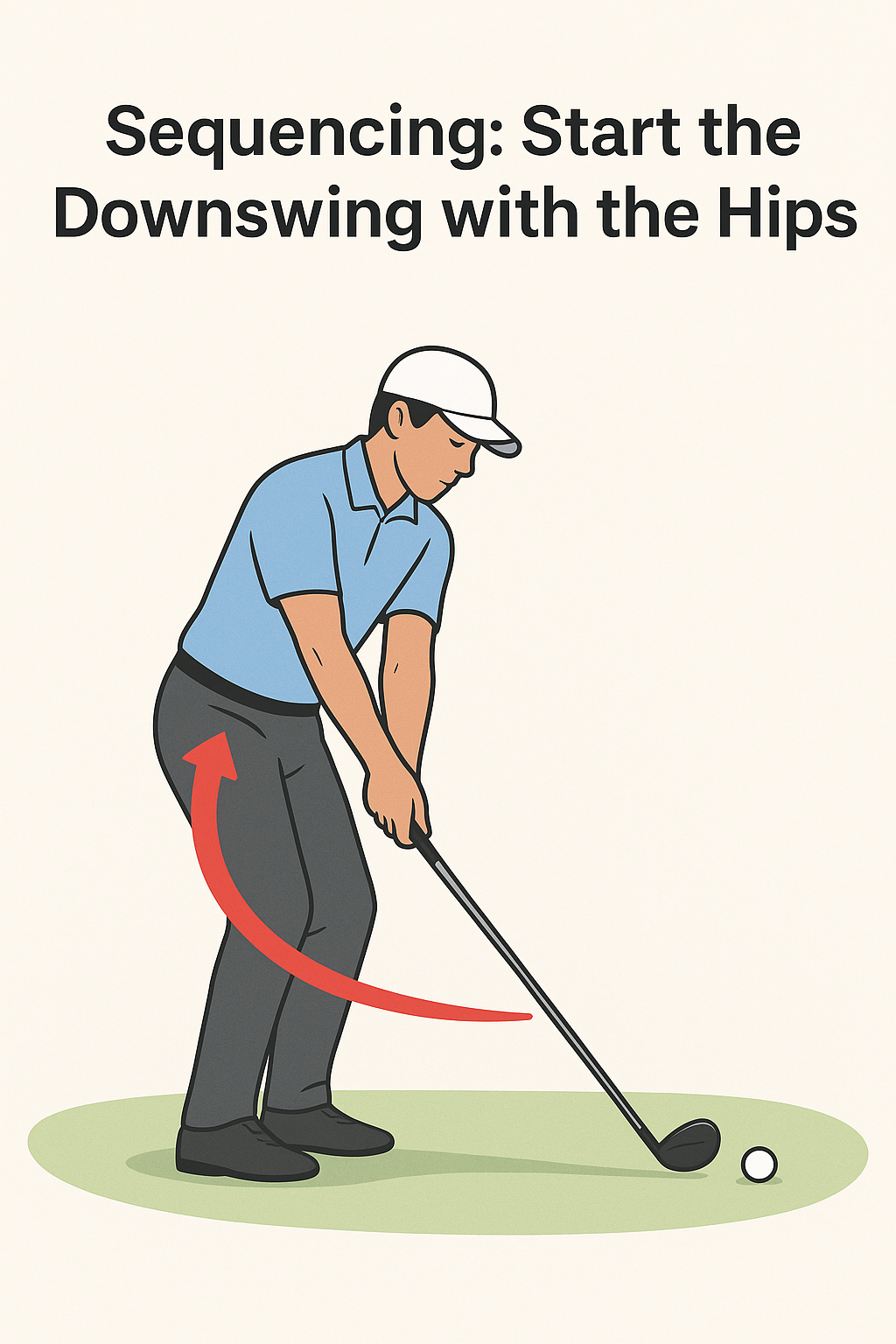
Sequencing: Start the Downswing with the Hips
Today we focus on one critical idea that helps many players hit more solidly and consistently: sequencing. In golf, sequencing means the order in which your body parts move during the swing. For a clean strike, the downswing should begin with the lower body (hips), then the torso, then the arms, with the club following. This simple order changes how energy flows from the ground up and can dramatically improve ball contact and distance control.
What the concept is
Sequencing is about timing. It’s not just how fast you swing, but which part of your body leads the move. In a good downswing, your hips start the motion by clearing space for the torso to unwind, the chest to rotate, and the arms to release smoothly. When done well, the clubface meets the ball squarely, you maintain some lag (the wrists delaying the release), and you finish with balance on the lead side.
Why it matters to the golf swing
Proper sequencing creates a smooth transfer of energy from your feet and legs up through your body to the club. Benefits include:
- Cleaner strike with more center-face contact
- Better control of the swing path and face angle
- More consistent distance and accuracy
- Less tension and fewer compensations (like casting or over-swinging)
What the golfer should feel when doing it correctly
- Feel the hips “pulling” the lower body toward the target first, not the arms.
- Weight shifts toward the lead foot early in the downswing; you should feel the trail leg unloading and the lead leg bearing more weight.
- Your torso unwinds after the hips begin, and your arms follow in a connected sequence.
- Hands stay slightly behind the chest at the start of the downswing, then release through impact as the hips and torso rotate.
2–3 common mistakes golfers make with this concept
- Mistake 1: The downswing is led by the arms or wrists, not the hips.
- Mistake 2: Weight doesn’t transfer properly; players slide or stall instead of rotating and shifting to the lead side.
- Mistake 3: The shoulders over-rotate or “jump ahead” of the hips, causing an over-the-top path or early release.
Simple, actionable fixes for each mistake
- Fix for Mistake 1: Practice slow, hip-led downswing reps. At the top, feel the hips rotate toward target first while the upper body stays quiet. Use a towel under both armpits to keep your arms connected so the swing doesn’t collapse into the arms.
- Fix for Mistake 2: Work on a deliberate weight shift. During practice swings, imagine stepping into the ball with your lead foot. Stop after impact, check that most of your weight is on the lead foot and that your trail knee has straightened slightly but not locked.
- Fix for Mistake 3: Slow the shoulders down and let the hips lead. Cue yourself with: “hips first, then torso, then arms.” Keep the chest facing slightly toward the target as the hips rotate to avoid flipping the wrists early.
One easy practice drill you can do at home or on the range
Hip-First Half-Swing Drill
- Take your normal stance and hold your club across your shoulders (or place the club along your spine so it touches your shoulders). This helps you feel your upper body staying connected.
- From the top of your backswing, rehearse the downswing in slow motion, focusing on initiating the movement with your hips. Keep the chest and arms quiet while you rotate the hips toward the target.
- With each rep, pause briefly at impact to check that most of your weight is on the lead foot and your hips have cleared space for the torso to unwind.
- Do 10–15 reps at a comfortable tempo, then try a full-speed swing while maintaining the same sequencing awareness.
Bottom line
Mastering sequencing—starting the downswing with the hips—helps you deliver the club on a consistent path with solid contact. Work this into your practice, keep your cues simple, and you’ll likely notice crisper ball striking and more repeatable results.
Sequencing: Start the Downswing with the Hips | Golf Swing Biomechanics
Sequencing: Start the Downswing with the Hips
What is sequencing in the golf swing?
In golf swing terminology, sequencing refers to the precise order in which the body’s segments unload energy during the downswing. The ideal kinematic sequence typically starts with the lower body, progresses through the core, and finishes with the arms and hands. When you start the downswing with the hips, you trigger a kinetic chain that transfers momentum efficiently from the ground up to the clubface. This hip-first activation helps you generate clubhead speed while maintaining control, consistency, and solid contact.
- : the hips begin rotating and transferring weight toward the target.
- : the chest and shoulders unwind in sequence, acting as a bridge to the arms.
- Arm release: arms and hands deliver the club with a controlled release, not an early fling.
- Impact alignment: a stable head position and solid impact are more achievable when the sequence is clean.
Understanding and training this order helps players of all levels—from recreational golfers to competitive amateurs—improve ball striking and distance control.The hip-first approach is a foundational element of efficient swing mechanics and a practical antidote to common faults like early arm lag or slides that disrupt the swing rhythm.
Why starting with the hips matters
starting the downswing with the hips offers several tangible benefits that show up in distance, accuracy, and repeatability. Here’s why this sequencing is a cornerstone of effective golf coaching:
- Efficient energy transfer: energy is generated in the legs and pelvis and then handed off to the torso and arms in a smooth cascade.
- Increased power without over-rotation: hip initiation builds torque through the pelvis and thorax while protecting the spine from over-rotation.
- Improved strike consistency: when the hips lead, the club’s path becomes more predictable, reducing fat or thin shots.
- Enhanced sequencing under pressure: in faster swing speeds, relying on the hips helps maintain timing and control when fatigue sets in.
- Injury prevention: a well-timed hip drive reduces compensatory torso or shoulder movements that can strain the back or shoulders.
Biomechanics of hip initiation
Ground reaction and the first move
The downswing begins with a dynamic shift of weight toward the target. The feet, ankles, and knees act as the first force transfer points, converting ground reaction forces into pelvic rotation. A clean hip start reduces lateral sway and keeps the pelvis stacked over the changed center of mass, supporting a stable base for the swing.
Pelvic rotation and sequencing
When the hips drive first, the pelvis rotates, creating a chain reaction: the spine and ribcage follow, the torso unwinds, and the arms and hands release the club at the intended arc. The key is to feel a controlled, progressive rotation rather than a snap that’s too abrupt. the objective is to maintain lag in the arms only to the degree that the hips have already unwound and transmitted momentum.
Torque, X-factor, and timing
Clinically, golfers talk about the X-factor—the separation between the hip turn and shoulder turn. Hip initiation tends to maximize this separation safely by creating torque without excessive spine angle. optimal timing aligns hip rotation with leg drive, then torso rotation, and finally arm release, keeping the club on plane and increasing precision at impact.
How to train hip-first sequencing
Training for hip-first sequencing involves a progressive mix of awareness, drills, and tempo control. Use a mix of slow-motion practice to feel the correct order, then gradually introduce speed while preserving the sequence. Below are practical drills and a clear progression you can follow.
Drill 1: Hip-first slow-motion swings
- Stand tall with feet shoulder-width apart and light knee flex. Practice a 50–60% speed swing,focusing on the hips initiating the downswing before the torso moves.
- Pause briefly at the top, then initiate the downswing with the hips.Hold the finish for a moment to confirm balance and hip-led sequencing.
- Repeat 10–15 reps, gradually increasing speed while maintaining the hip-first order.
Drill 2: Wall drill with hip turn cue
- Stand with your back about 6 inches from a wall. Make a half backswing, then rotate the hips toward the wall to feel the hip-first drive without losing posture.
- Keep a light pressure on the wall with your back, ensuring the upper body doesn’t over-rotate prematurely.
- Do 2–3 sets of 8–12 reps,progressing to full-speed swings as you feel comfortable.
Drill 3: Step-Through hip activation
- Address the ball as usual. On the downswing,step toward the target with your trail foot while your hips initiate the rotation.
- Focus on a fluid, ground-up motion; avoid passive or “arm-led” downswing reversals.
- Perform 20 reps, then mirror that with a normal swing to test continuity.
Drill 4: Half-swing progression with delayed arm release
- Take a half swing and deliberately delay the hands’ release until after the hips have rotated and the torso has unwound.
- Feel the arms “catch up” in sequence rather than trying to release early.
- Repeat 12–16 reps, then test full-speed swings with the same sequencing.
Drill 5: Ground-to-club connection (pelvic tilt and weight shift)
- Focus on feeling weight shift toward the target foot during the hip start. Use a small step or a balance board to ensure you’re not railing off the back foot.
- Pair this with a slight forward knee pressure to encourage a forward press through impact.
- Do 3 sets of 10 reps at a controlled tempo, then integrate into a full swing.
Drill 6: Tempo ladder for hip-first sequencing
- Use a metronome or rhythm cue (e.g., 60–90 BPM). Start with a slow tempo emphasizing hip initiation, then gradually increase speed while maintaining sequence integrity.
- Incorporate a small pause at the top to ensure the hips start first, then the torso, then the arms.
- Complete a ladder of 6–8 reps per tempo segment,ensuring clean sequencing at each step.
Progression: From practice to performance
Begin with 1–2 drills in a dedicated practice session, focusing on hip-first sequencing in slow motion. Then progress to 20–30% swing speed, and finally to full effort with consistent hip-driven tempo. Use video feedback or a coach to confirm the hip-first cue remains intact as speed increases.
Benefits of hip-first sequencing
- Greater consistency: a repeatable start to the downswing reduces timing variability and the likelihood of late arms or early releases.
- Enhanced power potential: efficient energy transfer through the kinetic chain translates to higher ball speed without extra strain.
- Better strike quality: solid contact improves launch characteristics and reduces shot dispersion.
- Improved swing balance: a stable base from the ground up helps maintain posture through impact.
- Injury resilience: reduces the tendency to over-rotate or torque the spine, protecting the back and shoulders over time.
Common mistakes and how to correct them
- Mistake: Arms start the downswing too early, causing an outside-to-in path. Correction: Re-tune the sequence with hip-first drills and wall drills to reinforce the order.
- Mistake: Excess weight shift to the front foot without hip rotation. Correction: Focus on moving weight with the hips while maintaining a centered spine angle.
- Mistake: Sway or slide rather than rotate. Correction: Use the step-through drill to encourage rotation and ground contact from the lead leg.
- Mistake: Over-rotating the hips, leading to a loss of posture. Correction: Slow down the tempo and use the hip-tause cue to control rotation.
- Mistake: Early head movement and head lift. Correction: Maintain a steady head position by anchoring with the spine and using hip initiation as the key trigger.
Case studies and first-hand experiences
case study: Maria’s journey from inconsistent contact to a confident hip-first downswing
Maria, a mid-handicap golfer, struggled with a frequent fat shot and an inconsistent ball flight. After a focused four-week program emphasizing hip-first sequencing, she reported clearer contact and tighter dispersion. the core elements of her enhancement included: starting the downswing with the hips, incorporating wall drills for feedback, and practicing tempo ladders to preserve sequence at higher speeds. Within six practice weeks,Maria reduced her handicap by three strokes and began hitting a more penetrating draw on demand. Her coach noted a more stable lower body action and a cleaner transition from backswing to downswing, especially in mid- to late-round rounds where fatigue frequently enough disrupted timing.
First-hand experience: a coach’s viewpoint on hip initiation
As a coach, I’ve seen countless golfers benefit from emphasizing hip initiation.the simple cue of “hips first” creates a powerful mental anchor that reduces the urge to “muscle” the swing with the arms. In practice, players report improved impact consistency and a more natural tempo. The key is to pair the cue with a clear drill progression and measurable feedback, such as a video check or a simple impact tape to confirm the sequence is delivering clubhead speed without sacrificing control.
Quick-reference drills table
| Drill | Focus | How to Do | Cues |
|---|---|---|---|
| Hip-first slow-motion swings | Downswing order | Slow backswing, lead with hips on the downswing, pause at top, finish | “Hips first, then torso, then arms” |
| Wall drill with hip turn | Posture and rotation control | Stand close to a wall, perform hip-driven downswing while keeping back near the wall | “Anchor the hip turn” |
| Step-through activation drill | Footwork and hip drive | Practice with a step toward target as hips initiate | “Step and rotate” |
| Delayed arm release | Coordinate release with hip initiation | Half swings with hands releasing after hips/torso unwind | “Delay the hands” |
Practical tips for different levels
- : Focus on the feeling of the hips initiating the downswing; keep the swing calm and controlled to embed the sequencing without rushing the motion.
- : Add tempo work and multiple drills to refine timing; begin integrating hip-first cues into full swings and monitor impact consistency with video analysis.
- Advanced players: Use higher swing speeds with a focus on maintaining sequence; employ tempo ladders and on-course practice to test sequence under pressure.
Frequently asked questions
Is starting the downswing with the hips always best for every golfer?
for most players, hip initiation improves sequencing, power, and consistency. Though,some individuals may have unique mobility,back,or shoulder considerations that require personalized coaching.A golf instructor can tailor hip activation drills to fit your biomechanics and swing style.
Can hip-first sequencing help with a slice?
Yes. A robust hip-first approach can promote a more inside-out path and reduce excessive hand path manipulation that often contributes to a slice. When the hips lead, the downswing path tends to stay on-plane and the face is more likely to square at impact if the arms follow in proper sequence.
how long does it take to feel a noticeable difference?
most players notice improvements within 3–6 weeks of consistent hip-first training, provided that the drills are executed with attention to tempo, posture, and feedback cues. Regular practice with video playback can accelerate progress.
Summary of best practices for hip-first sequencing
- Start the downswing with the hips to trigger a natural kinetic chain from the ground up.
- maintain a stable spine angle and avoid early upper-body rotation that can disrupt sequencing.
- Incorporate slow-motion drills, wall drills, and tempo work to reinforce the correct order.
- Use cues like “hips first” or “step and rotate” to reinforce the desired movement pattern.
- Progress drills from practice swings to full-speed swings with consistent feedback and gradual increase in speed.
Related topics to explore
- Kinesthetic sequencing in golf
- Biomechanics of the golf swing
- Ground reaction forces in golf
- Pelvic rotation and spine angle management
- Drills for improving impact consistency
Whether you’re chasing lower scores or simply aiming for more reliable contact, focusing on the hip-first downswing sequencing can transform your golf swing. by understanding the biomechanics, applying practical drills, and tracking progress with video or a coach, you can build a repeatable, powerful, and injury-resilient swing that works across clubs and playing conditions.