
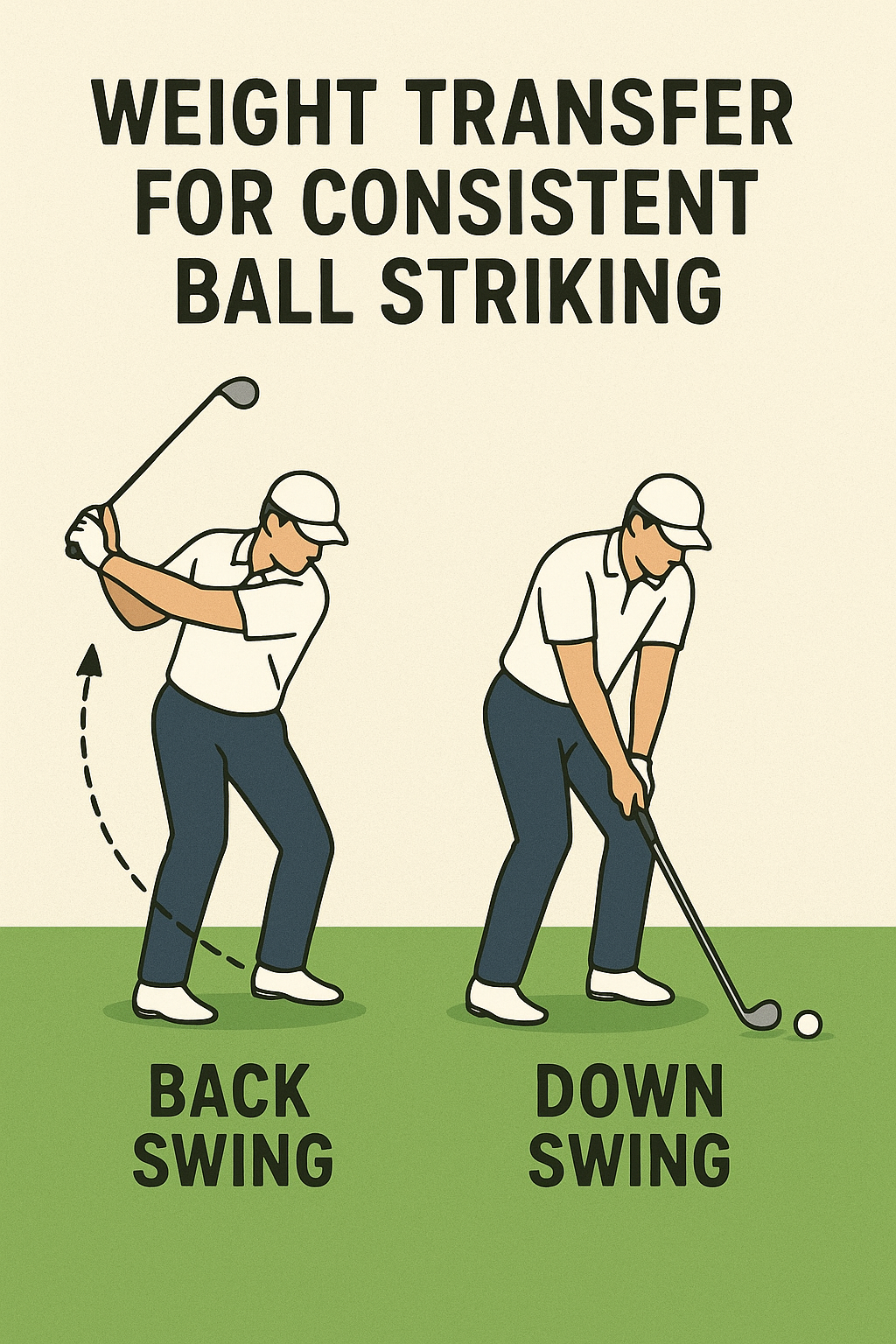
Weight Transfer for Consistent Ball Striking
Today we’re focusing on a single, powerful concept: how you move your weight through the swing. Mastering weight transfer helps you contact the ball more solidly, hit with more consistency, and control distance better. It’s a simple idea, but when you feel it correctly, you’ll notice immediate improvements.
What the concept is
Weight transfer means moving your body weight from the trail (back) leg toward the lead (front) leg as you swing. The goal is to have the majority of your weight on the lead foot at impact, while maintaining your posture and balance through the finish. It’s not a big lunge or a dramatic slide—it’s a controlled shift that supports solid contact and efficient energy transfer from your body to the club.
Why it matters to the golf swing
- Solid contact: Proper transfer helps you compress the ball consistently rather than “catching” the ball with your arms.
- Distance control: When the weight moves forward at the right moment, your center of mass stays in a better position to release the club smoothly.
- Posture and balance: Staying balanced through impact reduces fat/thin shots and keeps your swing path on track.
What you should feel when doing it correctly
- As you approach impact, you feel more pressure on the lead foot (the foot nearest the target).
- Your trail knee flex remains sufficient, but your chest and hips rotate toward the target—your weight shifts, not your head.
- You finish with most of your weight forward and balance centered over the lead foot, not falling back.
2–3 common mistakes (with simple fixes)
-
Mistake 1: Weight stays on the back foot at impact.
Fix: Cue yourself to “press into the lead foot” at impact. Think of a slight push off the trail foot as you rotate into the ball, so the lead side carries the majority of your weight after contact. Keep the trail heel light and allow the lead leg to do the work of delivering the shot. -
Mistake 2: Weight shifts too early before contacting the ball.
Fix: Build a small pause at the top of the backswing and then rotate into impact rather than sliding weight forward too soon. Think “coil first, then move” and feel your hips and torso unloading into the ball rather than your feet racing forward. -
Mistake 3: Loss of posture or balance during the shift (head or upper body moves too much).
Fix: Keep your spine angle constant and let the rotation do the work. A simple cue is to imagine your chest staying over the ball as you shift weight and rotate. Focus on keeping your head still while your hips and torso rotate toward the target.
One easy drill to reinforce the concept
Step-Through Finish Drill (great for home or range practice):
- Take your normal stance and a short, controlled backswing.
- As you strike the ball, deliberately step through with your lead foot to finish facing the target. Your weight should move onto the lead foot during the step and stay there in the finish.
- Progress from slow, deliberate swings to full-speed as you feel the weight transfer in a natural, controlled way.
Tip: start with this drill using a short iron or a wedge to build feel. Once you’re comfortable, apply the same feeling to longer clubs. Keep the movements smooth and maintain balance throughout the swing.
By focusing on weight transfer as the single, core element of your contact, you’ll develop a more stable foundation for the rest of your swing. Practice the cues and the step-through finish, and you’ll notice more consistent strikes and improved distance control over time.
Weight Transfer for Consistent Ball Striking
What is weight transfer and why it matters for ball striking
Weight transfer refers to the deliberate movement of your body’s mass from one foot to the other during the sequence of a shot. In sports like golf,tennis,and baseball,efficient weight transfer is a foundational driver of ball speed,solid contact,and repeatable results. When properly executed, weight transfer helps you:
- Generate greater clubhead or racket speed through effective sequencing
- Maintain balance and posture through the impact zone
- Improve ball flight control by aligning the body’s center of gravity with the target line
- Minimize late or early head/body movement that disrupts strike quality
Think of weight transfer as the kinetic link that connects lower-body stability with upper-body acceleration.The feet act as physical levers pushing and guiding energy, while the hips and torso act as the engine that channels that energy toward the point of contact.
Key biomechanics behind effective weight transfer
Sequencing: the chain from ground to impact
Effective weight transfer follows a predictable order known as the kinetic chain. When you initiate the stroke, your hips begin the rotation first, followed by the torso and shoulders, then the arms and finally the hands and club or racket. The goal is to unload stored energy in a smooth sequence so that each segment adds to the velocity of the next.
Center of gravity and balance
Your center of gravity should subtly move over the base of support (the feet) without losing balance. In a golf swing, for example, players typically start with a slight weight shift toward the back foot and finish with a transfer toward the front heel or toe, depending on style. In tennis, the weight shift often transitions from the back foot to the front foot during the forward swing, while in baseball, the weight shifts toward the front side as the hips rotate through the swing.
Ground reaction forces
Every hit is powered by pushing against the ground. The stronger and more intentional your push-off from the back foot, the more momentum you can transfer into the hit.Proper use of ground reaction forces also helps you maintain balance, so your swing or stroke doesn’t topple to one side.
Posture and spine angle
Maintaining a steady spine angle while transferring weight prevents the upper body from collapsing or rising too early, which can rob power and produce off-center strikes. small, controlled shifts work better than large, abrupt moves.
Weight transfer patterns across different sports
Golf: from the tee to the ball
In golf, weight transfer is a dynamic shift that starts with a slight loading of the trail leg (the leg opposite the lead hand) during the backswing and culminates in a powerful release through impact. The hips rotate toward the target while the weight transfers forward, helping the club head square the face and deliver solid contact.
Tennis: groundstroke momentum
Tennis weight transfer emphasizes forward momentum and post-impact stability. A well-timed shift from the back foot to the front foot allows the shoulder girdle to open and the racquet to accelerate through the contact zone. Ball control and spin benefit from consistent weight transfer with minimal upper-body wobble.
Baseball: driving through the pitch or swing
In baseball, efficient weight transfer supports velocity and bat control. The hitter loads the back leg, then pushes off the back foot as the hips rotate toward the pitch, transferring energy to the hands and bat through contact. A controlled finish completes the sequence with balance and alignment toward the target line.
Other examples: soccer, field hockey, and paddle sports
while the mechanics differ by sport, the core principle remains the same: stabilize, load, and transfer energy from the ground up to the point of contact.Players who master this transfer tend to see improved accuracy,better ball compression,and more predictable outcomes.
Benefits and practical tips for improving weight transfer
- Enhanced consistency: Repeating a reliable transfer pattern reduces miss-hit variability.
- Increased power without added effort: Efficient transfer converts ground reaction forces into clubhead speed or racket velocity.
- Better contact quality: Balanced weight shifts reduce fat shots and off-center hits.
- Improved balance under pressure: A stable transfer helps you stay grounded in tense situations (fast pitches, fast serves, or crowded swings).
Practical cues to reinforce proper weight transfer include simple, repeatable thoughts such as “rotate hips first, then shift to the front foot,” or “low center of gravity on the back, then explode forward.” Use cues that match your sport and comfort level.
Drill progression: from fundamentals to on-surface execution
Foundational drills (static stance)
- Weight transfer stance drill: Stand tall with feet shoulder-width apart. Shift weight fully onto the back foot, then slowly transfer to the front foot while maintaining balance and posture. Do 2–3 sets of 12–15 seconds per side.
- Pelvic tilt and hip slide: Practice a subtle pelvic tilt and hip glide toward the front foot while keeping the spine neutral. Focus on a quiet upper body and a clear ground push.
Dynamic drills (motion and sequencing)
- Step-through drill: Start with weight on the back foot, take a small step toward the target while maintaining hip rotation, and finish with weight planted on the front foot. Repeat 8–12 reps per side.
- Medicine ball chop: Hold a light medicine ball and perform a controlled rotational chop from back foot to front foot, focusing on transferring energy through the hips and torso.
Impact-focused drills (contact zone)
- Impact tape drill: Place a tape line on the ground and practice striking or swinging with footwork that keeps the weight centered over the front foot at impact. Record feedback for posture and contact quality.
- Slow-mo to full speed: start in a controlled, slow-motion swing or stroke, emphasizing exact weight shift, then gradually increase speed while preserving form.
Sport-specific cues
- Golf: “Load the trail heel, then release through the front foot.”
- Tennis: “Push off the back foot, rotate through contact, and land on the front foot.”
- Baseball: “Drive from the back leg, pivot the hips, and finish with balance over the front foot.”
Common mistakes and how to fix them
- Excessive head movement or early rise: Focus on maintaining spine angle and keeping the head steady by distributing weight gradually rather than abruptly.
- Over-rotation with poor sequencing: Ensure the hips initiate the move, while the upper body follows in a controlled path rather than turning too early.
- Locking knees or collapsing the posture on contact: Keep a slight knee bend and engage core muscles to maintain balance through impact.
- Rushing the transfer: Slow down the loading phase and practice feel-based cues until the movement becomes automatic.
Tip: Use video feedback to diagnose your weight shift. A simple side-angle view can reveal if you’re loading too late, too early, or finishing with a lopsided weight distribution.
Quick reference table: weight transfer cues by sport
| Sport | Typical weight transfer cue | Common error to avoid |
|---|---|---|
| Golf | Load the trail heel, then transfer weight toward the front foot through impact | Early front-foot pressure or late hip turn that disrupts sequencing |
| Tennis | Push off back foot and rotate through contact to land evenly on front foot | Upper-body wobble or late foot contact |
| Baseball | Drive from back leg, hip rotation toward the pitcher, and finish balanced | Over-rotation without forward energy transfer |
| soccer / Paddle sports | Controlled transfer with a stable core and grounded finish | Swapping weight too late or too early, causing off-center strikes |
Case studies and first-hand experiences
Real-world cases from players across sports illustrate how deliberate weight transfer translates into measurable improvements. These stories emphasize consistency, especially under pressure:
- A mid-amateur golfer integrated a simple two-beat weight transfer cue—“load-tap, load-front”—and reduced mishits by 28% within two weeks, reporting cleaner center-face contact and a more repeatable swing plane.
- A competitive tennis player used slow-motion drills to synchronize hip turn with forward weight shift, decreasing off-center forehands by nearly half and improving ball speed on both wings.
- A baseball hitter adopted a front-foot finish cue to ensure balance after contact, leading to higher on-base average and fewer weak pops up due to late weight transfer.
These cases highlight that success frequently enough comes from consistent practice with clear cues, progressive difficulty, and regular feedback rather than a single “perfect move.”
First-hand experience: coaches and players share their journey
Coaches commonly report that players who focus on weight transfer tend to develop a more reliable swing or stroke. While individual biomechanics vary, three common threads emerge:
- Start with a stable, athletic setup and a relaxed grip or hold to avoid stiffness that hampers transfer.
- Use small, deliberate shifts in the lower body to load energy, then release it through the torso and arms in a controlled sequence.
- Regular, objective feedback—video analysis, launch monitor data, or partner feedback—accelerates gains in accuracy and power.
In practice, the most accomplished players describe weight transfer as a “felt” motion rather than a purely mechanical one. Developing this sense comes from mindful practice, not just repetition.
Weight-transfer checklist for quick reference
- Set a balanced athletic stance with a slight knee bend and neutral spine angle.
- Load the back foot during the backswing or loading phase; feel the hips begin to rotate.
- Push off the back foot smoothly; transfer weight through the midfoot toward the front foot at impact.
- Keep the head and upper body steady while the lower body drives the movement.
- Finish with a balanced, targeted finish that reflects your swing plane or stroke path.