
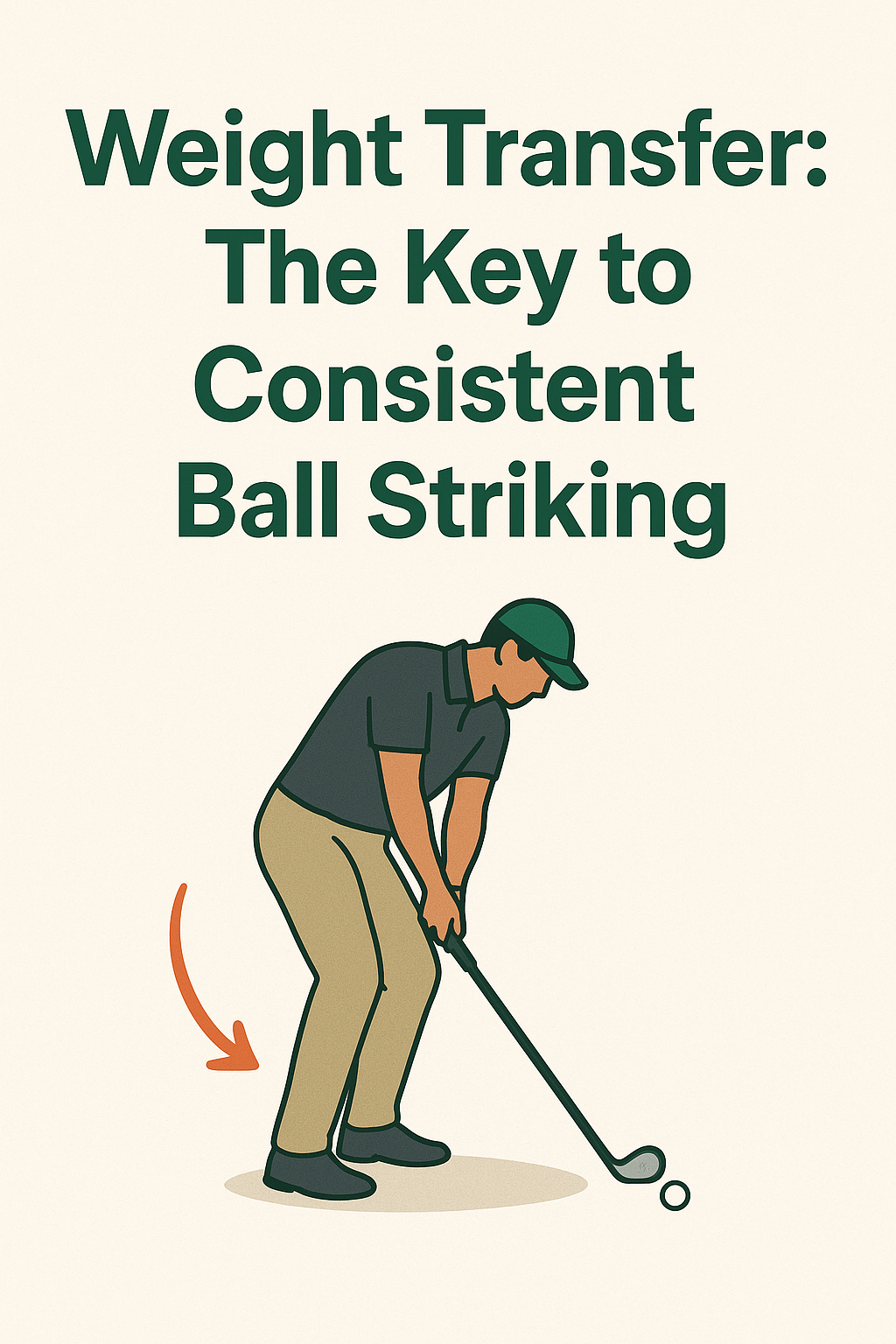
Weight Transfer: The Key to Consistent Ball Striking
For beginner to intermediate players, one single idea can make a big difference: how you transfer your weight during the swing. Focus on moving your load from the back foot to the front foot through impact. This weight transfer stabilizes your base, helps the club stay on the correct path, and leads to cleaner contact.
What the concept is
Weight transfer is the controlled shift of your center of gravity from the trail foot (the foot furthest from the target) toward the lead foot (the foot nearer the target) as you swing. It’s not a jump or a squat; it’s a smooth pivot and push with your legs that arrives at impact with your weight mostly on the front side.
Why it matters to the golf swing
Solid contact comes from balance and sequencing. When you transfer weight properly, you create consistent compression on the ball, maintain spine angle, and keep the clubface square longer into the hit. A good transfer also helps prevent common misses like fat shots (hitting behind the ball) or thin shots (hitting too much on the front edge of the ball).
What the golfer should feel when doing it correctly
- During the downswing, you feel pressure moving from the inside of your back foot toward the lead foot.
- As impact approaches, your lead knee flexes and your hips rotate toward the target.
- You finish with most of your weight on the lead foot and your chest squared to the target.
2–3 common mistakes and simple fixes
- Mistake 1: Hanging back – weight stays on the trail foot through impact.
- Fix: Initiate the downswing with a hip rotation toward the target and gently press into the lead foot as you shift weight forward. Practice half-swings, stopping at impact to feel the weight move onto the lead foot, then finish with your weight forward.
- Mistake 2: Swaying or sliding laterally instead of rotating on an axis.
- Fix: Maintain a steady spine angle and rotate your hips rather than slide your hips forward. A simple cue is to imagine you’re standing on a line; your head stays roughly above the same spot while your hips rotate and your trail knee tracks toward the target.
- Mistake 3: Premature weight transfer causing early release or loss of lag.
- Fix: Pause briefly at impact to feel the weight settle onto the lead foot, then allow the arms to release naturally. Practice a “load then unload” pattern: load weight on the trail side during backswing, transfer to the lead foot through impact, and finish with the weight forward.
One easy practice drill
The Step-Through Drill — great for building the feel of forward weight transfer.
- Set up as you would for a normal shot with a mid-iron.
- Take a half-swing, keeping your balance and spine angle intact.
- On the downswing, shift your weight toward the lead foot and step your trail foot forward to meet it, finishing with your weight on the lead foot and your chest facing the target.
- Perform 8–12 repetitions, focusing on a smooth, controlled transfer rather than speed. Use this drill at home or on the range to reinforce the sensation of weight moving forward through impact.
Sticking with weight transfer as your guiding idea will help you achieve more repeatable contact and more reliable ball flight. As balance and awareness improve, you’ll find it easier to swing with confidence—without overthinking the entire motion.
Weight Transfer: The Key to Consistent Ball Striking
What is weight Transfer? A quick overview
Weight transfer refers to the purposeful, coordinated shift of your body’s weight from the back side to the front side during the swing or stroke. In ball-striking sports, this movement is not just a power idea—it’s a timing and control mechanism. Proper weight transfer aligns your center of gravity with the line of impact, engages the kinetic chain (the sequence of body segments from feet to hips to torso to arms), and helps you deliver consistent contact. When weight transfer happens smoothly, you feel faster hands, better balance, and more predictable outcomes at impact.
Think of weight transfer as the bridge between setup and impact: it converts potential energy stored during the backswing into kinetic energy at the moment you strike the ball. In practise, it means your hips and torso rotate in concert with a controlled shift of pressure from the heels (or middle) of the rear foot to the forefoot of the front foot, all while maintaining posture and line of sight. The result is cleaner contact, increased power, and repeatable results under pressure.
The Science Behind Weight Transfer
Biomechanics at a glance
- Efficient weight transfer engages a sequential energy transfer from the ground up—feet, ankles, knees, hips, torso, shoulders, arms, and hands.
- The force exerted by the ground on your feet supports propulsion and balance during the swing.
- A controlled move of your COG over the base of support helps you maintain balance and drive through impact.
- The precise moment you transition weight affects clubhead speed and ball trajectory.
Collision with contact: why timing matters
inaccurate timing—either too early or too late—can mute power and disrupt direction.If the weight shift lags, the torso may over-rotate and the hands “hit” the ball late, resulting in slices, hooks, or weak contact. If the weight shifts too early, you can “stall” the clubface or lose spine angle, causing mis-hits. The sweet spot is a smooth, progressive transfer that coincides with the peak speed of the hands and the correct line to the target.
Benefits of Proper Weight Transfer
- Consistency: Reproducible contact and trajectory across a range of swings and weather conditions.
- power with control: Efficient energy transfer yields higher ball speed without over-relying on brute force.
- Balance under pressure: Better posture maintenance through impact reduces mis-hits on tight shots.
- Injury prevention: Natural sequencing reduces overload on a single joint, promoting healthier mechanics over time.
- Versatility across sports: The same principles apply whether you’re golfing, playing tennis, or swinging a baseball bat.
How Weight Transfer Affects Contact and Power
Weight transfer is the driver of impact efficiency. A well-timed shift loads the front side before contact, helping the clubhead (or racket) meet the ball with a stable body frame. This stability reduces “twist” at contact, keeps the face on the intended line, and allows for a more direct transfer of energy from the ground to the ball.
key concepts to internalize
- Power starts from the ground and moves up through the body as you shift weight forward.
- Pressing into the front foot during impact helps you hold your line and maximize face stability.
- Hip and torso rotation should be synchronized with the weight shift, not competing with it.
- Subtle pressure changes in the feet cue the rest of the body to respond with the correct sequence.
Common Mistakes That Undermine Weight Transfer
- Moving weight to the front foot before reaching impact can lead to thin shots or off-center strikes.
- Over-rotating the torso without a solid lower-body base disrupts balance.
- trying to “hit” the ball too quickly without allowing the hips to load then unwind.
- A rigid lead leg limits energy transfer and reduces contact quality.
- Stopping or sliding during the swing breaks the kinetic chain.
For players who struggle with weight transfer, a simple diagnostic is to pause at the top of the backswing and check if the weight is distributed evenly between the feet. From there, feel a deliberate, gradual shift toward the front foot during the downswing. If you observe mis-hits when you rush your transfer, the fix is usually tempo control and a clearer cue to start the forward shift around hip rotation.
Drills and Practice: Build the Habit of Smooth Weight Transfer
1. Feet-Only Shift Drill
Purpose: isolate the lower-body sequence and feel the transition of weight without the arms complicating the motion.
- Stand with feet shoulder-width apart, knees slightly bent.
- Hit gentle, short chips or soft forehands with just the lower body initiating the movement.
- Focus on a gradual transfer from back foot to front foot, keeping the torso quiet.
2. Slow-mloom Setup Drill (Mirror Drill)
Purpose: Improve timing by performing the swing slowly in front of a mirror to observe weight transfer and spine angle.
- Set up in your normal stance; take a half-swing with a slow tempo.
- Watch the sequence: back foot loads, hips rotate, weight shifts forward, and contact occurs around the front foot.
- Repeat for 5–7 reps, maintaining consistency in balance and line.
3. Step-Through Drill
Purpose: Encourage a connected transfer with forward momentum through the shot.
- Perform the swing and, after contact, step through with the front foot toward the target.
- Keep a smooth,continuous weight transfer without abrupt stops.
- Ideal for golf and tennis players who tend to decelerate after impact.
4. Single-Leg Balance Drill
Purpose: Build stability and proprioception to support consistent weight transfer.
- Balance on the trailing leg for 20–30 seconds, then switch sides.
- During balance holds, perform micro-movements with the hips to simulate the transfer during a stroke.
5. impact Alignment Drill
Purpose: Create a mental cue system for transfer timing and square contact.
- Place a small alignment stick or towel along your target line.
- Practice hitting the ball while thinking “load, shift, connect” as you move from back to front foot.
- Gradually increase speed while preserving accuracy and balance.
step-by-Step Plan to Implement Weight Transfer in Your Swing or stroke
- Ensure your posture allows for comfortable weight shift without losing balance.
- Use a simple cue like “hips lead, weight forward” to initiate the transfer.
- Start with slow, deliberate reps to ingrain the sequence before adding speed.
- Sync hip rotation with the weight shift to maximize energy transfer.
- focus on applying pressure through the back foot during backswing and transitioning to the front foot at impact.
- Rotate between the drills above to build a robust motor pattern.
- Use trackman data, videos, or ball feedback to gauge improvements in distance, trajectory, and consistency.
Practical Tips by Sport
Golf
- Maintain spine angle through impact while the weight shifts to the front foot.
- Feel the lead knee softening slightly as the hips rotate to maximize clubhead speed at the moment of contact.
Tennis
- Shift weight from the back foot into the front foot as the racket meets the ball, ensuring the shoulder line stays level.
- Use a stable core to prevent over-rotation that disrupts contact geometry.
Baseball
- Load the weight into the back leg during the leg kick and transfer to the front leg through contact.
- Keep the head steady to ensure consistent tracking of the ball as you rotate the hips.
first-Hand Experience: Case Highlights
Golf Case Study: 8-Handicap to 5-Handicap
A regional amateur improved consistency by slowing down the downswing tempo and focusing on a deliberate weight transfer. After four weeks, their fairways hit rate increased, and they reported fewer mishits on mid-length irons due to better timing of the forward shift and improved collision with the ball.
Tennis Case Study: Serve Revisions for a Club Player
A club-level player who struggled with consistency on serves found that a smoother weight transfer from back to front foot during the service motion helped stabilize toss timing and increase first-serve percentage by a notable margin.
Baseball Case Study: Power Hitters’ Kinetic Chain
Youth baseball athletes who integrated a front-foot drive with a strong hip rotate saw more consistent contact and improved ball exit velocity without compromising control.
Quick Reference: Weight Transfer Metrics and Outcomes
| Metric | What It Indicates | ideal Range / Cue |
|---|---|---|
| Backswing load | Preparation energy stored in the hips and legs | Balanced load, not excessive |
| Weight shift timing | When front-foot pressure increases relative to back foot | During downswing initiation or just before impact |
| Torso-to-hip sequencing | Optimal rotational flow through the kinetic chain | Hips initiate, torso follows, arms accelerate |
| Post-impact balance | Stability after contact | Centered over front foot with slight forward lean |
Frequently Asked Questions
Can weight transfer fix all swing flaws?
Weight transfer addresses a key aspect of impact consistency, but it works best when paired with proper sequencing, grip, posture, and practice. It’s part of a holistic approach to swing mechanics.
Is weight transfer different for golf and tennis?
The underlying principle is the same: move weight efficiently from back to front to drive the shot. The exact timing and body sequencing may vary with sport-specific demands and equipment.
How long does it take to see results?
Most players notice perceptible improvements within 2–4 weeks of focused practice, especially after incorporating the drills and cues in this article. Individual results vary based on starting technique and practice consistency.
Video Cues and Feedback Cues for Mastery
- Feel cues: “hips lead, weight forward, hands free.”
- Visual cues: “watch the toe of the back foot rise as you load, then feel it sink into the front foot at impact.”
- Video cues: Record at 60–120 fps and analyze the moment weight shifts with a side view.
Putting It All Together
Weight transfer is a practical,repeatable mechanism that ties together stance,posture,timing,and power.By understanding the biomechanics, implementing targeted drills, and practicing with focused cues, you can achieve more consistent ball striking across the activities you pursue. Remember to progress gradually, monitor your balance, and adjust cues to what feels natural for your body. The goal is a smooth, integrated motion where the ground reaction force, hip rotation, and forward weight shift converge at the exact moment of contact.