
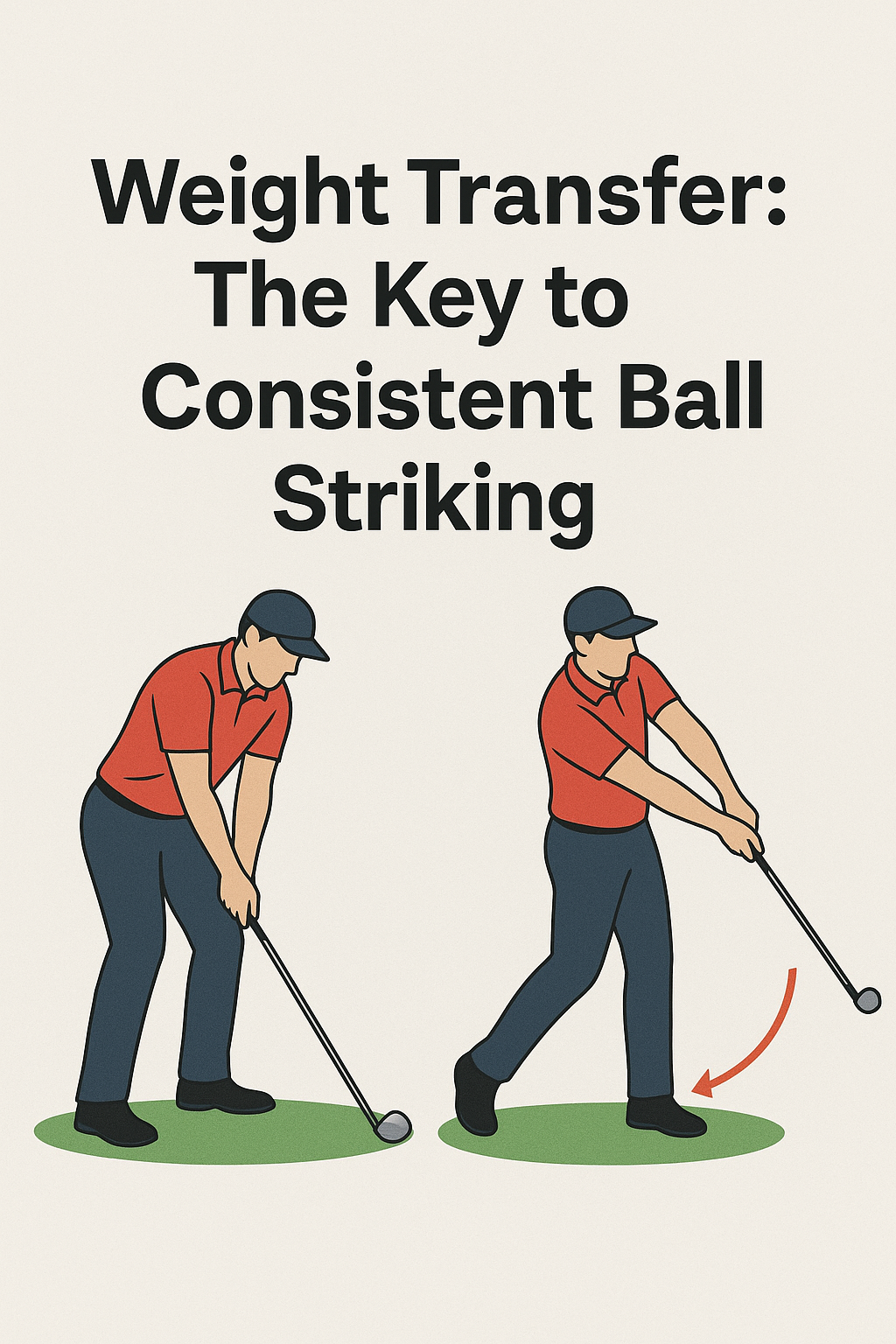
Weight Transfer: The Key to Consistent Ball Striking
As a PGA professional, I see a lot of players struggle because they don’t move their weight correctly. The single concept I want you to focus on is weight transfer—the deliberate shift of your body weight from the trail foot to the lead foot through impact. When done well, it helps you strike the ball more solidly, control direction, and maintain balance all the way to finish.
What the concept is
Weight transfer means moving your center of gravity toward the lead foot as you swing through the ball. At setup you’ll have more weight on your back foot; as you swing, the majority of your weight should shift to your lead foot by impact. After contact, your weight stays ahead as you finish tall and balanced. This is not a big “slide” or a lunge; it’s a smooth, athletic transfer that happens in rhythm with your swing.
Why it matters to the golf swing
- Solid contact: More weight on the lead foot at impact helps you compress the ball and keep contact centered on the face.
- Consistent divots and low point: Proper transfer helps the club meet the turf after the ball, producing better contact and turf interaction.
- Direction and stability: A controlled transfer reduces lateral sway and keeps your upper body from over-rotating, which helps you stay on your intended path.
- Tempo and timing: When weight moves in a smooth sequence, your swing becomes more repeatable from shot to shot.
What you should feel when done correctly
- Early in the downswing, you’ll feel pressure building from the outsole of the back foot toward the lead foot.
- Your lead knee flexes slightly as the hips rotate and the chest faces the target.
- Your trail foot becomes lighter; you feel more pressure in the lead foot at impact.
- You finish with most of your weight on the lead foot and your chest facing the target, with good balance.
2–3 common mistakes and fixes
Mistake 1: Swaying or sliding laterally instead of turning and transferring.
- Fix: Build a stable base by feeling your hips rotate toward the target rather than your hips sliding sideways. Practice with a wall drill: stand with your back foot touching a wall and swing, ensuring your hips rotate without the back foot slipping away.
- Fix: Limit excessive head movement. Keep your spine angle intact by imagining you have a small pendulum from your head to the ground—no big up-and-down motion.
Mistake 2: Not transferring enough weight to the lead foot at impact.
- Fix: Do a weight-forward check during practice: hit half-swings focusing on finishing with most weight on the lead foot. A simple cue: “drive through the ball, climb onto the front foot.”
- Fix: Use a step-through drill (see the drill below) to feel the weight moving forward as you rotate through the shot.
Mistake 3: Weight transfer happening too early or too late in the swing.
- Fix: Tempo cue—think “delay the lead foot pressure until you feel the club face square at impact.” Use a 3/4 backswing and a controlled downswing to let the hips initiate the move rather than rushing weight forward.
One easy practice drill you can do at home or at the range
Step-Through Drill
- Take a short iron and stand with feet close together, just a skinny stance.
- Take a small backswing (about 3/4) while keeping your head still and spine angle intact.
- As you swing down, step forward with your lead foot toward the target, and finish with your weight fully on the lead foot. Your trail foot should swing through and you should finish balanced.
- Repeat with a smooth rhythm, focusing on feeling the weight shift to the front foot as you rotate through the shot.
Bottom line
Efficient weight transfer is about turning and moving your weight onto the lead foot in a balanced, rhythm-based sequence. It reduces mishits, aids direction, and helps you finish with control. Practice the Step-Through Drill, keep your base stable, and let the transfer happen in sync with your rotation. With repetition, solid contact and consistent ball striking will follow.
Weight Transfer and Ball Striking: A Practical Guide
Weight Transfer: The Key to Consistent Ball Striking
Why Weight Transfer Matters
In any sport that involves hitting, striking, or projecting a ball, how you manage your body’s weight during the movement considerably impacts precision, power, and repeatability. Weight transfer is the deliberate shift of your center of gravity from one part of the body to another—usually from the back side to the front side—around a coordinated set of joints. When done correctly, weight transfer helps you maintain balance, increase impact efficiency, and produce a more consistent ball flight. Think of weight transfer as the engine that powers your kinetic chain, ensuring energy flows from the ground through your legs, hips, torso, and finally into the implement or ball.
Keywords to remember: weight transfer, weight shift, balance, impact timing, consistency, and kinetic chain. These concepts aren’t exclusive to one sport; they apply to golf, baseball, tennis, and even cricket or paddle sports where precise contact matters.
biomechanics of Weight Transfer
Understanding the biomechanics behind weight transfer helps coaches and players design better drills and cueing. The core ideas include:
- Ground reaction forces: Your feet push against the ground,and the ground pushes back with energy that you harness through your legs and hips.
- Kinetic chain sequencing: The movement starts from the ground up—ankles, knees, hips, torso, shoulders, and finally the arm or baton, racket, or foot contact with the ball.
- Hip-first rotation: Optimal power comes from rotating the hips slightly before the arms accelerate, ensuring a smooth transfer of momentum.
- Center of gravity control: Maintaining a stable core and head position helps the body transfer weight without losing balance or changing swing plane.
- Tempo and timing: An intentional tempo—loading on the back side, transitioning weight during the setup, and delivering at impact—reduces mishits and mis-hits.
Coaches often emphasize keeping the spine angle and a forward-facing chest through contact while enabling a controlled forward shift of weight. When athletes mismanage weight transfer—either staying on the back foot too long or rushing forward—impact becomes inconsistent and distances or directions vary.
Movement Sequence for Consistent Striking
Breaking weight transfer into a repeatable sequence helps players reproduce good contact under pressure.A practical sequence looks like this:
- Set and Align: Stand tall with a slight athletic knee bend. Feet hip-width apart, weight distributed evenly or slightly behind the midfoot for some sports, depending on preference.
- Load: Allow the back foot to feel a subtle load—your weight shifts slightly toward the back leg as you prepare to strike.
- Coil and Stabilize: Engaging the core and maintaining posture allows the hips to rotate slightly backward or to the side,depending on the swing plane. The head stays steady and eyes on the target.
- Transition (Weight Transfer): Initiate the forward transfer of weight through the midfoot and front foot. The hips lead the way while the arms and hands follow in swing- or strike-path alignment.
- Delivery and Contact: At impact, weight is fully or predominantly on the front foot, with the torso and hips fully engaged to deliver energy into the ball.
- Recovery: after contact, smoothly transfer weight back or reset to a balanced stance to prepare for the next action or shot.
Key cues to reinforce this sequence include “hips first,” “stay compact,” and “drive through the front leg.” The exact timing can vary by sport, but the underlying principle—weight loading on the back side, then forward transfer into contact—remains constant for consistency.
Benefits of Proper Weight Transfer
- Increased Power and Distance: Efficient weight transfer channels energy from the ground up, resulting in faster clubhead, bat, or paddle speed at impact.
- Enhanced Accuracy: A stable base and controlled weight shift minimize wobble, keeping the strike path closer to the intended line.
- Better Timing: A consistent transfer helps synchronize body segments, reducing timing errors at contact.
- Improved Balance: Maintaining balance through impact lowers mishits and post-contact instability.
- Reduced injury Risk: Proper sequencing reduces abrupt loads on joints, emphasizing a smooth energy transfer rather than abrupt, high-load deceleration.
Practical Tips and Drills for Better Weight Transfer
Use these cues and exercises to train the brain and body to execute a repeatable weight transfer pattern. Start slow, focus on form, and gradually increase speed and intensity as you feel more balanced and connected to the movement.
- Neutral Spine and Quiet Head: Maintain a stable head position during the entire sequence.A restless head disrupts timing and balance.
- Feel the Ground: Practice with a light ball or no ball, paying attention to how your weight shifts from the back foot to the front foot as you “press” into the ground.
- Slow-MMo Drill: Go through the full sequence at a pace of 1–2 seconds per phase. Use a mirror or video to verify posture and hip rotation cues.
- Single-Loot Drills (One Foot Focus): Do a drill series focusing on the back foot only, then the front foot, to feel how weight transitions through each phase.
- tempo Bottling: Use a metronome set to a pleasant tempo.Count “load, transition, strike” to build rhythm into your swing or stroke.
- Drill Variations for Different Sports:
– Golf: “Open stance” vs “square stance” and how weight transfer changes with swing plane.
– Tennis: Forward weight through the front foot with a low-to-high swing.
- Baseball/Cricket: A slight leg drive and hip rotation precede the bat/ball contact.
| Drill | focus | How to Perform | Common Cues |
|---|---|---|---|
| Step-Through Drill | Forward transfer into contact | Start with back foot; step forward and through toward target, keeping weight over front leg at impact | “Step and drive,” “front foot lead,” “hip lead” |
| Wall Drive Drill | Posture, transfer timing | Stand a comfortable distance from a wall; push the wall lightly with your front hand as you transfer weight | “Push from the ground, through the wall” |
| Heel-Flat drill | Stability during transfer | Hit a ball with your weight shifting from heel to midfoot to forefoot, keeping heel contact fluid | “Heel to toe,” “smooth transfer” |
| Hip-Lead Drill | Hip rotation sequencing | Tocus on rotating hips ahead of the shoulders while maintaining a compact upper body | “Hips first,” “torso follows” |
Case Studies
Real-world examples help illustrate how deliberate weight transfer can alter performance. The following synthetic case summaries show typical outcomes when athletes work on transfer mechanics.
- A recreational golfer reduced mishits and increased driving distance by focusing on hip-shoulder sequencing and transferring weight smoothly onto the front foot at impact. After 6 weeks of daily drills, average drive distance improved by 8–12 yards with better consistency.
- Tennis: A club player improved rally length and shot accuracy by stabilizing the head and building a deliberate weight transfer from the back foot through the front foot on groundstrokes. Forehand error rate dropped by ~15% in practice matches.
- Baseball/Softball: A hitter refined load-and-load timing to keep the head steady, allowing faster hands to reach contact with a stronger front-foot push. Bat speed increased modestly and contacts moved closer to the sweet spot.
Note: individual results vary based on baseline technique, athleticism, and follow-through quality. progress frequently enough comes from consistent practice, not a single drill.
First-Hand Experience: A Coach’s Perspective
As a coach who has watched dozens of players improve their ball striking through weight transfer, I’ve learned that the most powerful change is rarely a dramatic swing overhaul. It’s the subtle shift in how a player loads on the back foot, times the transition, and finishes with a stable front side. One athlete started with a solid base but struggled with timing. After teaching a simple cue—“hips lead into contact” and “stay centered”—the player felt the weight transfer more naturally, resulting in more consistent contact and fewer off-center hits within just two weeks of practice. The feeling of being “connected” to the ground reduced overthinking and allowed instincts to guide the strike more reliably.
in practice, I encourage players to record a few reps, review them, and compare the moment of first noticeable weight shift with the moment of contact. Over time, the player learns to feel the sequence without looking for it consciously, which is the hallmark of true consistency.
Common Mistakes and How to Fix Them
- Mistake: Staying on the back foot too long, losing forward momentum.
- fix: Practice a quicker transition by using a lighter grip and a deliberate forward press with the front leg during contact.
- Mistake: Leaning back at impact, which disrupts balance.
- Fix: Focus on keeping the chest over the front foot and maintaining a slight forward tilt through contact.
- Mistake: Over-rotating the hips or closing the swing too early,causing a path off the intended line.
- Fix: Use slower hip rotation during early phases and allow the arms to accelerate after the hips have opened.
- Mistake: Eye search for ball rather of target, breaking head stability.
- Fix: Keep the gaze steady on the target while the body completes its transfer sequence.
Key Takeaways for Weight Transfer and Ball Striking
- Weight transfer is a deliberate process: load on the back side, then shift to the front side through impact.
- Hip rotation should lead into contact, with the torso and arms following in a connected sequence.
- Balance and posture at impact are critical for repeatable contact and direction control.
- Practice with purpose: drills, cues, and tempo work build a reliable feel for the transfer without overthinking.
- Sports-specific nuances exist, but the basic principle—efficient energy transfer from ground to ball—remains global.