
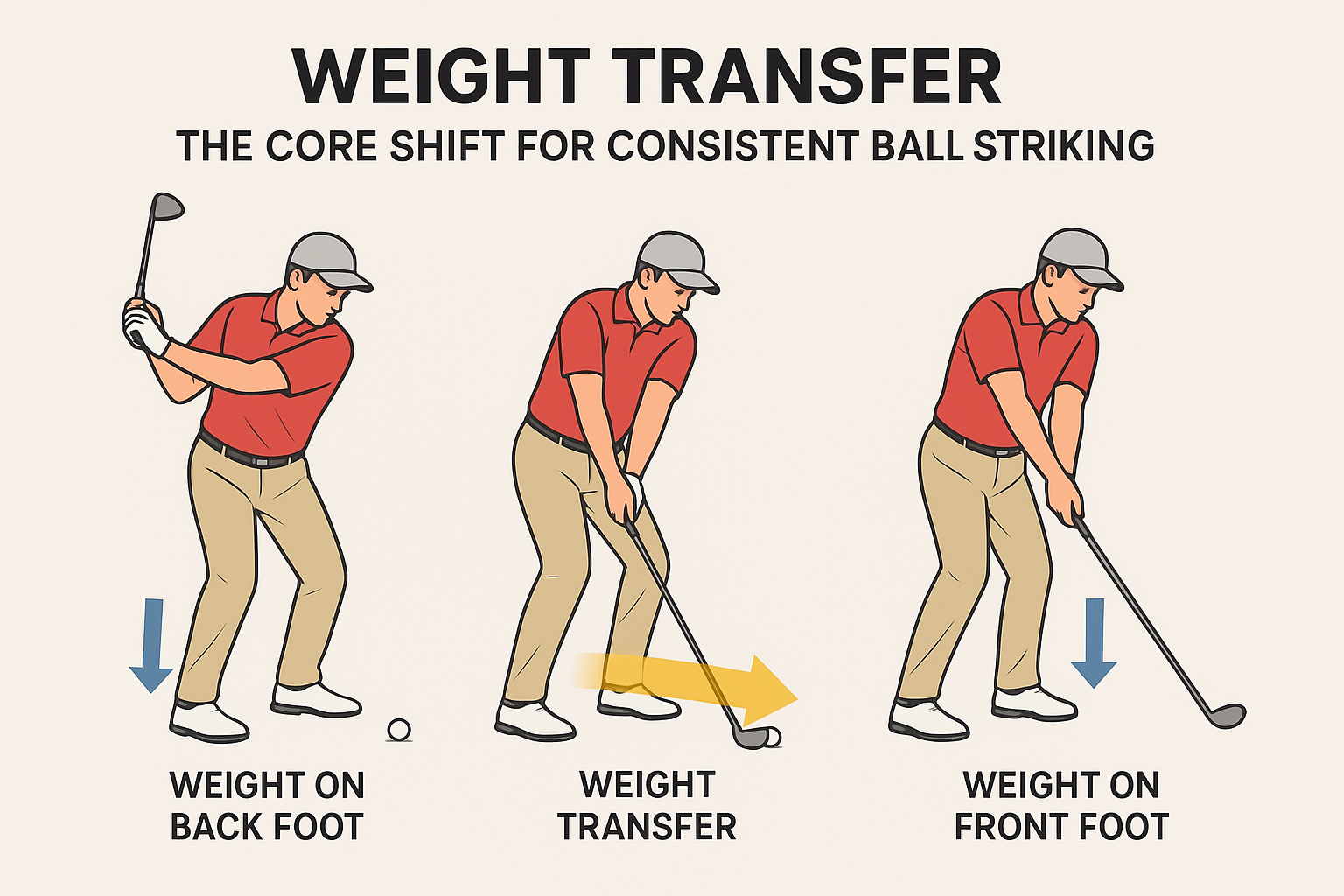
Weight Transfer: The Core Shift for Consistent Ball Striking
In golf, you won’t consistently strike the ball well if you don’t move your weight properly. Weight transfer is the smooth shift of your body’s weight from the right (trail) foot to the left (lead) foot as you swing. Done well, it helps the club face stay on the right plane and delivers solid contact time after time.
What the concept is
Weight transfer is not just “pushing off your back foot.” It’s a coordinated movement: during the backswing, some weight loads to the trail foot; during the downswing and through impact, that weight shifts toward the lead foot, finishing with most of your weight over the front foot. The goal is a natural, athletic transfer that accelerates the club in the direction you’re aiming.
Why it matters to the golf swing
- Solid contact: a forward transfer helps you strike the ball with the center of the clubface more often.
- Consistent ball flight: proper weight shift reduces hooks and slices by keeping the club on a stable arc through impact.
- Power and control: loading and unloading your legs allow you to generate speed without compensating with your arms alone.
What you should feel when doing it correctly
- At the start of the downswing, you feel the weight begin to move from the right foot toward the left foot, like you’re loading into the lead leg.
- You sense ground contact driving up through the lead foot as you connect with impact.
- Your head stays fairly steady, with your chest and hips rotating as the weight shifts forward.
2–3 common mistakes with fixes
- Mistake 1: Staying back on the right foot through impact
Why it hurts: The club releases late, contact is weak, and the ball tends to pull or pop up.
Fix: Begin transferring weight earlier in the downswing and finish with the majority of your weight over the front foot at impact (rough target: ~60–70% on the lead foot). Cue: “drive the lead heel into the ground” and feel your left hip burning forward as you swing. - Mistake 2: Excessive lateral slide without rotation
Why it hurts: Swapping weight by sliding your hips instead of rotating, which robs you of power and control.
Fix: Focus on rotating your hips and chest toward the target while your weight transfers. Cue: “turn the belt buckle toward the target” as you shift weight, not just lean to the left. - Mistake 3: Early extension or jumping up on the ball
Why it hurts: Your spine angle changes, causing thin or fat shots.
Fix: Maintain your spine angle and keep the chin tucked slightly; allow the hips to rotate and the weight to move forward without rising. Cue: “stay tall, let the hips move first.”
One easy drill you can do at home or at the range
- Set up with a normal stance and a mid-iron. Place a small towel or cross-lacing band under the sole of your right foot (for a right-handed player) to feel the need to transfer weight to the front foot without swaying.
- Take a few half-swings, focusing on loading to the trail foot in the backswing and then shifting toward the lead foot during the downswing. Don’t rush the transfer—let it happen as you rotate.
- Progress to full swings, aiming to finish with most of your weight on the front foot and your chest facing the target. Repeat 10–15 times.
Tip for practice: start slow, then gradually increase tempo as you feel the weight move smoothly. If you notice a loss of balance, pause and reset your stance before continuing—the transfer should feel controlled, not forced.
Mastering weight transfer takes time, but with the right feel and cues, you’ll notice cleaner contact, more consistent distance, and improved accuracy. Focus on the shift, not on forcing power—power will follow naturally from a solid, athletic transfer.
Weight Transfer: The core Shift for Consistent Ball Striking
Weight Transfer: The Core Shift for Consistent Ball Striking
Understanding Weight Transfer: The Core shift in Ball Striking
Weight transfer is the deliberate and coordinated movement of the bodyS center of gravity from the back foot toward the front foot during the hitting cycle. In many sports, the efficiency of this shift directly influences contact quality, power, and consistency. Rather than thinking about “striking harder,” elite athletes focus on how and when to move weight so that the club, racket, or bat meets the ball at peak speed and wiht maximal control.
The core idea is simple: generate stored energy from the trailing leg and hips, then unleash it through the front side at impact. When done well, the athlete maintains balance, minimizes deceleration, and preserves spinal posture, all while the body remains aligned to the target.
Core biomechanics: How weight transfer works
Prosperous weight transfer hinges on a synchronized kinetic sequence. A typical, efficient pattern looks like this: load in the back foot, rotate the hips and trunk toward the target, initiate leg extension, and release force through the front foot at impact. The timing matters: too early or too late in the sequence disrupts contact and reduces speed.
The role of hips, knees, and ankles
- Hips: Drive rotation and store elastic energy. A controlled hip turn creates the angular momentum needed to move the weight forward smoothly.
- Knees: Allow a natural flex and unflex to guide the shift without collapsing or swaying excessively.
- Ankles and feet: Anchor the base, transfer ground reaction forces, and provide the stability platform for the swing path.
Spine angle, balance, and posture
- Maintain a stable spine angle through impact to optimize energy transfer and minimize mis-hits.
- Balance on the center of gravity to avoid early extension or lateral sway that can rob speed and accuracy.
- Keep eyes on the ball and a relaxed jaw to help reduce tension that can impede fluid weight shift.
Ground reaction forces and timing
- Ground reaction forces flow from the ground up. Efficient transfer starts with a solid base and uses the ground as a springboard for speed.
- timing is key: the front-side firming should occur near impact to maximize the transfer of momentum into the ball.
Weight transfer across sports: What changes and what stays the same
Though the specifics vary by sport, the underlying principle remains: shifting weight effectively at the right moment improves contact, power, and control.
Golf
In golf, weight transfer usually starts with a slight loading of the trail leg during the backswing and culminates in a rapid, controlled shift to the lead leg through impact. The goal is to maximize clubhead speed at the moment of contact while preserving swing plane and spine angle.
Tennis
Tennis players frequently enough initiate weight transfer as they transfer weight from the back foot to the front foot in the forward swing. Proper transfer supports groundstroke pace, depth, and spin without sacrificing control.
Baseball/Softball
In bat-focused sports, weight transfer contributes to bat velocity. A well-timed load shift helps generate bat speed and ensures that the barrel meets the ball with a strong, level path.
Othre related activities
even in fielding or serving actions, a deliberate weight shift supports stability and power transfer, reducing the risk of overload on the back or shoulder.
Benefits of proper weight transfer
- increased contact consistency: A predictable transfer path helps you meet the ball more often in the sweet spot.
- Greater ball speed and power: Efficient energy transfer from the ground through the kinetic chain translates into faster clubhead or racquet speed.
- Improved balance and posture: A stable spine and centered mass reduce the likelihood of mishits and off-center contact.
- Better shot control and dispersion: With a repeatable sequence,directional accuracy improves and shot-to-shot variability decreases.
- Injury risk reduction: Proper sequencing reduces excessive stress on the lower back, knees, and hips by distributing load more evenly.
Practical tips and drills to master weight transfer
Practice with intention. The drills below help you feel the shift, align your base, and lock in a reliable sequence.start slowly, then progress as your body learns the pattern.
Essential cues
- Feel your weight move from the heel of the back foot to the ball of the front foot at impact.
- Keep the trail knee flexed as you rotate and transfer,avoiding early extension.
- Maintain a stable spine angle and keep your head steady during the transfer.
Drills
- Walk-through drill: Without a ball, take your posture and walk through the motion as if hitting a ball. Focus on shifting weight smoothly from back to front foot, ending with a balanced finish.
- 2-3-1 weight shift drill: In a static stance, count “2-3-1” as you shift weight from the back foot (2) to a loaded front foot (3) and then to a full front-side finish (1). Repeat slowly,then increase speed while preserving form.
- Step-through drill: Place a small obstacle or line ahead of your stance. Step into your forward swing while transferring weight, aiming to keep contact centered between feet.
- Balance beam drill: Use a low beam or tape line. Practise stepping onto the line with the lead foot as you transfer weight, then clear the line on the finish, ensuring a balanced finish.
Progression tips
- Begin with dry-swings (no ball) to engrain the sequence, then add a stationary ball.
- Move to half-speed shots before increasing tempo and distance.
- Record and compare swings to study how weight transfer correlates with contact quality.
Equipment-amiable cues
- Use a light resistance band around the hips to cue rotation without over-rotating.
- Place a small towel under the trail foot to encourage an unapologetic weight shift toward the front foot.
Table: Quick-reference drill guide
Use this concise reference to pick drills that match your current level and goals. The table uses WordPress-friendly classes for easy styling.
| Drill | Goal | Key Cues | duration/progression |
|---|---|---|---|
| Walk-through drill | Feel weight transfer without impact distortions | Load back foot, rotate hips, finish balanced | 4 sets of 8 swings, slow → moderate pace |
| 2-3-1 weight shift | Timing and sequencing | 2 = load, 3 = shift, 1 = finish | 6–8 reps per side, control first |
| Step-through drill | Directional balance and forward move | Lead foot steps into swing path, weight forward | 3 sets of 6 swings |
| Balance beam drill | Core stability and line control | Stay on line, smooth transition | 5 minutes per session |
Common mistakes and fixes
- Mistake: Early weight shift or weight staying on the back foot too long. Fix: Cue yourself to start the shift earlier by imagining your hips unwinding toward the target just before contact.
- Mistake: Swaying laterally instead of rotating. Fix: Practice with a mirror or video feedback to ensure your hips rotate,not your torso alone.
- Mistake: Over-rotation causing loss of spine angle. Fix: Keep a slight spine angle horizon and avoid over-turning the upper body; let the hips drive the motion with the trunk following.
- mistake: Flat-footed finish or excessive weight on the lead foot. Fix: Finish with a centered, balanced chest over the midline and soft knees to absorb momentum.
Case studies and first-hand experiences
Case Study A: Amateur golfer improves carries with a focused weight transfer plan
An amateur golfer struggled with inconsistent contact and short carries. After incorporating a structured weight-transfer routine—emphasizing a controlled trail-to-lead shift and hip-initiated rotation—the player reported a measurable increase in ball speed and more consistent strike zones.The player practiced the 2-3-1 drill for 12 weeks and observed a reduction in miss-hit frequency by roughly 40%.
Case Study B: tennis player gains depth and pace on groundstrokes
A developing doubles player noticed inconsistent depth on forehands. By adjusting weight transfer to begin the forward leg drive earlier in the stroke and maintaining a stable spine, the player achieved better ball depth and improved pace without sacrificing control. Video analysis showed a clearer transfer pattern and a more compact swing path.
Quick-start checklist for immediate improvement
- Stand tall with a slight athletic knee bend and balanced weight distribution.
- Feel load on the back foot during the initial backswing or readiness phase.
- Initiate the transfer with a controlled hip rotation toward the target.
- Touch down with the lead foot and finish with a balanced, centered stance.
- Keep the spine angle intact and eyes on the ball through impact.
FAQ: Weight transfer and ball striking
- What is weight transfer in simple terms?
- Weight transfer is the deliberate shift of your body’s weight from the back foot to the front foot during the hitting cycle to maximize power and consistency.
- Why does weight transfer matter for accuracy?
- A consistent transfer path helps you meet the ball at the right point, reducing mis-hits and improving dispersion.
- How do I know I’m transferring weight correctly?
- seek a smooth, continuous shift without excessive sway or early extension. Use video feedback or a mirror to verify hip rotation leads the movement,with the front foot driving contact.
- Can weight transfer prevent injuries?
- Yes, by distributing forces more evenly through the kinetic chain, it reduces excessive load on the lower back and knees and promotes better posture during impact.