
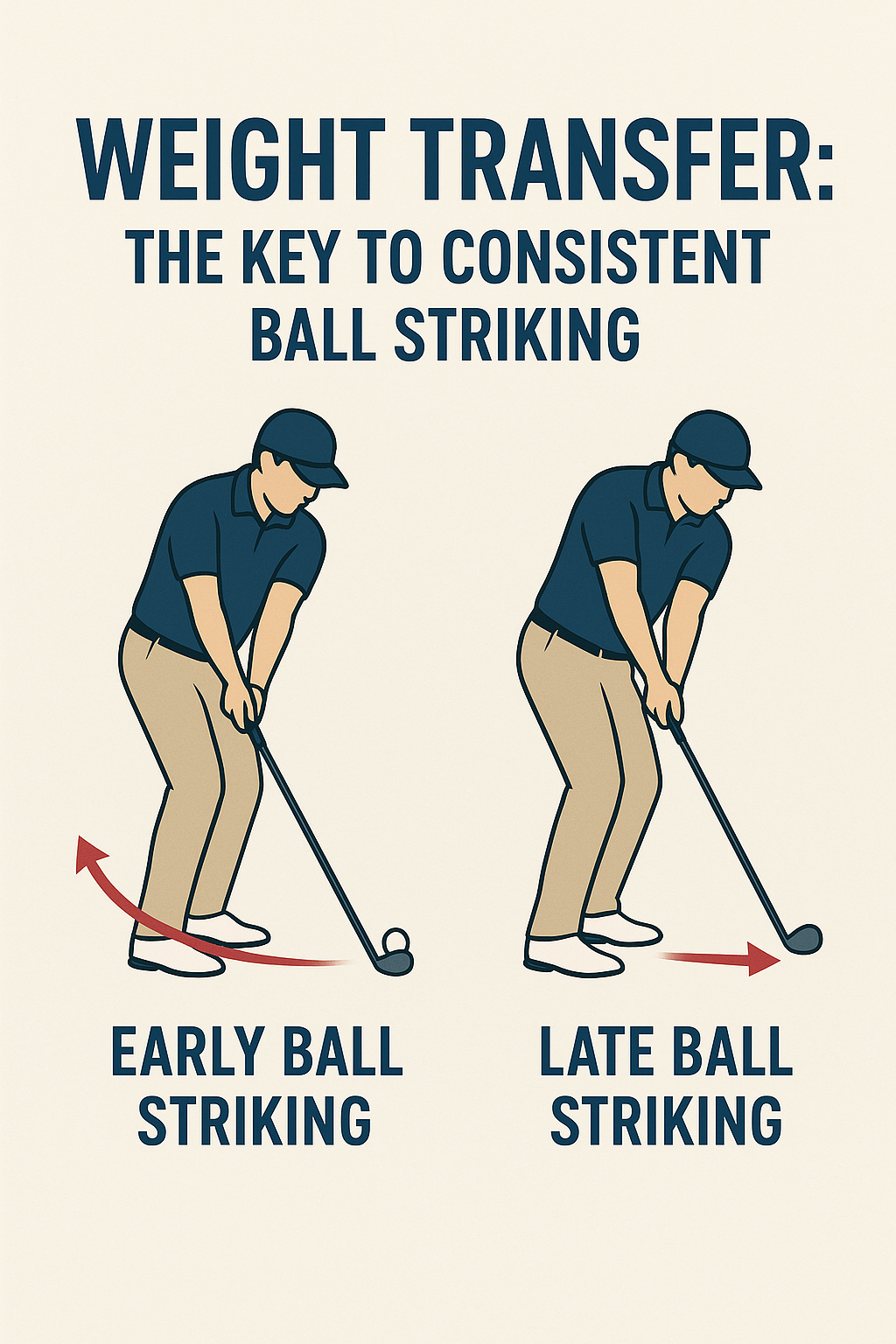
Weight Transfer: The Key to Consistent Ball Striking
What this concept is. Weight transfer is the deliberate movement of your body’s weight from the trail foot (right foot for most right-handed players) to the lead foot (left foot) as you move from the top of the backswing, through impact, and into the finish. It isn’t a jump or a lunge; it’s a controlled shift and rotation that keeps your body connected to the swing and your hands from taking over too early.
Why it matters to the golf swing. Proper weight transfer helps you strike the ball more consistently with solid contact, straighter paths, and better distance control. When weight moves correctly, the clubface stays square to the path longer and your body can maintain posture and tempo. The result is crisper contact, predictable ball flight, and fewer fat shots or hooks/slices caused by early or late arm dominance.
What you should feel when doing it correctly. At setup, your weight sits evenly or slightly toward the middle. In the backswing, you feel a gentle loading toward the trail foot. As you begin the downswing, your hips rotate toward the target and your weight shifts onto the lead foot. By impact, most of your weight is on the lead foot, with a slight knee flex in that leg. You should feel the spine angled forward enough to stay balanced, not upright or falling back. Finish with your chest facing the target and your weight solidly on the lead foot.
2–3 common mistakes and quick fixes
- Mistake 1: Weight stays on the trail foot too long into impact. This delays your impact and can lead to fat shots or thin contact because the hands take over before the lower body is square to the ball.
- Start the downswing with your hips rotating toward the target while the trail heel releases off the ground. Think “lead with the hips” and “drive into the lead foot.”
- Do slow-motion swings focusing on the transition. Pause at the top, then swing through while actively feeling weight shift to the lead foot at impact. Gradually increase speed as the feeling becomes natural.
- Mistake 2: Swaying laterally instead of rotating. A pronounced slide to the right (for right-handers) can throw your path off and rob you of solid contact because the hips aren’t turning enough.
- Emphasize hip rotation over a big lateral shift. Keep your upper body quiet while your hips rotate toward the target.
- Place a chair or alignment stick just outside your trailing hip line. As you swing, try to rotate past the stick without bumping it—this trains a rotation-first weight shift rather than a big sway.
- Mistake 3: Weight remains heavily on the trail foot at contact. This often shows up as inconsistency and misses to the heel or toe side of the clubface.
- Maintain a balanced posture with your center of mass over the mid-foot through impact, finishing with most of your weight forward (on the lead foot).
- Use a metronome or count aloud: “1-2-3-impact-finish.” Focus on finishing with weight on the lead foot and the trail foot light on the ground.
One easy drill to try at home or on the range
Step-Through Weight Transfer Drill
- Take your normal grip and stance. Start with the clubhead at waist height and your feet close together (about shoulder-width apart).
- Take a half to three-quarter backswing. As you begin the downswing, shift your weight toward the lead foot and, just after impact, step forward with your trail foot into a comfortable follow-through, finishing with your chest facing the target and your weight solidly on the lead foot.
- Focus on a smooth sequence: hips rotate toward the target, weight shifts, then you finish tall with balance. Do 8–12 repetitions, then gradually increase to full-speed swings as the feeling locks in.
Bottom line. Treat weight transfer as the engine of your ball striking. When you move weight properly from trail to lead foot with coordinated hip rotation, you’ll notice cleaner contact, more consistent trajectory, and better control—without trying to muscle the ball. Practice this with intention, and the rest of your swing will follow.
Weight Transfer: The Key to Consistent Ball Striking
Weight Transfer: The key to Consistent Ball Striking
Weight transfer is the cornerstone of repeatable, powerful ball striking in many sports. Whether you’re swinging a golf club, racquet in tennis, or using a bat in baseball, the ability to move your weight efficiently from the back foot to the front foot — while maintaining balance and control — directly influences contact quality, accuracy, and distance. This guide dives into the science behind weight transfer, practical drills, and actionable tips you can start using today to improve every shot.
Why Weight Transfer Matters for consistent Ball Striking
At its core, weight transfer is about timing and sequencing. The body’s kinetic chain starts with stable ground contact and culminates in a well-timed release of energy through the ball.When weight shifts too early, too late, or unevenly, contact quality suffers and shot dispersion increases. Correct weight transfer promotes:
- Better contact and ball speed through optimized energy transfer
- Improved balance,reducing swing faults and off-center hits
- Consistent ball flight by aligning upper body rotation with lower body movement
- Injury reduction by distributing load through the hips and legs rather than the spine
Biomechanics of Weight Transfer
Understanding the biomechanics helps translate feel into repeatable technique. The body acts as a kinetic chain, with the legs, hips, torso, shoulders, and arms delivering energy in a coordinated sequence. Key concepts include:
- Ground reaction forces: The floor supplies resistance that allows you to transfer weight effectively into the shot.
- Centroid control: Maintaining a stable center of gravity helps you stay balanced while the footwork and hip rotation drive power.
- Hip rotation and spine angle: Rotation from the hips initiates the downswing or forward swing, while preserving spine angle prevents loss of power and accuracy.
- Timing and sequencing: The transition from backswing to downswing should feel like a controlled “coiling and firing” of energy, not a rush or a stall.
Phases of the Swing (or Stroke) and Weight Transfer
- Establish a stable base with even weight distribution, often slightly favoring the trail foot (the foot farthest from the target) depending on the sport and individual style.
- Backswing: The weight remains balanced or slightly loaded on the trail side, preparing the torso for rotation.
- Transition: Initiate movement by the hips and torso turning toward the target while the trail knee remains flexed, creating space for the upcoming shift.
- Downswing (or forward stroke): The weight shifts toward the lead foot, driven by hip rotation and a controlled drop of level shoulders into the shot.
- Impact: the majority of weight should be on the lead foot, with the energy from the ground transferred into the ball for crisp contact.
- Follow-through: The final position reinforces balance and completes the transfer, preventing early head lift or loss of posture.
Common Mistakes that Break Consistency
Recognizing errors is the first step toward correction. Here are frequent missteps and how they disrupt weight transfer:
- Early weight shift: Moving weight to the front foot before contact reduces elastic potential and shortens the swing arc.
- Reverse weight transfer: Pushing weight onto the front foot too soon and losing connection with the trail side can cause pulls or pushes off target.
- Excess lateral slide: Side-to-side movement without proper forward progression creates inconsistency and balance issues.
- Over-rotation without sequencing: Hips rotate too quickly while upper body lags,causing timing errors and toe/heel strikes.
- Head and eye drift: Lifting the head early or losing visual focus disrupts balance and shift timing.
- Inadequate core engagement: A weak core reduces the ability to control weight transfer during the transition.
Drills and Practical Tips to Master Weight Transfer
Practice-driven cues and drills help translate theory into reliable performance. Use these during training sessions to ingrain sound weight transfer mechanics:
Foundational Drills
- Stand with feet shoulder-width apart,hold a club or racquet lightly,and practice a smooth backswing-into-downswing with a deliberate trail-to-lead weight shift while keeping the head steady. Do 2×30 seconds sessions.
- 目 Place a small step behind the trailing foot.On transition, step into the lead foot while keeping your torso square to the target. The goal is a controlled, progressive weight transfer.
- stand with your back a few inches from a wall.As you swing, your back should lightly touch the wall only if you’re maintaining spine angle and balance. If your hips or shoulders push off too early, you’ll feel the wall sooner.
More Targeted Weight-Transfer Drills
- Toe-Tap Rythm Drill: while holding the grip,alternate tapping the lead toe with a light bounce to feel the ankle and knee flex while weight shifts forward during the strike zone.
- Medicine Ball Rotations (Light load): With a light medicine ball in hand, perform controlled torso rotations while maintaining a stable lower body. This reinforces hip-shoulder sequencing and helps you feel the transfer from trail to lead side.
- Pump Drill (Short Swings): Take short swings, focusing on a 1-2 inch shift of weight toward the lead foot at impact, than resetting the hips for the next repetition. Repeat 20–30 reps.
Feel-Based Cues for Better Translation
- “Hips lead, hands follow” to ensure the hips drive the sequence rather than the arms pulling the club.
- “Stay connected to the ground” to emphasize ground reaction forces as the source of power.
- “Lengthen through impact” to promote a stable spine angle and a strong finish after contact.
Sports-Specific Adjustments
- Golf: Emphasize a slight trail-side heel raise during the backswing and a pronounced lead-foot pressure build during impact to maximize compression and flight control.
- Tennis: Focus on transferring weight from the back foot during the backswing to the front foot at contact, with a continuous step forward after contact to maintain balance and pace.
- Baseball/Softball: Use a compact weight shift sequence that aligns the hips with the pitch or pitch-like motion to ensure solid contact and reduce thin or early-rotated hits.
Case Studies: real-World Improvements Through Weight Transfer
- A mid-handicap player reduced inconsistent contact by focusing on a controlled transition from trail to lead foot, reporting crisper impact and more consistent carry after six weeks of weekly drills and tempo work.
- A club-level player increased pace and accuracy by teaching the stepping-forward sequence on forehand strokes, with an emphasis on maintaining balance while transferring weight through contact.
- Implemented wall touch and toe-tap drills to reinforce balance; within a month, shot variety and placement improved due to steadier weight transfer and better timing.
First-Hand experience: coaching Insights on Weight Transfer
From working with players across skill levels,the most striking improvement comes when practitioners move from counting repetitions to feeling the transfer. The coach’s eye often catches subtle cues: a player’s weight lingering on the trail foot too long, a rush to the front side, or a collapse in the upper body during impact. By validating the sensation of a proper transfer — a deliberate, smooth shift from back foot to front foot with hip rotation initiating ahead of the hands — players begin to execute with less thought and more automatic balance. This shift in mindset transforms drills into second-nature responses on the course,court,or field.
Practical Practice Plan: 4-Week Schedule to Improve Weight Transfer
- Daily 15-minute sessions focused on balance and posture, two drills per session (Balance Drill, Wall-Touch Drill).
- Week 2 — Transition Emphasis: Add the Step-Through Drill and Toe-Tap Rhythm Drill; integrate cues “hips lead” and “weight forward” during all shots.
- week 3 — Sequencing: Incorporate Pump Drill with a focus on transition timing; monitor head stability using a mirror or video feedback.
- Week 4 — Integration: Combine all drills into full-swing practice and match play or live drills; measure contact quality, consistency, and shot dispersion.
Key Metrics and Tools to Track Progress
Quantifying progress helps maintain focus. use these metrics to gauge weight transfer quality over time:
- Ball impact position relative to body: center, slightly forward, or behind center.
- Lead-foot pressure percentage at impact (rough target: majority on the lead foot).
- Hip rotation timing relative to arm swing (early, on-time, or late).
- Balance indicators: steady head position, minimal knee wobble, and upright posture through impact.
| Phase | Primary Focus | How to Check | Common Feedback |
|---|---|---|---|
| Setup | Even weight, grounded stance | Feet feel connected; weight roughly 50/50 with a slight bias to trail | “I’m falling to one side” |
| Backswing | Stability plus stored energy | Shoulders rotate; back foot stays grounded | “I’m losing balance in the backswing” |
| Transition | Shift toward lead foot | Hip rotation initiates before arms move | “My hips jump into the shot” |
| Impact | Lead-foot dominance; crisp contact | Weight on lead foot; high-quality contact | “Miss hits or pulls push” |
| Finish | Balanced finish, relaxed deceleration | Controlled finish with hips facing target | “I stop early or fall back” |
Frequently Asked Questions
What is the simplest cue for improving weight transfer?
A practical cue is “hips lead, arms follow.” Focusing on initiating the move with hips and letting the arms follow helps synchronize the transfer with rotation and makes the movement more repeatable.
Can weight transfer help with both power and accuracy?
Yes. Proper weight transfer creates a stable base and efficient energy transfer, which tends to improve both ball speed and directional control. When the sequence is clean,you’ll see tighter shot dispersion at various swing speeds.
how do I know if I’m transferring weight correctly during a live shot?
During a live shot, you should feel a natural push-off from the trail leg into the launch, a solid lead foot contact, and a balanced finish. Video analysis or feedback from a coach can help confirm if the transfer aligns with the desired motion.
Final Thoughts on Mastering Weight Transfer
Weight transfer is a dynamic blend of stability, timing, and sequencing. The goal is not just to move weight but to coordinate that move with rotation and the arc of your swing or stroke.By building a strong foundation with balance drills,reinforcing the transition with targeted drills,and tracking objective metrics,you can elevate your ball-striking consistency across golf,tennis,and other racquet sports. Remember, small, deliberate improvements compounded over time deliver meaningful performance gains without risking overload or injury.