
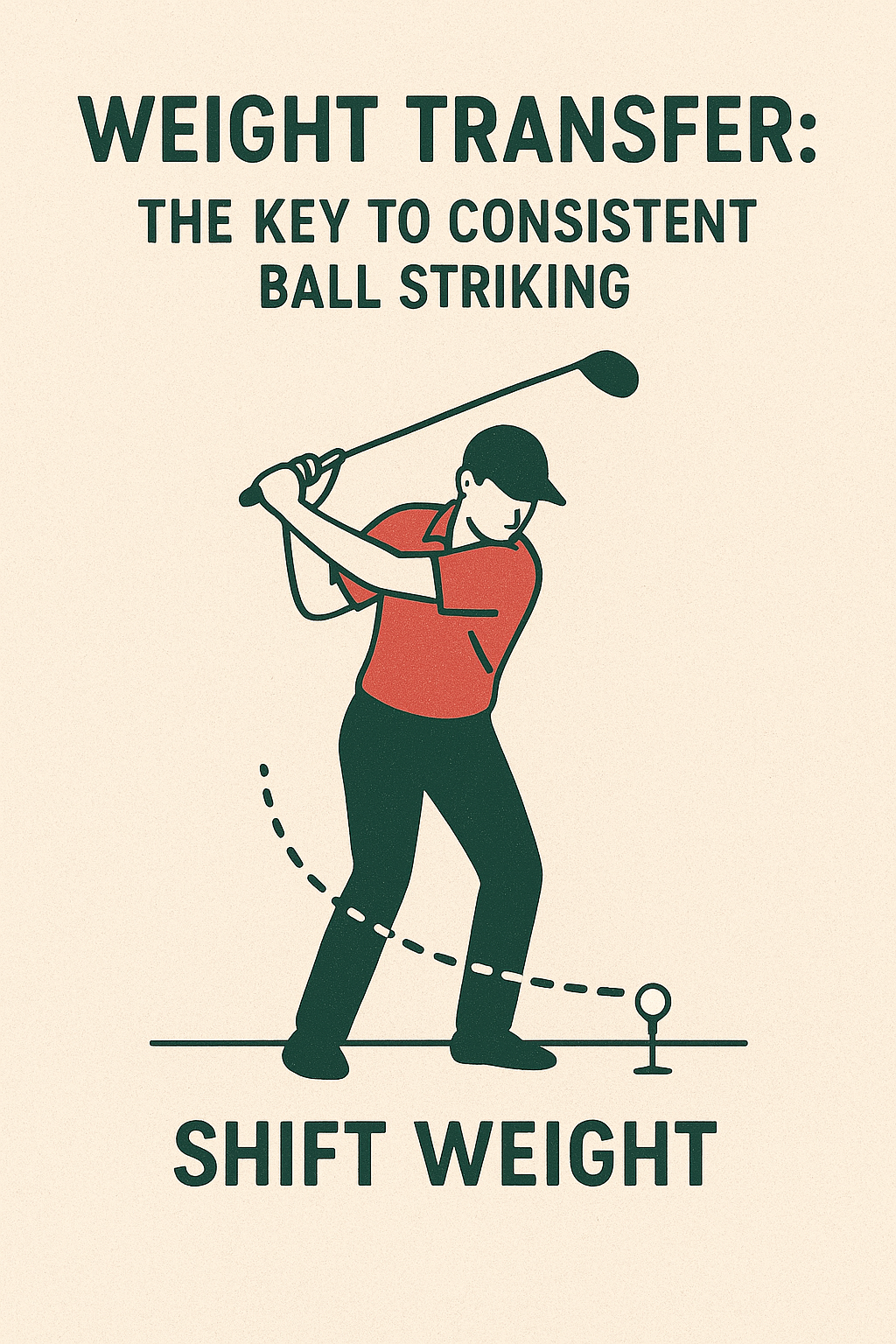
Weight Transfer: The Key to Consistent Ball Striking
Today we’ll focus on a single, crucial aspect of the golf swing: weight transfer. For most amateur players, getting this right is the difference between solid contact and inconsistent shots. Weight transfer is not just “pushing forward.” It’s a coordinated shift of your center of gravity from your trail foot to your lead foot as you rotate into impact and through the finish.
What the concept is
Weight transfer means moving your weight from the right foot (for a right-handed golfer) toward the left foot as you swing. It happens as you start the downswing and continues into impact and the follow-through. Proper transfer is a blend of hip rotation, torso rotation, and a controlled shift of pressure across the soles of your feet, so you finish with most of your weight on the lead foot.
Why it matters to the golf swing
- Improves contact and consistency. A well-timed weight shift helps you strike the ball with the center of the clubface more often.
- Promotes solid compression and distance control. Efficient transfer helps you maximize energy transfer to the ball.
- Stabilizes your balance. Without the transfer, shots commonly go high, low, left, or right, and you’ll feel “behind” the ball.
What you should feel when doing it correctly
- During the backswing, you feel a light load onto your trail foot without collapsing the knee.
- During transition, your weight starts to move toward the lead foot as your hips rotate toward the target.
- At impact, most of your weight is already on the lead foot, with your chest facing the target and your spine a little tilted toward the target.
- In the finish, your weight remains mainly on the lead foot and you’re balanced, not hunched or falling forward.
2–3 common mistakes with fixes
- Mistake 1: Staying back on the trail foot past impact. This leads to thin, fat, or pushed shots and a loss of distance.
- Fix: Feel the pressure move into the lead foot as you approach impact. Practice with half-swings focusing on loading the lead leg and finishing with your weight on the left foot. A simple cue: “press into the lead foot, turn the belt buckle toward the target.”
- Mistake 2: Swaying laterally instead of rotating. The body shifts forward without enough hip turn, so the path becomes inconsistent.
- Fix: Focus on rotating the hips to open the chest toward the target while you transfer weight. Keep your head relatively still over the spine and don’t let the chest drift toward the ball. Practicing with a wall drill or a mirror can help you feel the rotation without excessive slide.
- Mistake 3: Releasing weight transfer too early or too late. If you shift weight too soon or too late, you’ll lose control of the clubface and stroke path.
- Fix: Time the transfer with a smooth, coordinated sequence: load on the trail foot in the backswing, initiate the downswing with hip rotation, and complete the transfer through impact. A good cue is “turn first, then transfer”—rotate the hips and torso to the target before you feel the weight move aggressively forward.
One easy drill to train this at home or on the range
Step-Through Weight Transfer Drill (great for beginners and intermediates):
- Take your normal stance with a mid-iron. Practice a few light half-swings to feel the load on your trail foot.
- On a deliberate downswing, start the transfer by rotating your hips toward the target. As you approach impact, shift your weight to your lead foot and pretend to step forward with your trail foot after contact.
- Finish with most of your weight on the lead foot and your chest facing the target. If space is limited, simply step your trail foot slightly forward in place after contact while keeping balance.
- Do 6–8 repetitions, focusing on a smooth, coordinated transfer rather than a forceful drop of weight.
Tip: keep your head stable relative to your spine and avoid excessive knee bend or collapse on the lead side. A mirror or video can help you check that your weight is moving and your hips are rotating, not just sliding forward.
Working on weight transfer builds a reliable foundation for every swing. Start with slow, controlled reps, then gradually add speed as your balance and understanding grow. With patience and consistent practice, you’ll notice cleaner contact, straighter shots, and better distance control.
weight Transfer: The Key to Consistent Ball Striking
In any sport that involves hitting a ball, from golf and tennis to baseball and cricket, weight transfer is the invisible engine behind solid contact, improved power, and repeatable results. Mastering how and when your body moves weight from one foot to the other during the swing or stroke unlocks a new level of control. This article breaks down the science, offers practical drills, and provides actionable tips to help you cultivate a reliable pattern of weight transfer that translates into consistently cleaner ball striking.
Understanding the core idea of weight transfer
Weight transfer refers to the purposeful movement of your body’s center of gravity through the phases of a swing or strike. It is not simply “pushing off the back foot” or “landing on the front foot”; it’s a coordinated sequence that starts from the ground up.Proper weight transfer aligns the kinetic chain—from the feet and ankles, through the legs and hips, up to the torso, arms, and hands—so that energy is stored, released, and directed toward the ball at impact.
The kinetic chain and balance
- Ground reaction forces: Every swing begins with a stable base. Efficient weight transfer uses ground reaction forces to propel the body toward impact without loss of balance.
- Center of gravity path: A smooth arc of center of gravity from the rear foot to the front foot helps deliver consistent strike quality.
- Hip and trunk sequencing: The hips initiate the turn, the torso follows, and the arms and club release energy. When sequencing is off, energy leaks and contact becomes inconsistent.
- Posture and spine angle: maintaining a constant spine angle while transferring weight ensures the swing plane remains on plane, which improves contact point and ball flight.
What “consistent ball striking” means in practice
Consistency isn’t about a single perfect move; it’s about repeatable patterns. With proper weight transfer, you’ll notice:
- more solid contact on the clubface or racket, leading to straighter shots and better dispersion.
- A stable arc of the swing or stroke,reducing mishits and off-center strikes.
- Better energy transfer to the ball, resulting in cleaner feel and improved distance control.
- Enhanced control under varying conditions because the body’s transfer pattern remains reliable.
Weight transfer in a golf swing: a model you can train
Golf is perhaps the clearest example where weight transfer is visible, measurable, and trainable. Think of weight transfer as a deliberate shift from the back foot toward the front foot during the downswing, followed by a balanced delivery at impact and a controlled recovery after contact. Below are practical components you can work on to develop a repeatable pattern.
setup and posture
- Feet shoulder-width apart with slight knee flex. Distribute weight evenly at address, then prepare to shift smoothly.
- Maintain a slight tilt in the spine and a steady head position to keep the center of gravity over the mid-foot region as you move.
- Grip pressure should be light to moderate; excessive grip tightness often tethers the hands and limits weight transfer.
The sequence: back foot to front foot
- Takeaway: The weight begins to shift toward the trail foot as the club moves away from the ball, storing energy in the legs and hips.
- Downswing: Hips lead the rotation; the weight shifts toward the lead foot,accelerating the torso and arms through the impact zone.
- Impact: Weight should be balanced through the center of the stance, allowing the hands to release with authority while maintaining control of the face and path.
- Release and follow-through: After impact, weight continues to move onto the lead foot, promoting a full, balanced finish without flailing.
Common missteps to fix
- Early reverse weight shift: Pushing weight toward the front foot to soon can cause early release and pulls or slices.
- Flat-footed finish: Failing to transfer weight fully to the front foot can reduce power and consistency.
- Excess spine tilt or sway: Losing posture disrupts weight transfer and swing plane, leading to inconsistent contact.
Drills and practices to master weight transfer
Drills are where theory becomes repeatable results. The following exercises help you feel and train the correct weight transfer pattern, reinforcing the kinetic chain’s sequence without sacrificing balance or rhythm.
Drill 1: Feet-together weight shift
- Stand with feet together and knees soft.Practice shifting weight from the back foot to the front foot in a controlled, small arc.
- Progression: Increase the arc’s width gradually while maintaining balance and posture.
- Goal: Feel the ground reaction forces as you shift, and keep head quiet and eyes steady on the ball path.
Drill 2: Step-and-slide (feet-to-feet)
- start with feet together,step back with the trail foot,then slide into a loaded position on the back side of the stance.
- As you swing, allow the weight to transfer forward fluidly into the lead foot, finishing with balanced weight on the front leg.
- Goal: Develop smooth sequencing, minimize loss of posture, and improve contact stability.
Drill 3: Slow-motion sequence analysis
- Perform a slow backswing and downswing focusing on where the weight is at key checkpoints (address,top of the swing,just before impact,and after impact).
- Use a mirror or video to ensure you’re not swaying or over-rotating, and that weight moves predictably from back foot to front foot.
Drill 4: Impact bag or towel drill
- Place a towel or soft impact bag just outside the lead thigh. The goal is to brush it with the lead hip as you release, showing you’re transferring weight through the center rather than collapsing to one side.
- Feel: The towel should move with your hip rotation as you maintain steadiness through impact.
Drill 5: Board drill with tempo cues
- Place a lightweight board or strip under the trail foot and practice a deliberate tempo-downswing with a cue like “load-rotate-press.”
- Goal: Internalize the tempo, connecting weight shift with timing.
Case studies and first-hand experiences
Case Study A: Mid-30s golfer seeking more consistency
A club player repeatedly hit a consistent distance but struggled with directional control. After focusing on weight transfer patterns, the player reported fewer pushes and pulls, especially on off-center hits. The changes included updated setup quality, more deliberate trail-foot activation, and a smoother transfer to the lead foot. Within six weeks, shot dispersion narrowed by up to 25%, and contact improved on average by 3–5 yards of carry with more consistent spin control.
Case Study B: Tennis player optimizing groundstrokes
A competitive tennis player found that heavy backswings caused timing issues on groundstrokes. By training weight transfer from the back foot through the hips into the leading foot during forehands, the player achieved a more stable platform at contact for both topspin and flat shots. this increased rhythm, reduced misses, and created confidence in aggressive plays from the baseline.
Case Study C: Baseball hitter refining contact
A youth baseball hitter faced struggles with line drive consistency.Integrating a focused weight transfer routine helped align the stride with the swing path and improved contact quality. The hitter’s hands stayed in front of the body longer,the bat speed remained high,and the enhancement manifested as more consistent line drives to all fields.
Benefits of proper weight transfer
- Higher hit quality: Greater sweet-spot contact and less mishit variation.
- Improved power and distance control: More efficient energy transfer translates to crisper shots and longer drives or rallies.
- Increased balance and stability: A well-timed weight transfer reduces post-impact decay and improves follow-through consistency.
- Better injury prevention: Balanced loading and unloading of the joints reduces stress on the lower back and shoulders.
- Adaptability across conditions: When the weight transfer pattern is reliable, adjustments for wind, turf, or ball type become easier.
practical tips for coaches and players
- Start with your base: A stable, athletic stance provides the best platform for controlled weight transfer. Ensure your feet and ankles can move without restriction.
- Lead with fundamentals: Teach the hip-first sequence as a cue for initiating the downswing or side-on stroke.
- Use feedback tools: Video analysis, pressure mats, or simple foot-placement checks help athletes feel the transfer pattern.
- Progress gradually: Begin with slow-motion practice and build to full-speed swings as confidence grows.
- Individualize cues: Some athletes respond to “load and explode,” others to “stay behind and rotate.” Use language that resonates with the player.
Weight transfer across other ball-striking sports
the principle of weight transfer is global across ball-striking disciplines. In tennis, such as, a deliberate weight shift from the back foot through the forehand or backhand improves pace and control. In baseball, a coordinated transfer from the back side to the front side sustains swing speed through the ball. Even in cricket or hockey, maintaining a stable base and a controlled weight transfer during shots enhances accuracy and power. the core concept remains the same: energy generated from the ground up should be released through the ball with minimal loss due to imbalance.
Measuring progress: data, cues, and progress tracking
Tracking progress helps players visualize improvement and stay motivated. The following table provides a compact, easy-to-use reference for drills, cues, and observed improvements. It uses WordPress-kind table formatting so it can be pasted directly into a post editor that supports the wp-block-table class.
| Drill | Cues / Focus | Key Feedback | Progress Indicator |
|---|---|---|---|
| Feet-together weight shift | “Shift,don’t rush” | Balanced weight transfer; smoother contact | Contact stability improves week-to-week |
| Step-and-slide | “Lead foot hits the gas” | Clear trail-to-lead sequence | Better ball compression on impact |
| Slow-motion sequence | “Check the arc of weight” | Identify/posture deviations | Fewer timing issues in full-speed swings |
| Impact towel drill | “Brush the towel with hip” | Hip rotation and weight transfer through impact | More solid impact face contact |
Frequently asked questions
Is weight transfer the same as weight shift?
In practice,yes,weight transfer and weight shift describe the same general idea of moving your body’s weight through the swing. Some coaches differentiate “transfer” as the intentional, efficient process of moving energy from the ground up, while “shift” emphasizes the movement of the body’s weight from one side to the other. Either way, the goal is the same: a controlled, repeatable sequence that optimizes impact.
How long does it take to improve weight transfer?
Improvements vary by individual, but many players see meaningful changes after 4–6 weeks of focused practice, especially when drills are consistent and integrated into on-course or on-court practice sessions. regular feedback, video review, and deliberate tempo are key to accelerating progress.
Can weight transfer fix a swing flaw only in one sport?
Weight transfer patterns influence all ball-striking disciplines because they rely on a stable base and efficient energy transfer. If you have a persistent flaw in one sport, addressing the fundamental weight transfer mechanics will typically benefit the others.However, sport-specific adjustments may be needed for grip, arm mechanics, and stroke path.
Final thoughts: embracing a transfer-based approach
Weight transfer is the bridge between technique and tangible results.By understanding the underlying physics—the way the feet,legs,hips,and torso coordinate to move weight through the swing—you can cultivate a repeatable pattern that improves ball striking consistency. The practical drills outlined here, along with real-world case studies, show that the path to better contact is not about chasing a single “perfect swing” but about building a reliable sequence your body can reproduce under pressure. Embrace the process: train the transfer, trust the sequence, and watch your ball-striking consistency rise across golf, tennis, baseball, and beyond.