
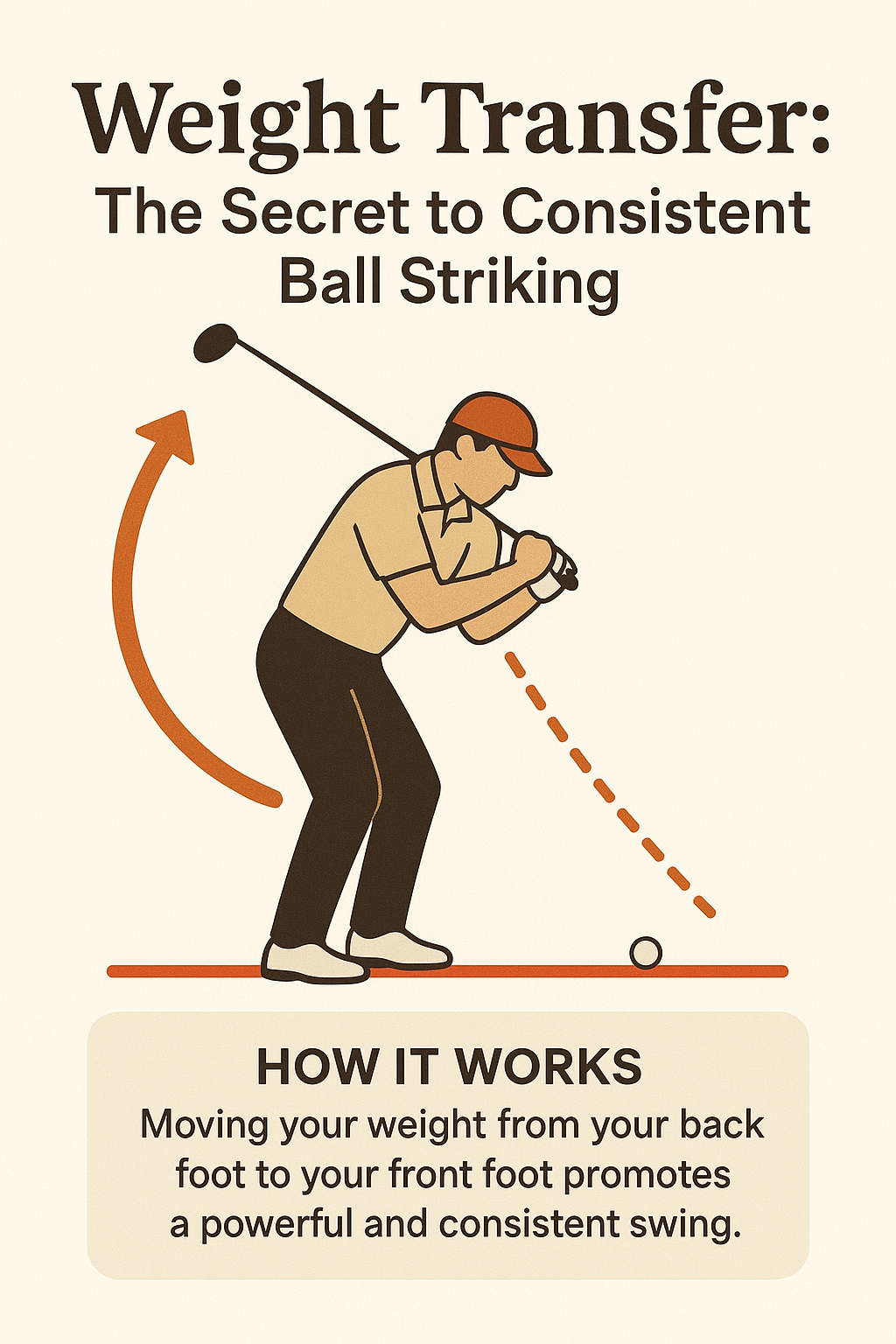
Weight Transfer: The Secret to Consistent Ball Striking
As a PGA professional, I see this one idea make or break a lot of golfers who want to hit the ball better and more consistently: weight transfer. It’s not a loud move, but it’s a powerful cue that helps you strike the ball cleanly, stay balanced, and control where the ball goes.
What the concept is
Weight transfer is the deliberate shift of your body’s pressure from the back foot (the trail foot) to the front foot (the lead foot) as you move from backswing into through impact. The goal isn’t to twist your hips into overdrive; it’s to allow your lower body to support the arms and club so you can deliver the clubface square to the ball at the moment of contact.
Why it matters to the golf swing
- Better contact: When your weight is properly over the lead foot at impact, the clubface is more likely to strike the ball before the turf, producing solid, consistent hits.
- More accuracy: A controlled weight shift helps you maintain your spine angle and swing path, reducing pushes, pulls, and slices.
- Power with control: Transitioning weight smoothly sets up a clean release and helps you tap into your stored energy without “doing all the work” with the arms.
What the golfer should feel when doing it correctly
- During the backswing, you feel some pressure build on the trail foot, like loading a spring.
- As you move toward impact, you feel that pressure shift onto the lead foot; the lead knee flexes slightly and supports your balance.
- Your hips rotate naturally, your spine angle stays tall, and the weight finishes on the lead foot with a balanced, steady finish.
- Keep your head steady over the ball and avoid a big slide to the target. You’re rotating around a stable spine, not sliding the hips too far forward or backward.
2–3 common mistakes golfers make with weight transfer
- Mistake 1: Staying loaded on the trail foot at impact. The ball tends to go fat or thin, and you miss consistency.
- Mistake 2: Early weight transfer or “pop” to the lead foot before contact. This can produce a high, thin, or over-rolled shot and balance loss.
- Mistake 3: Swaying or sliding the upper body instead of rotating the hips and transferring weight. You lose control of the swing path and distance.
Simple, actionable fixes for each mistake
- Fix for Mistake 1: Practice finishing with most of your weight on the lead foot. At address, feel a light connection to the trail foot; through impact, consciously shift weight forward, aiming for roughly 60–70% of your weight on the lead foot at impact. Use a mirror or video to confirm you’re not staying back.
- Fix for Mistake 2: Slow the transition and feel the weight move forward as you approach impact. Think “drive through the ball” rather than “jump to the finish.” Pause for a split second after contact to confirm your weight is forward and your finish is balanced.
- Fix for Mistake 3: Emphasize hip rotation over lateral movement. Practice with a small towel under your arms to reduce excessive upper-body sway; let your hips rotate and allow your chest to stay over the ball as you shift weight.
One easy practice drill you can do at home or on the range
- Split-Weight Drill: Stand with your feet shoulder-width apart. Without a club, take 6–8 half-swings, focusing on shifting your weight from the back foot to the front foot and finishing with most weight on the lead foot. Add a light club or just your hands to feel the same sensation with a smoother motion. If you have a mirror or recording device, check that your weight is forward at impact and your finish is balanced.
Remember, this is about a smooth, controlled transition rather than a forced move. With consistent practice, you’ll feel more solid contact, more accuracy, and more distance—all from a simple, repeatable weight transfer pattern.
Weight Transfer: Teh Secret to Consistent Ball Striking
Note: This article uses a cross-sport perspective (golf, baseball/softball, tennis, cricket) to explain weight transfer. The goal is a repeatable, athletic impact position that improves accuracy, power, and control.
Why Weight Transfer Matters
weight transfer, or proper weight shift, is the hinge that connects setup to impact. When you correctly move your body’s mass from the back foot toward the front foot during the swing or stroke, you maximize the efficiency of the kinetic chain. The result is more consistent ball striking, better control of where the ball goes, and improved power without sacrificing accuracy.
- Improved contact quality: the center of mass moves into the ball, leading to sweet spots and cleaner strikes.
- Enhanced power generation: sequential loading and unloading recruit the larger muscles of the legs and hips.
- Better control of direction and trajectory: front-side stabilization helps you manage angle of attack and spin.
- Reduced injury risk: balanced weight transfer reduces abrupt deceleration and excessive torque on joints.
The Anatomy of a Proper Weight Transfer
A reliable weight transfer follows a coordinated sequence: load, shift, and stabilize. Think in terms of three phases: initiation, transition, and release. Each phase should feel like a smooth,continuous motion rather than a staccato step-by-step action.
Key phases
- – establish a solid base with slight knee flex and a neutral spine. Your back foot begins to load, preparing to store energy.
- – hips rotate and the torso unwinds toward the target.Weight starts moving from the back foot to the front foot while keeping balance and posture.
- – the majority of weight lands on the front foot at impact,with the hips and torso delivering the final acceleration to the ball. The extension through the front hip and leg stabilizes your contact point.
In practice, you should feel a controlled “push” of weight forward rather than a sudden lurch. The goal is a seamless transfer that aligns your center of gravity with the target line at impact.
Body mechanics to monitor
- hip rotation: efficient hip turn generates torque and helps translate energy into the ball.
- Spine angle and posture: maintain a stable spine angle to avoid over-rotation or loss of balance.
- Foot pressure distribution: a gradual increase of pressure through the midfoot to forefoot on the front side signals a clean transfer.
- Core engagement: a braced, engaged core supports the pelvis and transfers energy from legs to arms.
Weight Transfer Across sports
Golf: precision through a forward shift
in golf, weight transfer is a defining factor for solid contact and consistent ball flight. A muted weight shift risks thin or fat shots, while an exaggerated shift can throw off balance. the ideal sequence: load into the right foot (for right-handed players), rotate the hips, and then transition weight to the front foot through impact. This creates a stable impact position with the hands delivering a dynamic yet controlled clubhead path.
Baseball and softball: timing and ramp-up
Batting requires a fast, confident weight transfer to the front side at contact.A properly timed shift allows the hips to lead and the hands to follow, maximizing bat speed while maintaining control of the barrel path. Players who struggle with contact often over-rotate without transferring weight, or drift onto their back foot, losing power and consistency.
Tennis: stability on groundstrokes and serves
Tennis relies on a coordinated weight transfer for both baseline rallies and serves. Groundstrokes benefit from a slight knee flex and forward pressure through the front foot as the racket head meets the ball.Serves require a pronounced forward weight shift from the legs through the hip extension to the contact point and into the toss, generating pace and accuracy.
Cricket: driving the ball with a forward drive
Cricket players use a forward weight transfer to drive the ball. The front foot stabilizes, the front knee nods into impact, and the torso unwinds to transfer momentum into the bat. A poor weight transfer can cause mis-timed shots or closed bat face angles, reducing energy transfer to the ball.
Practical Drills and Progressions
These drills help you feel the correct weight transfer, build kinetic- chain sequencing, and translate the feeling to live ball striking. Start slowly, with a focus on rythm and balance, then progress to live-ball scenarios.
Drill 1: Back Foot to Front Foot Feel
Stand with feet shoulder-width apart. Take a half-step off the back foot and gently transfer weight to the front foot as you swing or stroke. Focus on keeping the front knee slightly flexed and the spine angle stable.
Drill 2: Hip Rotation Cue
Place a small alignment stick or chair behind the back hip. initiate the swing by rotating hips toward the target while keeping the torso compact. You should feel the hips driving the transfer of energy first, followed by the arms and hands.
Drill 3: Wall Drill with Front-Side Contact
Stand a few inches from a wall at waist height. As you start the backswing,imagine brushing your front hip against the wall during the transition. This cue encourages a clean, forward-weight shift without over-rotating.
Drill 4: Tempo and Rhythm Drill
Use a 1-2-3 tempo: 1) load on the back foot, 2) shift weight through the hips, 3) release and contact. Repeat with a metronome or a soft-count. Consistent tempo helps maintain the timing of weight transfer, which improves ball striking across shots.
Drill 5: Balance-Band drill (progression)
Attach a light resistance band around your hips and anchor it to a stable object behind you. Perform dry swings or practice stroking with the band providing gentle resistance as you transfer weight forward. This reinforces stability through impact.
Common Mistakes and Fixes
- Fix with a deliberate, progressive forward shift and a shorter, controlled backswing to maintain balance.
- Emphasize a delayed release by allowing the hips to lead the way and keeping wrists quiet through impact until after contact.
- Maintain posture by engaging the core and keeping a slight knee flex; think of keeping a vertical line from head to hip during impact.
- Prioritize hip-driven movement and limit torso rotation to the point that it outpaces the hips. This helps avoid going past the front foot too early.
- Practice with a pressure drill: feel a gradual shift of weight from the heel to the forefoot on the front foot, maintaining even pressure from the middle of the stance outward.
Case Studies and First-Hand Experience
Case Study 1: Golf Pro adjusts for Consistency
A mid-handicap golfer struggled with fat shots and inconsistent contact.By emphasizing a smoother weight transfer from the back foot to the front foot during impact, he achieved a more centered strike line. the coach introduced a 1-2-3 tempo and hip-rotation cues,and within six weeks,the player reported fewer mishits and a measurable increase in fairway hit percentage.
case Study 2: Baseball Hitter Improves Round-Player Contact
A high school hitter saw significant improvements after focusing on front-side weight transfer at contact. The hitter used a front-sole pressure cue and a wall drill to prevent drifting onto the back foot. After a season, the player reported higher on-base percentage and more consistent line drives.
First-Hand Experience: A coach’s Perspective
From coaching across multiple sports, the simplest way to think about weight transfer is to imagine the body’s mass as a fluid that moves from back to front in a controlled arc. When the arc is smooth, your contact point becomes more predictable, your shots travel straighter, and your energy transfer feels effortless. When the arc breaks—too quick, too late, or too lateral—the ball’s behavior becomes erratic, and timing suffers. The goal is to feel that forward acceleration through impact while maintaining posture and balance.
Benefits and Practical Tips
- Consistency: a repeatable feel and movement path for every shot type.
- Power efficiency: better energy transfer reduces the need for brute force and improves endurance in longer sessions.
- Injury prevention: balanced load through the legs and core protects the lower back and hips.
- Adaptability: the same weighting concept translates to diffrent grips, stances, and shot shapes.
Practical tips for players of all levels
- Begin with slow, deliberate movements to feel the weight transfer. Speed up only after you’ve established the correct sequence.
- keep the head steady and eyes on the ball. A stable head helps preserve balance during the shift.
- Record a few swings or strokes from the side to observe the back-to-front weight move. look for smooth, continuous transfer rather than abrupt changes in direction.
- Integrate breathing with rhythm: a controlled inhale during setup, exhale through impact can definitely help synchronize movement and timing.
- Progress from dry swings or shadow strokes to hitting lighter balls before moving to full-speed practice.
Checkpoints for a Consistent Weight transfer
Use these checkpoints as a quick guide before training or competition.
| Phase | what to Feel | common Mistakes | Drill Cue |
|---|---|---|---|
| Setup | Balanced stance, slight knee flex, neutral spine | Arms too disconnected; eyes too high | Root into the back foot slightly; feel a subtle weight starting at heel |
| Load/Initiation | Back foot bears more weight; hips start to rotate | Early hip turn; loss of posture | slow, guided turn of hips without overrunning posture |
| Transition | Weight shifts toward the front foot; torso unwinds | Front knee collapses or over-rotates | Front-foot push and hip lead with controlled torso twist |
| Impact | Majority of weight on front foot; stable spine | Loss of balance; late or soft contact | Front-side contact cue; maintain leg drive through impact |
| Follow-through | Balanced finish; hips faced target | Over-rotation or collapse of posture | Finish with steady weight transfer and full extension |
Drill Progression Table
progress gradually from bodyweight drills to simulated ball striking. Each stage reinforces the weight transfer pattern.
| Drill | focus | Beginner Cue | Advanced Cue |
|---|---|---|---|
| Wall-Stride Drill | Front-side contact | Touch wall with hips, feel forward shift | Minimal wall interaction; maintain distance and rhythm |
| Tempo Shadow Swing | Rhythm and sequencing | count 1-2-3 in tempo | Integrate take-back and extension more compactly |
| Balance-Tire Drill | Stability through impact | Single-leg stance with light sways | Increase load transfer while maintaining balance |
| Dry-Hit Front-Foot Drill | Contact feel without ball | Hinge forward into front foot with controlled pause at contact | Dynamic, fast-paced front-foot contact with accurate timing |
Final Tips for Long-Term Betterment
- Consistency comes from a repeatable pattern. Prioritize rhythm, balance, and posture over brute force.
- Injury prevention starts with proper weight transfer. If you feel sharp pain, slow down and reassess technique with a coach.
- Track progress with video: compare side-by-side swings/strokes over weeks to verify the weight transfer pattern.
- Adaptability is essential. The same weight-transfer principles apply to different shot types, but cues may vary by sport.