
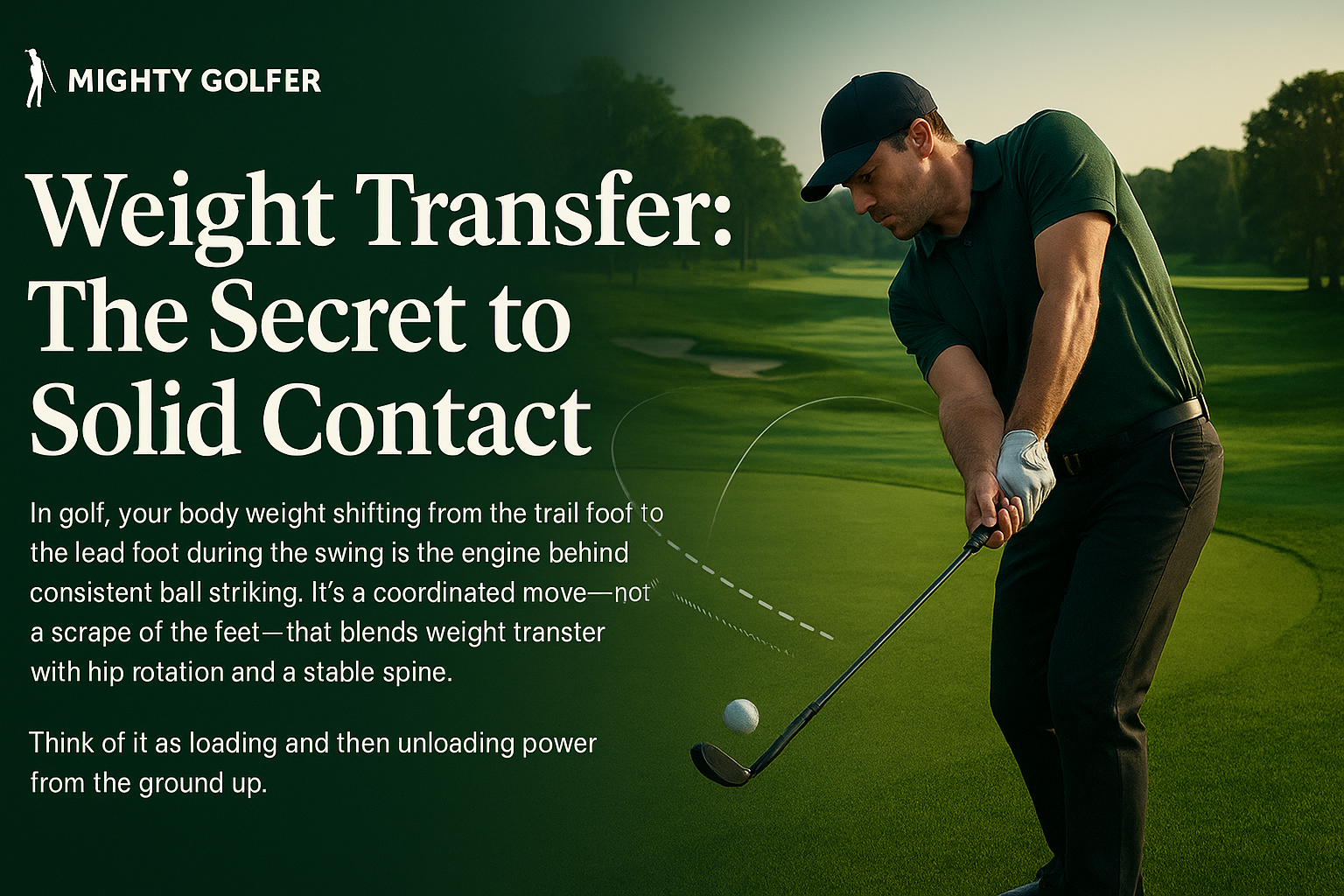
Weight Transfer: The Secret to Solid Contact
In golf, your body weight shifting from the trail foot to the lead foot during the swing is the engine behind consistent ball striking. It’s a coordinated move—not a scrape of the feet—that blends weight transfer with hip rotation and a stable spine. Think of it as loading and then unloading power from the ground up.
What the concept is
- For a right-handed swing, start with more weight on the right (trail) foot. As you move into the downswing, shift toward the left (lead) foot while your hips rotate toward the target. Your spine angle remains relatively constant, and your center of gravity travels along your stance line rather than jumping forward.
- Weight transfer is a coordinated action: it’s not a slide. It combines a deliberate pressure shift with turn of the hips to deliver the clubhead on the correct path at impact.
Why it matters
- Solid contact: a purposeful forward shift helps strike the ball before the ground, producing crisper, more reliable contact.
- Consistent ball flight: proper transfer supports an on-plane path and clean compression.
- Better tempo and rhythm: a smooth, whole-body load and unload improves timing and distance control.
What you should feel when doing it correctly
- Early in the backswing: weight stays mostly over the center of your feet, prepared to shift forward.
- Downswing to impact: you feel pressure building on the trail foot as you rotate, then a clear shift toward the lead foot through impact.
- Finish: chest and hips face the target, with most of your weight on the lead foot and the trail foot light or barely on its toe.
2–3 common mistakes and fixes
- Mistake 1: Swaying laterally without rotating the hips.
Fix: Let the hips rotate toward the target as you transfer weight. Think “belly button to target” to cue rotation while the feet stay connected to the ground. - Mistake 2: Hanging back too long—keeping most weight on the trail foot through impact.
Fix: Feel your lead foot engaging the ground as you strike. Practice with small backswing halves and a gentle chest rotation into the target, keeping the trail knee soft. - Mistake 3: Not finishing with weight forward.
Fix: Finish tall with your chest square to the target and most weight on the lead foot. If you’re popping up or sliding out, slow the tempo and confirm rotation first, then transfer.
One easy drill you can do at home or on the range
Pump Drill: From a comfortable setup, make a half-swing to chest height. Pause and feel the weight shift from the trail foot to the lead foot while your hips rotate slightly toward the target. Then swing through to contact and hold the finish. Do 8–12 reps, focusing on a smooth, balanced transfer with each shot.
If you’d like, I can tailor cues and drills to your current setup and tendencies to help you feel this transfer more clearly on every swing.
weight Transfer: The Secret to Solid contact
Weight Transfer: The Secret to Solid Contact
Why weight transfer matters
weight transfer is more than a catchy coaching cue. It is indeed the essential mechanism that links your body to the ball or object you’re trying to control. When you shift your weight efficiently, you create a stable base, generate capital power from the ground up, and align your hips, spine, and arms for a clean, repeatable impact. Across sports-golf, tennis, baseball, and even throwing activities-solid contact is nearly unachievable without an intentional, controlled transfer of weight from the rear to the front side of your stance or stance-like setup.
Key benefits of proper weight transfer include increased contact consistency, improved ball speed without sacrificing control, better accuracy, and reduced risk of over-rotation or early extension. In short: when you move your weight correctly, your club, racquet, or bat meets the ball at the right place and at the right time.
How weight transfer works (in plain language)
Think of weight transfer as a simple sequence: start balanced, load your movement by shifting weight to your back leg, then unload smoothly toward your front leg as you contact the ball or target. The timing and amount of transfer depend on your sport, but the core ideas stay the same:
- Ground reaction: You push into the ground with your legs, using that force to rotate your hips and torso rather than relying solely on arm strength.
- Center of gravity control: You keep your center of gravity over a stable base while transferring a portion of your weight forward toward contact.
- Sequencing: A clean kinetic chain starts from the ground up, with energy flowing from feet to ankles, through the legs and hips, and finally to the upper body and the implement (club, racquet, or bat).
- Balance and timing: The transfer should feel like a controlled shift rather than a lurch; balance is critical to avoid loss of control at impact.
when executed well, weight transfer helps you reach the “impact window” where the clubface or striking surface meets the ball squarely, maximizing both speed and accuracy.
Weight transfer in golf: from address to impact
In golf, solid contact hinges on a precise but repeatable transfer of weight from the back foot to the front foot as you swing through impact. The golfer’s spine stays relatively centered while the hips rotate and the chest squares to the target. The front knee should flex naturally, supporting a stable platform for the later-stage release of energy.
- Address: Feet shoulder-width apart, weight evenly distributed or slightly favoring the back foot depending on your swing plan.
- Backswing: Load into the trail leg while maintaining connection between hips and shoulders; avoid over-rotation that pulls you off balance.
- Transition: Initiate weight transfer by planting the trail foot and starting the hip turn toward the target; this is the “loading” phase that primes impact.
- Downswing and impact: the hips lead the way; weight shifts progressively onto the lead leg. Aim for a moment where your body stack is compact and your hands meet the ball at a clean strike.
- Follow-through: Allow the weight to continue moving forward with a full,balanced finish,ensuring you aren’t hanging back or steering with the arms alone.
Weight transfer in tennis and other racquet sports
In tennis, weight transfer accelerates the racquet head through contact, increasing ball speed and spin while maintaining control. The same principles apply to badminton,squash,or racquetball-every stroke benefits from a intentional shift of weight that starts from the ground and moves through the hips into the arm.
- Ground contact and leg drive: You use your legs to generate force, not just your arm muscles.
- Hip rotation: Efficient weight transfer is tied to a coordinated hip turn that closes slightly toward the target as you strike.
- Forward weight at contact: A small amount of forward weight helps you compress the ball and control depth and angle.
- Recovery: After contact, your body uncouples in sequence to prepare for the next shot, preserving balance and readiness.
Cues that help players harness weight transfer in tennis include “push off the ground,” “drive through the shot” and “stay with the ball,” which all reinforce the idea of moving energy from the feet up through the body.
Weight transfer in baseball and similar bat sports
Baseball hitters rely on a dynamic, well-timed weight transfer to maximize bat speed and contact quality. A prosperous swing typically features a pronounced shift of weight from the back foot to the front foot during the swing, with the hips leading the torso and the hands staying connected to the torso for as long as possible before fast hands release.
- Stride and load: A small stride helps set up the weight shift without disturbing balance.
- Hip-torso sequencing: The hips initiate the turn; the torso follows, then the hands strike with the bat coming through on an intended plane.
- Hands-forearm connection: Maintaining a firm connection between the upper body and the bat reduces wasted motion and improves contact consistency.
- Finish position: A balanced finish indicates proper weight transfer and timing.
Benefits and practical tips for training weight transfer
- Start with balance drills: Balance is the foundation of reliable weight transfer. Use two-leg and single-leg drills to improve stability, which translates to cleaner contact under pressure.
- Scan the ground reaction: practice feeling the change in pressure from the back foot to the front foot. A subtle difference in weight distribution can be your cue that transfer is happening.
- Use slow-motion practice: slow down the swing or stroke to feel each stage of transfer. Increase speed gradually as your control improves.
- Keep the core engaged: A strong, engaged core helps transmit energy efficiently from the lower body to the upper body and the implement.
- Neutral spine alignment: Avoid excessive leaning or twisting that disrupts the transfer sequence; maintain a stable spine angle through impact.
- Breathing cues: Exhale slightly as you move into the forward-weight phase to help relax and maintain timing under pressure.
Drills to develop solid contact and transfer mechanics
Below is a compact drill progression designed to build awareness, control, and repeatability. Each drill focuses on a facet of weight transfer, from stability to sequencing to impact quality.
| Drill | Cue | Key Focus |
|---|---|---|
| Balance Board Press | Stay centered, press through the front foot | Improve balance and forward weight transfer without losing posture |
| Wall Board Drill | Push off the back foot into the front foot toward the wall | Engage hips and torso sequencing, limit excess arm action |
| Slow-Motion G2G (Ground to Ground) Swing | feel the sequence: ground → hips → torso → arms | Build timing and awareness of transfer during a swing |
| Impact Tape Drill | Hit the tape with the front foot as you contact | Encourage forward weight at impact for solid contact |
Tip: Start each drill with 2-3 minutes of quiet walking focusing on foot pressure changes, then add the motion. Progress to full speed only when control is consistent.
Case studies and firsthand experiences
Real-world examples illustrate how weight transfer translates to improved performance. Here are two concise cases from coaching clinics and amateur players.
“Before focusing on weight transfer, I felt like I was swinging with my arms. After incorporating a simple drill to shift weight smoothly, my contact became cleaner and my misses dropped dramatically.” – Amateur golfer,42
in another case,a junior tennis player learned to use the ground to drive through shots rather than over-rotating the upper body. Within a few weeks, thier footwork improved, resulting in crisper groundstrokes and more consistent depth on serves.
Practical takeaway: Weight transfer is highly trainable. Small, repeatable improvements in how you push off the ground can yield outsized gains in contact quality.
Common mistakes and how to fix them
- Over-rotating too early: This can pull you off balance and delay the transfer. Fix with slower tempo and emphasize a controlled hip turn before the front side loads.
- Leaning back at impact: Keeps weight on the rear foot and reduces forward impact. Work on maintaining a tall, connected posture through impact.
- Hands taking over: Let energy flow from the ground through the hips-don’t let the hands “hit” the ball independent of your body.
- Stiff front knee: A rigid front leg disrupts the transfer. Allow subtle knee flex and natural weight progression to the front foot.
Measuring progress and setting targets
Tracking progress helps you stay motivated and ensures that improvements are sustained. Consider these simple metrics:
- Consistency of impact position (e.g., where the ball hits, or where the bat meets the ball) across sessions
- Balance indicators: average time in a centered finish, and the absence of excessive weight shifting back into the trail foot at contact
- Speed of the transfer: how quickly you shift weight without sacrificing control
- Feedback from cues: ability to recall cues like “drive through the front foot” while performing under pressure
Frequently asked questions
Q: Do I need to tilt or shift my weight dramatically?
A dramatic shift is rarely necessary. The most repeatable actions are subtle, controlled shifts that align your center of gravity with the target. Overdoing weight transfer can disrupt timing and reduce control.
Q: Can weight transfer compensate for poor technique elsewhere?
Weight transfer is a powerful amplifier, but it doesn’t replace fundamental technique. It works best when you combine it with proper grip, posture, and timing.
Q: How long does it take to see improvements?
Most players notice improvements in 4-6 weeks with consistent practice and properly structured drills. The key is deliberate practice and mindful feedback during sessions.
Final notes for coaches and players
Weight transfer is a unifying concept across sports that helps athletes connect their lower body mechanics with upper body execution.By emphasizing balance, sequencing, and controlled energy flow from the ground up, you create a dependable platform for solid contact. Tailor drills to your sport, your body, and your goals, and progress gradually to avoid overloading the nervous system or joints.
Remember: the goal is not to “move your weight” as a stand-alone cue, but to coordinate a coherent sequence that makes contact more consistent, powerful, and controllable. When you master weight transfer, you unlock a reliable pathway to improved performance and more enjoyable practice sessions.